
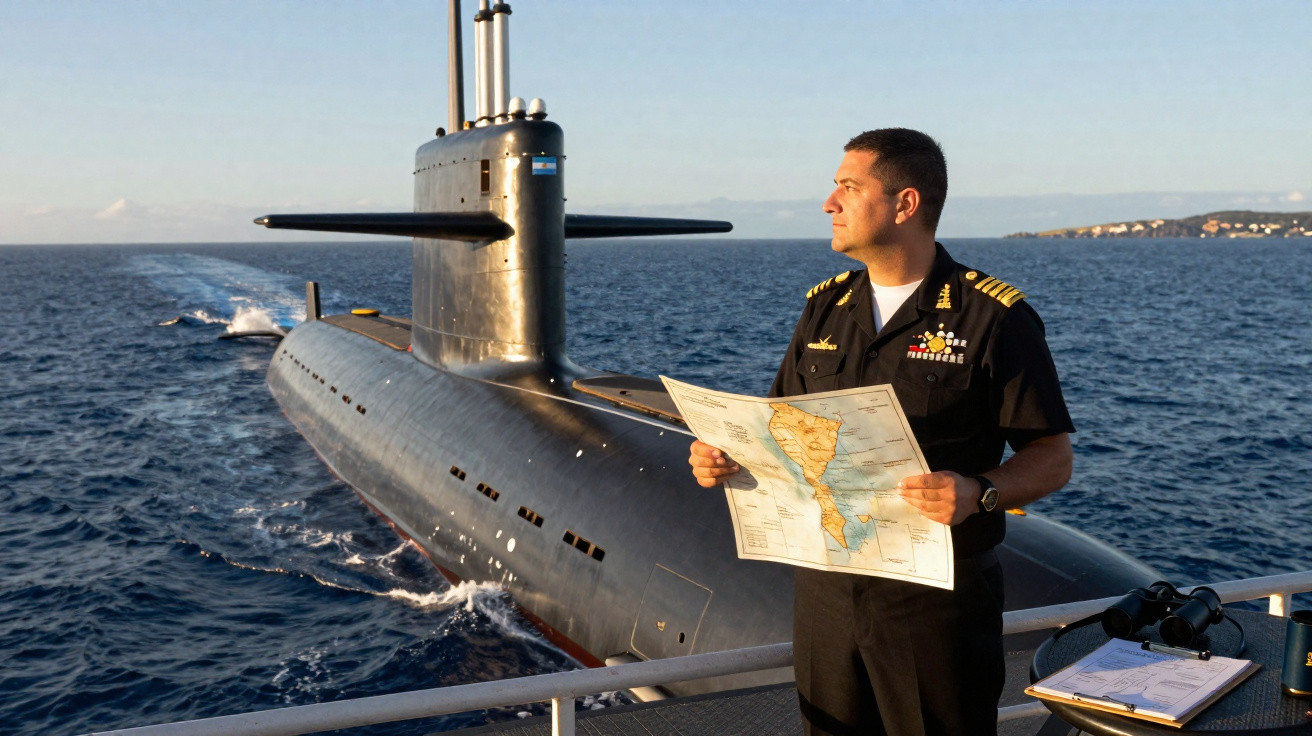
Argentina’s path towards equipping the Navy, making it operational and establishing itself as a key player in the South Atlantic is directly linked to budgetary constraints, structural shortcomings and the need for long-term planning. In this context, naval modernisation-particularly the renewal of its submarine force-cannot rest solely on buying weapons systems. It also demands the comprehensive rebuilding of operational, logistical and human capabilities.
Argentina’s defence budget currently remains below 1% of Gross Domestic Product (GDP), placing substantial limits on any re-equipment programme. This level of spending restricts both the procurement of new assets and the upkeep of those already in service, creating a gap between the capabilities the country ought to possess and those it can actually deploy in the South Atlantic.
Structural issues affecting the Armed Forces further compound this situation, including the decline of the military healthcare system and low pay levels. These conditions undermine the retention of qualified personnel and the continuity of specialist technical staff, with a direct effect on the operational readiness of complex naval units.
The initial priority must therefore be to restore the defence system as a whole. That means not only gradually raising the budget towards levels close to 1.5% of GDP, but also reorganising logistics, maintenance and readiness structures, all of which are essential to ensuring that naval assets are genuinely available for service. In other words, allocating more money from the national budget alone will not enable the Argentine Republic to obtain a modern, current Navy able to operate across the vast Argentine sea. It is also necessary to reorganise how those resources are distributed: both to address today’s critical and urgent problems and to plan for future objectives.
Rebuilding Argentine Navy submarine capability
The second phase should concentrate on recovering critical capabilities, especially at sea. The acquisition of conventional attack submarines (SSKs) stands out as one of the strategic priorities because of their deterrent value and their ability to control maritime space in the South Atlantic.
Conventionally powered submarines are a technically and financially feasible option, although they require medium-term planning. Their estimated introduction timeframe is between five and eight years from the political decision, accounting for negotiations, construction, crew training and operational integration. The Argentine Air Force’s F-16 AM/BM programme provides a clear example: it began with political backing in 2024, and only at the end of 2025 did 6 of the 24 aircraft purchased from Denmark join the force. They are not yet being operated, as pilots and the technicians responsible for maintaining these systems still need to be trained.
Does Argentina need attack submarines? The answer is yes. The Argentine Navy currently has 2 attack submarines: the ARA Santa Cruz, which is inactive because its repair programme was cancelled, and the ARA Salta, which is used solely for alongside training. This means that, since the ARA San Juan tragedy in 2017, Argentina has had no genuine submarine capability.
Maritime surveillance and access denial in the South Atlantic
Alongside the submarine component, another central priority is strengthening maritime surveillance. This includes expanding the offshore patrol vessel fleet, employing uncrewed systems and consolidating radar networks, with the aim of improving control over the Exclusive Economic Zone and tackling issues such as illegal fishing.
The development of air-defence capabilities and anti-ship missiles also forms part of measures intended for access denial-that is, possessing the real and credible capacity to prevent an adversary from entering an area Argentina considers strategically important. Such systems raise the operational cost for potential adversaries and help protect critical infrastructure and strategic sea routes.
In this respect, Argentina must recognise that it currently has a conflict hypothesis involving a second-order power: the United Kingdom. The British maintain the largest military base in the entire Southern Hemisphere in Argentine waters. Mount Pleasant Airfield is located on East Falkland, while the deep-water military port of Mare Harbour lies only a few kilometres away. Does this mean the dispute over the archipelago should be settled militarily? Not at all. Moreover, this is prohibited by the first transitional provision of the Argentine National Constitution, which states: “The recovery of those territories and the full exercise of sovereignty, while respecting the way of life of their inhabitants and in accordance with the principles of international law, constitute a permanent and irrevocable objective of the Argentine people.” The point of this analysis is that Argentina must rebuild its Armed Forces in order to possess a capability for deterrence, as set out in Article 2 of the National Defence Act.
Nuclear submarines and Argentina’s long-term constraints
The prospect of pursuing more complex systems, such as nuclear-powered submarines, is an extremely long-term alternative. This kind of undertaking requires an industrial, technological and doctrinal foundation currently held by only a small number of countries, including the United States, China, Russia, the United Kingdom and France.
It should be remembered that there are 2 principal categories of submarine: attack submarines and ballistic-missile submarines. Whereas the former are designed to attack vessels and protect a Carrier Strike Group, the latter are intended for nuclear deterrence, specifically through the launch of intercontinental ballistic missiles that may carry nuclear warheads. Examples of the latter include the United States’ Ohio class, Russia’s Borey class and the United Kingdom’s Vanguard class, which will begin to be replaced by the new Dreadnought class from 2030.
Taking the previous paragraph into account, a question can be asked: would it be viable for Argentina to acquire nuclear ballistic-missile submarines in order to guarantee the strategic deterrence referred to in Article 2 of the National Defence Act? Unlike conventionally powered attack submarines, this kind of weapons system entails either development or procurement constrained by Argentina’s international commitments. These notably include the Treaty on the Non-Proliferation of Nuclear Weapons and the Missile Technology Control Regime, which limit the spread of these systems and regulate the transfer of their technology.
Beyond these legal restrictions, ballistic-missile programmes or nuclear capabilities involve very large-scale investment and lengthy development periods. As a reference point, an Ohio-class submarine operated by the United States Navy costs approximately USD 3.640 billion each, without considering the cost of its development programme, maintenance, or the training of sailors and technicians. These factors, together with potential diplomatic consequences, make such an option less viable in the short and medium term within Argentina’s strategic framework.
Given all of the above, Argentina’s priority should be to consolidate conventional submarine capabilities, focusing on control of maritime space and the defence of economic interests in the South Atlantic. In practical terms, it should acquire approximately 4 to 6 attack submarines, with scope for further expansion in the future. Which should it choose? There are several suppliers and classes, but the names most frequently mentioned are France’s Scorpène class and Germany’s Type 209NG. This approach would make better use of resources and create deterrent effects without taking on high-risk financial or political commitments.
Ultimately, building a functional and effective Navy depends on the continuity of public policy over time. Sustained implementation of these measures over a period of between ten and twenty years is considered decisive in reaching the operational standards that would allow Argentina to play a relevant role in the South Atlantic.
Cover image showing the three Argentine submarines ARA San Juan, ARA Salta and ARA Santa Cruz during training exercises in 2015.



Comments
No comments yet. Be the first to comment!
Leave a Comment