
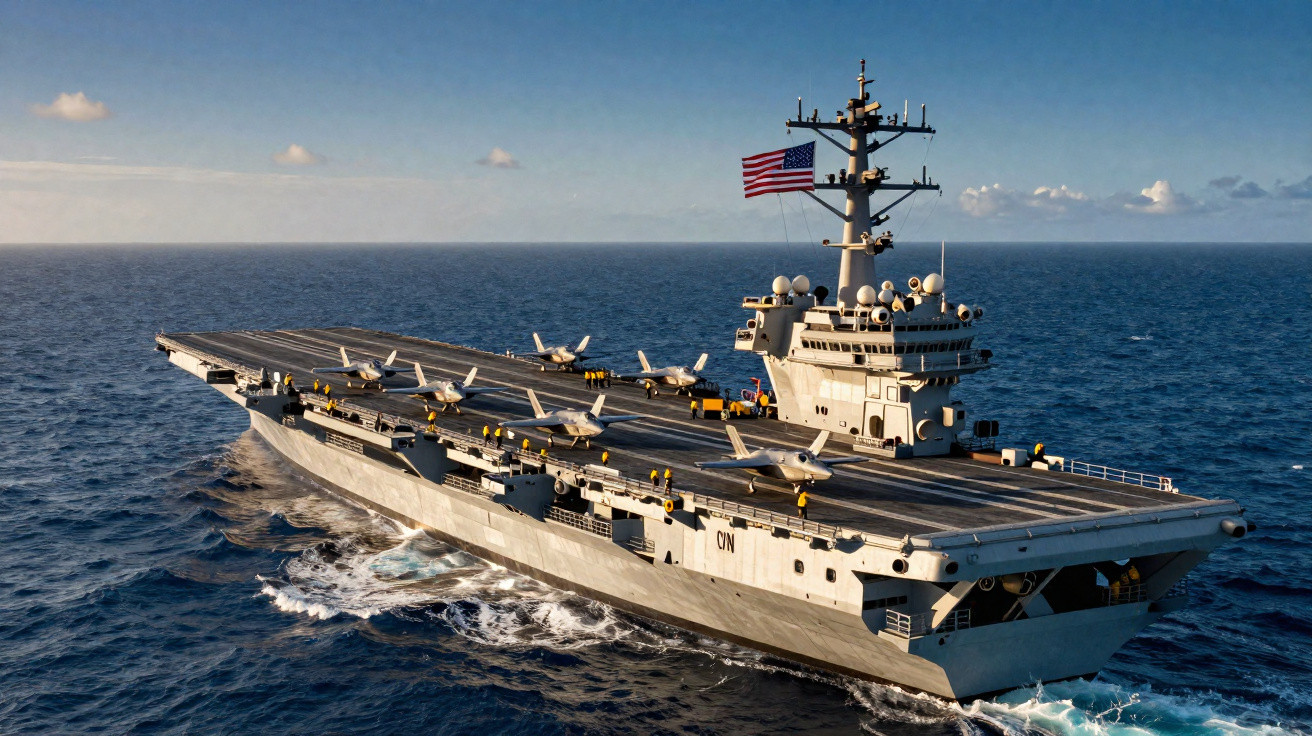
At Newport News, the pier carries the scent of rust, salt water and heated metal. Workers in hard hats look up at a vast grey steel structure that appears to erase the sky: the future USS Enterprise, CVN-80, emerging slowly like an artificial cliff face. A crane lowers an enormous module into position, and the site falls briefly quiet, as though everyone has paused to breathe with the ship.
Far out in the Pacific, Chinese sailors are studying satellite images of that very hull.
They understand what is on its way.
The giant that reminds Beijing who still controls the blue horizon
Get close to the dry dock and scale becomes difficult to grasp. CVN-80’s hull stretches so far that your eyes take time to follow it, while its decks rise high enough to seem lost in low cloud on a humid Virginia day. The third of the Ford-class supercarriers, it follows a Cold War icon and is the vessel the United States hopes will send a quiet signal across the Pacific: we’re not leaving the ocean any time soon.
China is putting carriers into the water at an unprecedented pace, yet Enterprise belongs in another class.
It is a floating city equipped for a new phase of great-power competition.
Sailors who have served aboard a Nimitz-class carrier tend to smile and roll their eyes at the memory: 5,000 people sharing one steel island makes for a combination of circus, factory and small town. CVN-80 will have broadly the same total number of people, but the capability of those 5,000 will be far greater. More sorties each day. Quicker weapons movement. Improved radar reach.
That concentration of people is significant. Every passageway, tight sleeping berth and late-night queue for food on the mess deck contributes to a display of power that can be heard in the engines’ constant vibration.
When the vessel enters service in the early 2030s, it will carry an air wing capable of striking targets hundreds of miles away, while its crew operates a floating airport 24/7.
By hull numbers, China’s navy now exceeds the US Navy. Beijing is fond of the figure because it is straightforward, neat and easy to repeat in television addresses. Yet one Ford-class carrier, operating with cruisers, destroyers, submarines and support vessels, is an entirely different proposition. It is more than a warship; it is a strategy that can move.
Enterprise is being constructed with electromagnetic catapults, advanced arresting gear and dual-band radar, allowing aircraft to leave the deck more quickly and safely. The result is more jets airborne, more frequently. During a Taiwan crisis or confrontation in the South China Sea, those additional sorties turn numbers from an abstract calculation into something frighteningly real.
How a 5,000-sailor city keeps the US in command at sea
The real achievement of American maritime power is not merely the construction of an enormous hull. It is making 5,000 people function as a single nervous system as aircraft hit the deck every 45 seconds and helicopters buzz above the island. The Ford-class design reshapes that nervous system from within.
Greater automation beneath the decks changes the equation. Elevators carry bombs and missiles more rapidly. Digital systems take the place of miles of wiring and hundreds of manual jobs. As a result, the same 5,000 sailors do not simply operate the vessel: they extract greater combat capability from every available inch.
The contrast shows in sailors’ movements. On older carriers, crews regularly describe long delays at weapons elevators, along with clanking chains and hydraulic groans that consumed minutes at a time. On CVN-80’s sister ships already in service, such pauses are gradually disappearing. Weapons reach the flight deck sooner, and aircraft are rearmed and refuelled through shorter cycles.
From space, that pace is lethally understated. Chinese analysts viewing satellite feeds see only screen dots shifting location. Those aboard experience sweat, noise and repetition - plus the feeling that this supposedly “aging” superpower still possesses the more efficient machine.
The logic beneath the steel is straightforward: naval wars favour the side that can produce effects most rapidly and sustain them longest. A carrier able to launch and recover more aircraft each day resembles a newsroom capable of publishing twice as many stories that genuinely count. You do not merely fill the space; you control the narrative.
In truth, nobody standing on the pier and watching welders cast sparks is likely to run through every strategic possibility in their mind. But that is precisely the kind of contest this ship is designed for: a prolonged, punishing rivalry in which fatigue, logistics and crew morale silently determine who remains in the contest.
The quiet message to China: we still operate differently across oceans
If the United States excels at one thing at sea, it is converting presence into pressure. Nothing needs to be said on state television when a 100,000-ton carrier group appears just beyond a rival’s comfort zone. CVN-80 is being shaped for this kind of gradual diplomacy, with extended deployments, substantial endurance and adaptable missions.
Nuclear reactors buried deep in the hull provide power for decades. The ship produces its own fresh water. Supplies can arrive by air or by sea. Enterprise can therefore remain in an area for months, flying the flag, exercising alongside allies and quietly marking where the lines across the deep blue are drawn.
Many people picture naval dominance as a line of perfectly ordered warships, missiles prepared and admirals confronting one another. The reality is less tidy. It involves logistics officers concerned about spare parts, junior sailors attempting not to lose their way in a labyrinth of corridors, and pilots calculating fuel to the decimal point in a dark briefing room.
The US has spent generations learning from mundane challenges of this kind. China is moving quickly to close the gap, and it will, but accumulated time at sea cannot be bought in bulk. Anyone who has taken up a complicated hobby late will recognise the sensation of continually finding fresh errors. That is the position Beijing occupies now, even while its third carrier undergoes sea trials.
As one retired US admiral put it not long ago: “Ships are hardware, but what wins at sea is software - the people, the habits, the mistakes you’ve already made and learned from.”
- Enterprise as a symbol – Its name connects the vessel to a line of American carriers that fought from the Second World War to the Gulf.
- 5,000 sailors on board – A floating cross-section of the United States, ranging from mechanics from small towns to Ivy League engineers.
- Quiet reassurance for allies – Japan, South Korea, Australia and the Philippines all interpret this hull as a promise.
- Unspoken warning for rivals – More ships can be built, but matching this network of training, logistics and alliances is a different matter.
- The plain truth: power at sea is about who can show up, stay, and still be ready on day 120, not just day one.
A new carrier, an enduring question: who truly rules the sea?
From the bow of an unfinished carrier, the future does not resemble a polished Hollywood shot. It is scaffolding, sparks, shouted instructions and the slight smell of scorched paint. Still, the United States is betting that this disorder can be assembled into an unambiguous message for Beijing and everyone observing Asia’s crowded waters. The message is this: yes, the world is changing; yes, rivals are gaining strength; but certain habits - such as sailing a giant crewed by 5,000 sailors into disputed waters without flinching - are difficult to abandon.
We have all experienced the moment when someone newer, quicker and more determined enters your territory, forcing a choice between retreating and quietly improving your performance. CVN-80 represents the US improving its performance, one steel plate at a time. As the ship progresses from dry dock to sea trials and then its first lengthy deployment, the central question will extend beyond radar and catapults. It will concern whether an aging superpower can still transform raw metal and young people into a force that reshapes geopolitics.
The oceans have no interest in pride or speeches. They favour the side able to stay out there longest, under pressure and without losing its nerve. That is the test Enterprise is truly being built to meet.
| Key point | Detail | Value for the reader |
|---|---|---|
| Ford-class scale and crew | CVN-80 will carry around 5,000 sailors and a powerful air wing on a 100,000-ton nuclear hull | Provides a tangible impression of what “sea dominance” looks and feels like in physical terms |
| Tech edge over China | Electromagnetic catapults, advanced arresting gear, high sortie rates and deep experience at sea | Helps readers understand why the US still asserts naval supremacy despite China’s expanding fleet |
| Symbolic and strategic message | Enterprise reassures allies and discreetly cautions rivals by converting presence into lasting pressure | Demonstrates how a single ship can alter perceptions, alliances and crisis calculations across the Indo-Pacific |
FAQ:
- Question 1 When will the new USS Enterprise (CVN-80) enter service? CVN-80 is expected to join the fleet in the early 2030s, following several years of construction, fitting out and sea trials.
- Question 2 How many sailors will serve on the ship? The carrier will accommodate roughly 4,500–5,000 people when its ship’s company, embarked air wing and staff are all included.
- Question 3 Why is this carrier seen as a message to China? It combines leading technology, long-range air power and decades of US carrier experience at a time when China is expanding its own navy rapidly.
- Question 4 Is China’s navy already bigger than the US Navy? China has more ships by hull count, although the US continues to lead in large-deck carriers, worldwide logistics and operational experience at sea.
- Question 5 What makes the Ford-class different from older US carriers? It combines nuclear power, new launch and recovery equipment, increased automation and redesigned decks to generate more flights and remain effective for 50 years or more.
Comments
No comments yet. Be the first to comment!
Leave a Comment