
Why add us? Get the latest updates from Zona Militar in your Google feed.
Join our official WhatsApp channel and receive the news as it happens.
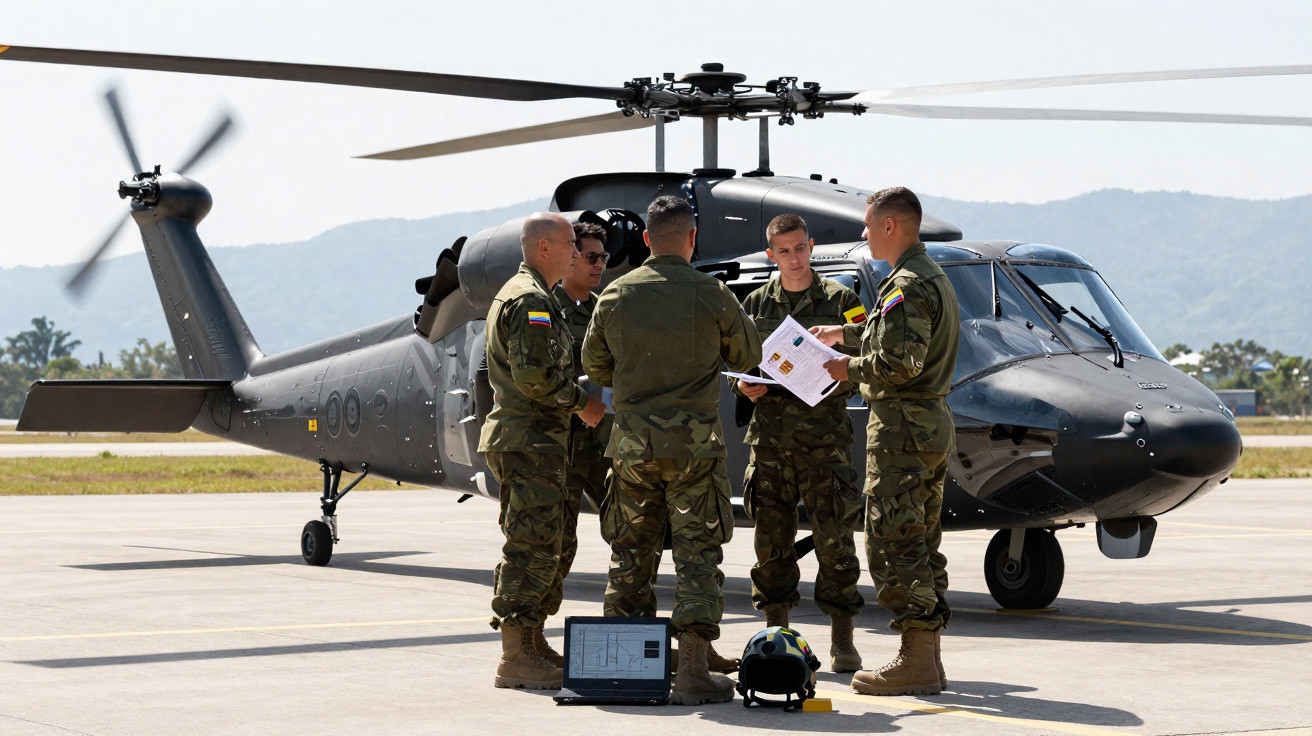
Personnel from the Argentine Army have visited the Colombian Air Force’s Combat Air Command No. 4 (CACOM 4), where they were able to examine the organisation’s operational, technical and training capabilities. The visit is of particular interest to Argentina’s Army Aviation Directorate, given Colombia’s extensive experience in operating and sustaining Sikorsky UH-60 Black Hawk helicopters. This has been one of the platforms considered for years as a potential option for a future renewal of the Argentine Army’s helicopter fleet.
👉 Read more: Navantia UK has laid the keel of the first of the Royal Fleet Auxiliary’s new logistics vessels
During the visit, the Argentine delegation toured several CACOM 4 facilities and reviewed its training, simulation and aircrew preparation procedures. According to information released by the Colombian Air Force, the activity was intended to share knowledge and experience while strengthening cooperation links between the two services.
The visit is especially notable because CACOM 4 is one of the Colombian Air Force’s foremost rotary-wing operating centres and has extensive experience with the UH-60 Black Hawk family. The service operates several variants of the platform, including the UH-60L and AH-60L Arpía, the latter progressively developed in Colombia to undertake missions specific to the force.
According to sources consulted by Zona Militar, the Argentine delegation is understood to have shown particular interest during the activity in pilot and maintenance personnel training processes associated with this aircraft family.
This latter point was not specifically mentioned in the official Colombian statement, which merely noted that the Argentine officers had reviewed the unit’s operational, technical and strategic capabilities, as well as its training and simulation processes. Therefore, any specific interest in Black Hawk-related courses should be treated as unofficial information, rather than confirmation that negotiations are currently under way between the two countries for the acquisition of these aircraft.
The visit is relevant in the context of the Argentine Army Aviation’s ongoing modernisation process and its need to assess the gradual medium-term replacement of its ageing UH-1H and UH-1H II helicopters. Within this setting, the UH-60 Black Hawk has repeatedly emerged as a platform of interest. However, bringing a new helicopter into service entails more than acquiring aircraft: it also requires an aircrew training system, technical staff instruction, maintenance, infrastructure and logistical support capable of keeping the fleet operational for several decades.
Colombia’s UH-60 Black Hawk experience
In this regard, Colombia is a particularly relevant case. Both the Colombian Air Force and the Colombian National Army operate Black Hawk family helicopters and have accumulated decades of experience with the platform, establishing their own operating, training and maintenance capabilities. As a result, the country now possesses a rotary-wing ecosystem that extends beyond the operational use of the aircraft and has also taken on a regional dimension.
Background of cooperation with the United States
Part of this capability stems from cooperation developed with the United States Army. After assessing the existing capabilities of different forces across the region, the U.S. Army transferred to the Colombian National Army the ability to deliver certain aviation courses in Spanish that had previously been conducted at US facilities, chiefly Fort Rucker, Alabama, and Fort Eustis, Virginia. These included initial qualification courses for UH-60 Black Hawk and UH-1H pilots, maintenance test pilots, and several technical specialities related to avionics, propulsion systems and aircraft maintenance.
This transfer gradually established a regional Spanish-language training capability in Colombia, intended not only for personnel from its own Military Forces and National Police, but also for members of forces from other Latin American countries.
US cooperation also took tangible form through the transfer of aircraft specifically intended for training. In 2019, the United States Army transferred 60 TH-67 Creek helicopters to Colombia. This military training version of the Bell 206B-3 had been used for years for the initial training of U.S. Army pilots. The aircraft were assigned to Colombia’s rotary-wing training system, particularly the Regional Helicopter Training Centre in Melgar.
The TH-67 transfer was part of a broader cooperation programme intended to strengthen Colombia’s aviation training capabilities. According to information released at the time by the US Army itself, the initiative sought to help establish Colombia as a regional rotary-wing training hub, able to train both its own personnel and those of allied countries.
The process went beyond the transfer of aircraft. The United States continued to support the development of Colombian infrastructure and instructional capabilities. In 2025, new facilities were handed over to the Advanced Rotary-Wing Training Centre (CEAAR), expanding its capacity to receive and train domestic and foreign students. These facilities form part of a structure designed to train pilots, aircrews and technical specialists associated, among other platforms, with UH-60 Black Hawk and UH-1 helicopters.
Training and maintenance capabilities in Colombia
Colombia’s training capacity is also complemented by its growing autonomy in sustaining the Black Hawk fleet. In 2025, the Colombian National Army Aviation announced that, through a programme developed with Sikorsky, it had gained depot-level structural maintenance capability for UH-60 helicopters. To achieve this capability, Colombian technical personnel received specialised training from the manufacturer’s representatives for approximately one year.
This capability enables high-complexity structural maintenance work on Black Hawks to be carried out in Colombia, reducing the need to send certain components or aircraft abroad and reinforcing the platform’s logistical autonomy. Colombia consequently now combines operational experience, pilot and technician training, dedicated training infrastructure and major maintenance capabilities for the UH-60 family.
Within this context, the visit by Argentine Army Aviation personnel to CACOM 4 could be particularly valuable beyond any future selection of the Black Hawk. Colombia’s experience provides an opportunity to observe a regional model for introducing and sustaining a sizeable fleet of US helicopters, including the training and maintenance processes needed to support it over time.
For now, the visit does not indicate that Argentina has decided to acquire the UH-60, nor does it confirm negotiations with Colombia or the United States. Nevertheless, the exchange allows Army Aviation to examine capabilities first-hand that could prove relevant should it move forward with a platform from this family in the future, and particularly to assess regional cooperation opportunities that could reduce the costs and time involved in training aircrews and technical personnel.
Comments
No comments yet. Be the first to comment!
Leave a Comment