
Add us to your favourites on Google
Why add us? Get Zona Militar news on Google.
US Marine Corps bids farewell to the AAV-7A1
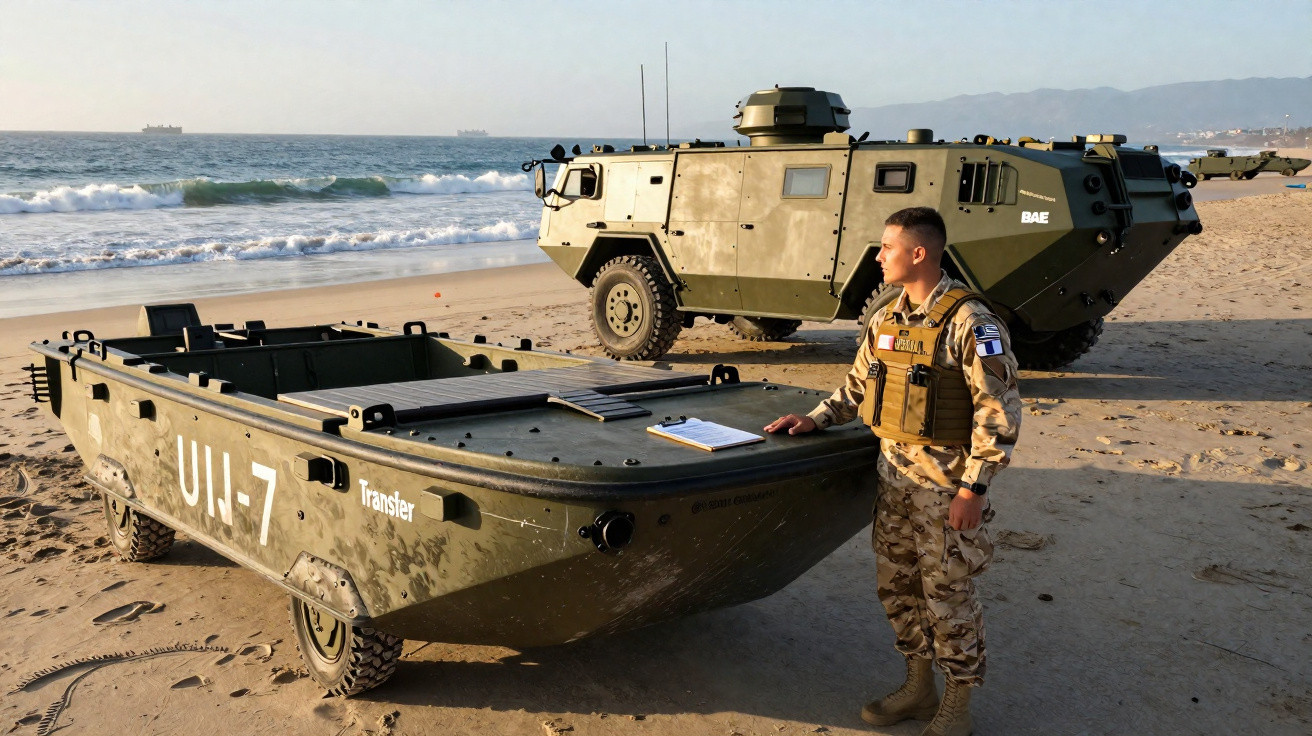
At the end of September, the US Marine Corps held a farewell ceremony for its long-serving AAV-7A1 amphibious armoured vehicles, bringing more than five decades of service with the force to a close. The platform is being progressively replaced by BAE Systems’ new 8×8 ACV models, the first of which was delivered at the beginning of 2024. The recently retired armoured vehicles could ultimately be transferred to the Armed Forces of Greece and Romania.
The event took place at the Amphibious Assault School at Camp Pendleton, California. It included a short parade of AAV-7A1s and, in a notable touch, an officer dressed as an “alligator” - the nickname given to these tracked armoured vehicles during their service with the Corps. “Amtrac” is another term used for vehicles of this type.
In his address, Colonel Lynn W. Berendsen, commander of the Amphibious Assault School, stated: “The AAV P7 was many things: a ship-to-shore connector, an armoured combat vehicle, a troop carrier, a logistics platform and, at times, even a rescue craft. More importantly, it was there wherever Marines left their mark in combat, service and sacrifice… The AAV gave Marines mobility and armoured protection, allowing them to close with the enemy and seize objectives quickly. In the desert, just as on Pacific beaches decades earlier, it proved to be more than a connector: it was an essential combat vehicle for the Marine Air-Ground Task Force.”
From LVTP-7 to AAVP-7 modernisation
The armoured vehicle entered service in 1972 under its original LVTP-7 designation. It succeeded the smaller, longer-range LVTP-5, which had been in use since the 1950s. At the time, the model was innovative because it incorporated a rear-mounted tube system that produced powerful water jets, improving movement at sea, which had previously relied solely on its tracks. It was also fitted with a .50-calibre M85 machine gun mounted on the upper hull, while command-and-control and vehicle-recovery variants were also available.
During the early 1980s, the Marine Corps’ LVTP-7 fleet underwent major modifications under a modernisation programme. The work included a redesigned engine, a new transmission system and upgrades to the aforementioned pumps. It was subsequently redesignated AAVP-7. The original machine gun was later replaced by M2 variants and the 40 mm Mk.19 grenade launcher. In the 1990s, the vehicles received Enhanced Appliqué Armour Kits (EAAK), increasing protection against small-arms fire and shrapnel; further improvements were also made to the propulsion system.
The type also accumulated an extensive operational history, both with the US Marine Corps itself and with the forces of other nations. Its deployments included multinational peacekeeping operations in Lebanon in the early 1980s and the US intervention in Grenada in 1983. In export service, the vehicles were also among the Argentine platforms used during the 1982 Falklands War. The model later saw action in the 1991 Gulf War and in concurrent US operations in Somalia and Iraq in 2003, where it was involved in a friendly-fire incident alongside A-10 Warthog aircraft.
AAV-7A1 replacement and potential transfers to Greece and Romania
Its retirement, only recently completed, had been looming for the past decade after unsuccessful attempts to replace it with the new Expeditionary Fighting Vehicles (EFV), which were abandoned because of their high cost. The decision to procure the ACV was taken in 2018. In 2020, a tragic accident that claimed the lives of nine US servicemen resulted in the AAVP-7 rapidly losing the authorisation required to take part in maritime operations, except for emergency-response missions. The ACV itself began to assume a more prominent role in international missions, as demonstrated in Japan in 2024.
Looking ahead, AAVP-7s retired by the United States currently have two potential opportunities to remain in service with allied countries: the Armed Forces of Greece and Romania mentioned above. In Greece’s case, the State Department issued the relevant approval in 2023 for the sale of up to 63 vehicles, in a deal that would represent an investment of US$268 million for Athens. Romania received equivalent approval, also in 2023, although only for a batch of 16 vehicles valued at approximately US$120.5 million.
Illustrative images
You may be interested in: Brazilian Air Force records further progress in the modernisation of its A-29 Super Tucano attack aircraft
We are looking for you! Vacancy open in the Blue Field Media Editorial Team for the role of Correspondent in Brazil




Comments
No comments yet. Be the first to comment!
Leave a Comment