
Add us to your favourites on Google
Why add us? Receive the latest updates from Zona Militar in your Google feed.
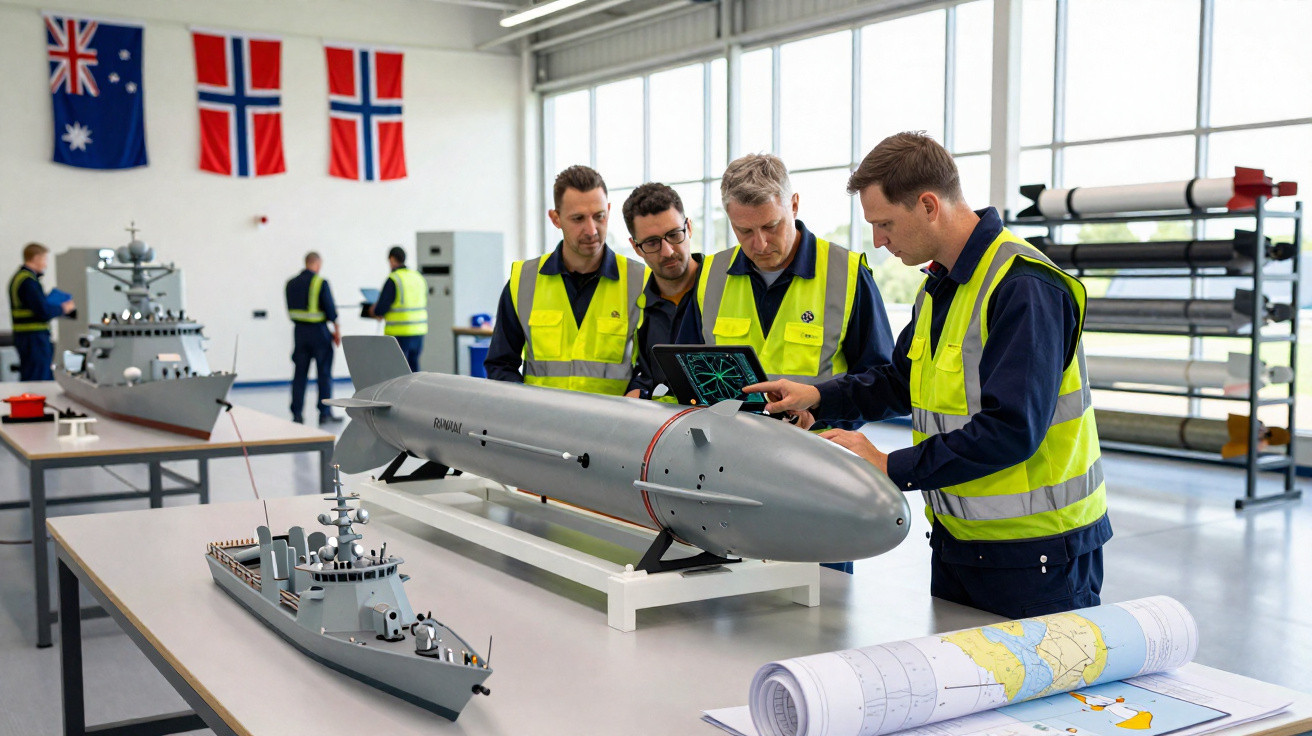
Australia has taken a further step towards the domestic production of Naval Strike Missile (NSM) anti-ship cruise missiles after Anthony Albanese’s government signed a Memorandum of Understanding (MoU) with Norway. The agreement is intended to deepen co-operation on the procurement, manufacture and maintenance of missiles on Australian soil. Announced on 14 May, it forms part of Canberra’s strategy to reduce its overseas dependence for long-range munitions and establish the country as a regional hub for missile production alongside allied partners.
Naval Strike Missile production and the Strike Missile Family
The arrangement is part of the Strike Missile Family, which brings together Australia, Norway and ten other nations that also operate the Naval Strike Missile and Joint Strike Missile (JSM), both produced by Norwegian company Kongsberg Defence & Aerospace. According to the Australian Department of Defence statement, the agreement will broaden information-sharing and industrial co-operation among the participating countries, supporting Australia’s efforts to procure, manufacture and sustain both systems in accordance with the 2026 National Defence Strategy and the 2024 Guided Weapons and Explosive Ordnance Plan.
The initiative is underpinned by an investment of up to A$850 million to enable domestic manufacture and maintenance of NSM and JSM anti-ship cruise missiles, as well as priority components. This includes the construction of a new production facility in Newcastle, which is due to start making missiles for the Australian Defence Force and partner countries from 2027. The project is also part of a broader investment, estimated at up to A$36 billion over the next decade, to speed up the acquisition and national production of longer-range munitions.
NSM modernisation for the Royal Australian Navy
For the Royal Australian Navy, the NSM holds a central position in the modernisation of its anti-surface warfare capabilities. Australia had already selected the missile to progressively replace the ageing RGM-84 Harpoon on surface vessels, including Hobart-class destroyers and Anzac-class frigates, thereby reinforcing its long-range naval strike capability. In particular, the Norwegian system features a sea-skimming flight profile, low radar signature, inertial/GPS guidance, adaptive terrain navigation and an imaging infrared seeker during its terminal phase, enabling it to engage naval targets and, depending on its configuration, coastal land targets.
It should be noted that the Royal Australian Navy used the missiles during RIMPAC 2024, marking a further milestone for the naval capabilities of its vessels. The NSMs were acquired under an agreement signed with Norwegian company Kongsberg in 2023, after being selected as part of Project Sea 1300.
Mogami Improved frigates and Australia’s missile supply chain
Domestic production must also be viewed alongside the recent selection of the Japanese Mogami Improved frigate for Australia’s general-purpose frigate programme. As reported, Australia agreed with Japan to acquire the first three vessels of this class, with the total later expanding to 11 ships. These future frigates are also expected to integrate the Naval Strike Missile, which would make the NSM the standard anti-ship missile across Australia’s surface fleet for decades to come.
For Defence Industry Minister Pat Conroy, the agreement with Norway is intended to strengthen weapons stockpiles, create local jobs and move towards a defence industry “made in Australia”. In strategic terms, the message is broader: Canberra is seeking to move from being an advanced purchaser of missiles to becoming a producer within an allied supply network, at a time when the ability to sustain long-range arsenals has become a deterrence priority in the Indo-Pacific region.





Comments
No comments yet. Be the first to comment!
Leave a Comment