
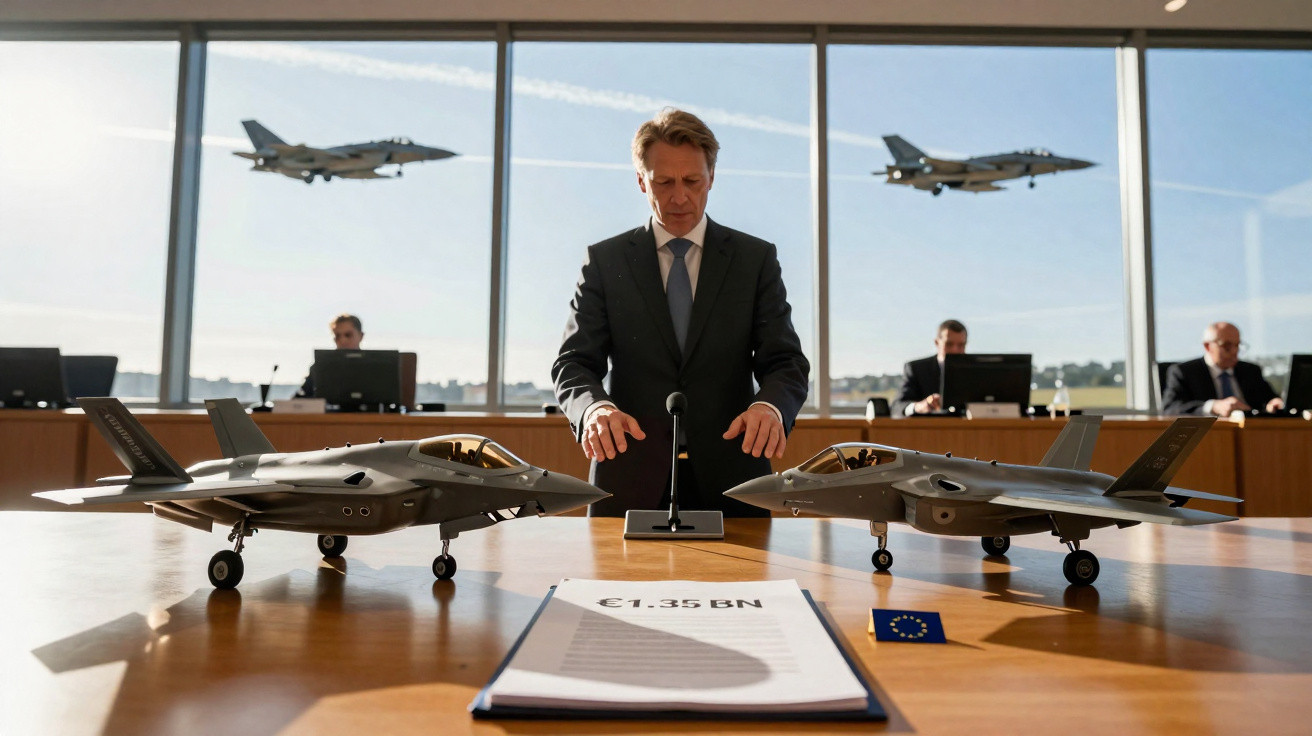
Switzerland, an Alpine country traditionally regarded as a cautious and conservative purchaser of arms, is now caught in a fraught dilemma: retain the US-built F-35 or reconsider Europe’s Rafale and Eurofighter as concerns mount over costs, schedules and political reliance.
Why a seemingly settled F-35 deal no longer seems certain
For months, the Swiss government has delivered an identical message to parliament and the electorate: Lockheed Martin’s F-35A is the sole practical replacement for the ageing F/A-18 Hornets between 2030 and 2032.
Ministers and officials maintained that launching another competition would require no less than three years. They argued that such a delay would leave the country’s airspace perilously unprotected as the existing aircraft approach the end of their certified service lives.
The official line was simple: no F-35, no credible Swiss air defence by the early 2030s.
That argument has been destabilised by disclosures from a confidential 2 July 2025 meeting of the federal parliament’s security commission.
Several attendees say Swiss air force chief Lieutenant General Peter Merz told legislators that the F/A-18 force could actually remain operational “without problem” until at least 2035, and possibly until 2037, if it underwent specific upgrades.
Should that statement be verified, it weakens the government’s position that urgent timing made a swift, US-focused agreement unavoidable.
The €1.35 billion issue over the F-35 price
The political fallout accompanies an expanding financial problem. New papers provided to MPs indicate that the full F-35 programme is already costing around 1.3 billion Swiss francs more than first outlined - approximately €1.35 billion at current exchange rates.
This sum excludes the aircraft’s long-term operating and maintenance spending over a 30-year service life. Instead, it largely covers support, infrastructure and training expenditure associated with acquiring 36 jets.
| Cost item | Estimated amount |
|---|---|
| Purchase of 36 F-35A | 6.035 bn CHF (≈ €6.3 bn) |
| Extra logistics & training costs | +1.3 bn CHF (≈ €1.35 bn) |
| F/A-18 life extension (alternative) | 0.8–1 bn CHF (≈ €0.85–1.06 bn) |
An unnamed commission member quoted in Swiss media expressed a concern shared by many colleagues: if extending the F/A-18s is technically possible and costs less than the current overspend, how can the F-35 still be presented as the only realistic choice?
The “impossible” Rafale option starts to look a lot less far-fetched once another €1.35 billion quietly appears on the F-35 bill.
What General Merz’s silence suggests
General Merz has issued no public denial of the remarks credited to him. Within defence circles, that lack of response is considered significant. It indicates that his private assessment of the F/A-18 fleet’s potential may not align comfortably with the narrative adopted by the government.
MPs who attended the meeting say Merz noted that keeping combat aircraft in service beyond 30 years is common across NATO air forces. The US itself still upgrades and operates F/A-18s and F-16s that first entered service in the Cold War era.
For Switzerland, a service-life extension would probably involve structural strengthening, improved avionics, and restricted upgrades to radar and weapons systems. Specialists believe those measures would preserve the fleet’s credibility for an additional three to five years.
Those additional years matter most. They could allow a new appraisal of rival aircraft - notably France’s Dassault Rafale and the Eurofighter Typhoon - rather than binding Switzerland to the F-35’s worldwide ecosystem according to Washington’s timetable.
Rafale and Eurofighter return to the Swiss fighter contest
Rafale and Eurofighter were both on the shortlist during the initial competition. Bern ultimately chose the F-35, saying its stealth, connectivity and price-performance balance had no equal.
Opponents now argue that this assessment was overly limited and optimistic, particularly regarding lifetime costs and political dependency. Several MPs are publicly pressing for a second tender process.
- Rafale is described as a “mature” multi-role aircraft offering robust reliability and an extensive combat record.
- Eurofighter provides strong performance and close integration with several major European air forces.
- Both are offered with commitments for more substantial industrial offsets for Swiss companies.
Backers of a European solution contend that Switzerland could gain technology partnerships, maintenance activities and collaborative development programmes in areas including avionics, sensors and aerospace materials.
They maintain that a properly planned F/A-18 extension would create sufficient financial room to negotiate those arrangements, rather than directing further billions into US logistics networks.
Patriot delivery delays fuel wider sovereignty concerns
Cost is not the sole issue. Recent US action concerning other defence equipment has made Swiss politicians more alert to the strategic dangers of excessive dependence on Washington.
The Pentagon has delayed the delivery of Patriot air-defence batteries to Switzerland because of Ukraine’s immediate requirements. Though understandable from the US viewpoint, the decision has unsettled Bern.
Patriot delays have become a real-world example of what happens when a small neutral country depends on a superpower’s production queue.
Some MPs now worry that the F-35 could face an equivalent situation. Should tensions escalate in Europe or Asia, US forces and larger NATO allies might receive priority for aircraft, spare parts and software assistance.
Even a brief interruption would make Swiss air-policing planning more difficult. More prolonged disruption could force the country to operate upgraded F/A-18s and ageing F-5 Tigers beyond the intended period, or to adopt hurried temporary solutions.
Trust erodes between parliament and the federal council
The dispute now developing extends beyond technical specifications. It directly affects trust between the federal council - Switzerland’s seven-member executive - and parliament, which already considers itself excluded from important security decisions.
Legislators say they were told that failing to sign the F-35 agreement promptly, at an allegedly “fixed” price, would create catastrophic risks. They now face higher costs and the revelation that a workable F/A-18 bridging option was available throughout.
Pressure is increasing for former defence minister Viola Amherd to return before committees and account for the decision-making sequence and information provided at every stage. Certain parties seek to pause elements of the F-35 programme while alternatives are reviewed.
For its part, the government is concerned that reopening the competition might bring penalties, postpone essential infrastructure projects and harm Switzerland’s standing as a reliable participant in defence procurement.
How a Rafale comeback could unfold
For many aviation observers, the immediate issue is whether Rafale has a genuine opportunity to win a contract that appeared closed, valued at roughly €6–7 billion before decades of maintenance income are included.
A plausible route, proposed by a number of European defence analysts, could be as follows:
- Switzerland formally approves an F/A-18 service-life extension to approximately 2035.
- A focused fast-track competition is opened, restricted to aircraft that have already completed Swiss technical assessment: F-35, Rafale, Eurofighter.
- The Paris and Berlin–London–Rome consortia improve their proposals with more extensive industrial partnerships, pilot-training packages and assured delivery slots.
- Lockheed Martin revises its own cost and offset offer in an attempt to preserve the agreement.
Under that outcome, Rafale’s principal advantages would be operational maturity, a lower projected lifetime cost and a more even political relationship with another European country. Among the Swiss public, avoiding total dependence on US software updates and data flows could be influential.
Key terms shaping the fighter-jet debate
A number of concepts underpin this debate and explain why the figures and timeframes carry such importance:
Cost of ownership over 30 years. The purchase price is only the starting point. Fuel, spares, software upgrades, pilot instruction and mid-life modernisation commonly amount to several times the original acquisition cost. This is an area in which the F-35, because of its complicated logistics structure and classified parts, may prove more costly than non-stealth competitors.
Industrial offsets. States buying foreign combat aircraft frequently require part of the contract value to return through work awarded to domestic businesses. With Rafale or Eurofighter, Swiss companies could manufacture components, service engines or jointly develop electronics. The F-35 programme is much more concentrated in US factories and those of established partner nations.
Sovereignty and data control. Modern combat jets are airborne computers as well as airframes. Control over mission data, encryption keys and software updates determines how independently a nation can operate its aircraft. European alternatives generally provide more shared governance, while US systems may impose greater restrictions, including on close allies.
Implications for other small European air forces
Switzerland is not alone among non-NATO states and smaller NATO members in confronting these decisions. Finland, Belgium, Denmark and the Netherlands have already committed to the F-35. Others, including Greece and Croatia, continue to balance US and European choices.
Should Bern reopen the competition or obtain improved terms from Washington following public pressure, ministries of defence across Europe will monitor the outcome closely. Elsewhere, officials may feel encouraged to seek clearer cost detail, stronger offset arrangements or firmer guarantees of delivery priority.
Conversely, a disorderly reversal could make US negotiators less flexible. They might urge future customers into quicker, less adaptable contracts, citing Switzerland as a warning.
For the moment, one conclusion is evident: a choice of the F-35 that once appeared inevitable and almost purely technocratic has become a politically charged test case. In that test, Rafale - and, to a lesser degree, Eurofighter - has shifted from the margins to the centre of debate, propelled by a €1.35 billion question that will not disappear.




Comments
No comments yet. Be the first to comment!
Leave a Comment