
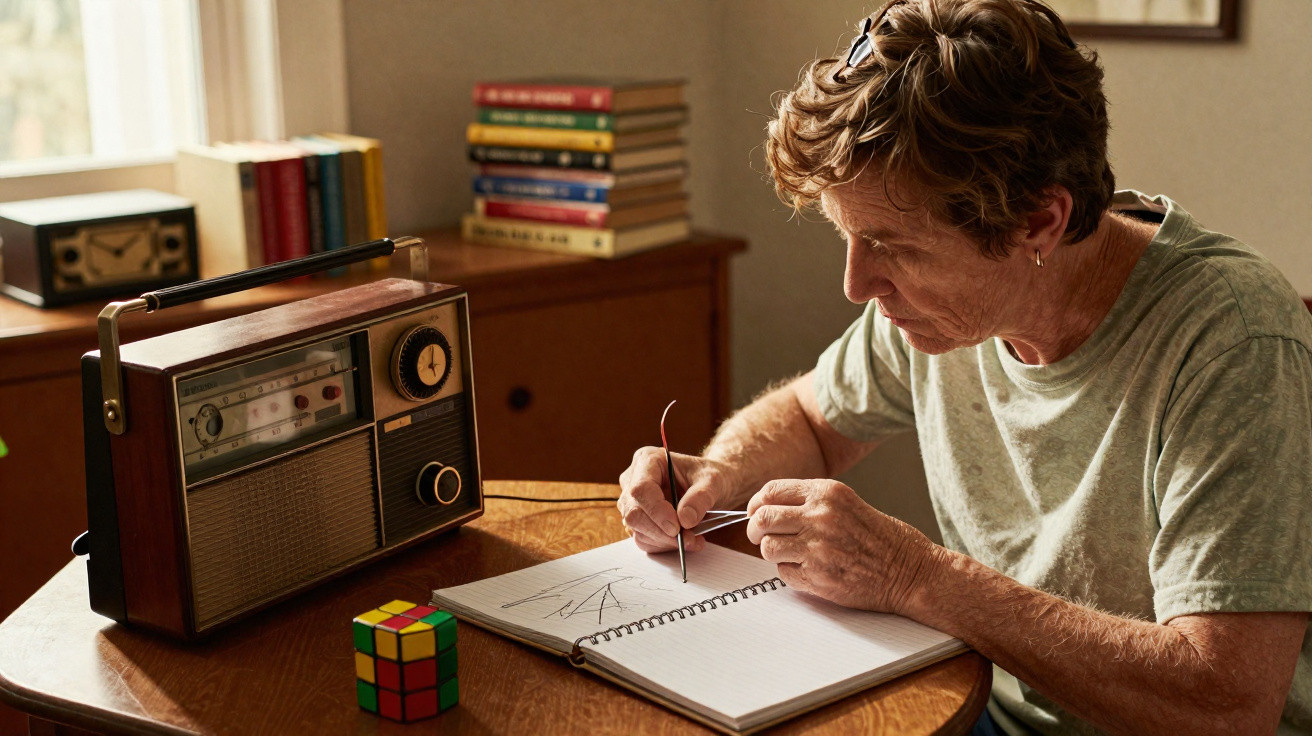
They tend to hold themselves a touch more upright at a café table.
The man carefully folds his newspaper rather than checking his phone. Opposite him, the woman circles her spoon through her coffee with the same unhurried motion she may once have used while making soup for four children in 1978. All around them, younger customers scroll through their screens, headphones on and shoulders hunched towards their ears.
He recalls walking three miles to school through snow, prompting an eye-roll from his granddaughter. Yet the way he recounts it is striking: no theatrics, no grievance, only a calm “that’s what we did”.
Spend time watching people raised in the 60s and 70s and a pattern begins to emerge. They often possess a mental backbone that is never loud, but seems reluctant to give way. Psychologists are now examining that pattern, and several of their findings may be unexpected.
The silent toughness of growing up without a safety net
Psychologists identify a particular form of resilience in children raised with fewer protective guardrails. There was less adult supervision and fewer warnings built into everyday life. You stayed outdoors until the streetlights appeared, rather than until a parental tracking app alerted someone. When you came off your bike, you climbed back on with grazed knees, because there was still time left in the day.
That generation practised self-regulation as life happened. When boredom struck, they had to create their own entertainment. If they got into trouble, they faced a teacher, parent or perhaps a neighbour who had already rung home. Repeated experiences like these shape the brain over time. The lesson becomes: discomfort is not an emergency; it is simply part of an ordinary Tuesday.
Consider the familiar “latchkey kid”. Across the US and UK, millions of children during the 70s returned from school to an empty home. There was no WhatsApp and no text asking, “Did you get in okay?” They kicked off their shoes, prepared a snack, switched on the television and completed homework by themselves. A 2013 study of adults who had been latchkey children found higher problem-solving and emotional-independence scores than among their peers.
One woman, now in her late 60s, put it this way: “I learned young that no one was coming to fix it. If I lost my gym kit, I’d better come up with a plan before morning.” Viewed from today, that may sound harsh, even unfair. But each of those hundreds of small decisions built a powerful sense of capability in her mind: an internal voice saying, I can handle this. I’ve handled worse.
Psychologists use the term “frustration tolerance” for the capacity to remain emotionally steady when life refuses to cooperate. For many people raised in the 60s and 70s, it was a daily exercise. Television channels were limited, downloads were not instant and there was no “next day delivery”. You waited, put money aside and sometimes missed out, then had to accept it.
Across the years, this became a mental strength that is now uncommon: being able to bear discomfort without seeking an immediate escape. They do not have to drown every uncomfortable emotion in sound or notifications. They can remain in a waiting room without reaching for a phone. It may seem insignificant, but it is not. It underpins emotional endurance.
Seven rare mental strengths carried by the 60s and 70s generation
When psychologists speak with people brought up in the 60s and 70s, seven mental strengths repeatedly appear. They emerge not as catchphrases but as ingrained behaviours. The first is a substantial tolerance for uncertainty. Plans altered, buses did not arrive on time and parents worked shifts. Because life could be unpredictable, their minds learned to move with it rather than panic.
The second is a form of practical optimism. This is not the kind found in an Instagram quote; it is the belief that “we’ll figure something out”. They watched parents mend clothing, repair household appliances and manage bills. Problems were concrete matters dealt with around the kitchen table.
Third comes low entitlement. Many shared bedrooms, clothes and even bathwater. They did not presume that life ought to adapt itself to every personal preference. This does not mean they never grumbled; it means they seldom expected the world to reorganise itself around them.
More personally, a therapist in her 40s told me that she enjoys working with clients in their 60s and 70s. “They show up, they do the work, they don’t need therapy to be comfortable,” she said. “They need it to be useful.” This points to the fourth mental strength: tolerating emotional discomfort for the sake of development.
The fifth is delayed gratification. They saved for a record player, waited a week for film photographs and sent letters before waiting days for a reply. Their reward systems became accustomed to gradual pay-offs rather than uninterrupted dopamine hits. Sixth is perspective. They witnessed major change at close range: civil rights, Vietnam and women entering the workforce on a new scale. After watching history shift, it is more difficult to treat every small setback as a catastrophe.
The seventh may be the most overlooked: relational loyalty. Friendships started in playgrounds and remained for decades. You did not “ghost” a person when you might see them at the local shop. You resolved conflict, or learnt to coexist with some tension. This creates a capacity now rarely seen: remaining in relationships when they are imperfect instead of treating people as apps to uninstall.
Psychologists emphasise that these were not inherited gifts. The strengths were shaped by circumstance: less digital cushioning and more real-world friction; more chores and fewer carefully curated childhoods. This does not suggest trauma or neglect were beneficial, since both caused genuine harm. Rather, regular and moderate challenges trained a particular mental muscle, one that is scarce today.
How to borrow their strengths without going back in time
We cannot reproduce the 60s and 70s, and in truth we would not want every aspect of those decades to return. We can, however, recreate some conditions that developed these mental strengths. Begin modestly by choosing one part of life in which you always pursue the easiest option. It could be keeping background sound on constantly or refusing to leave home without your phone.
Give yourself a small “old school” challenge. Take the dog for a walk without headphones. Allow yourself to feel bored while queuing. Leave an online purchase for 24 hours before buying it. On the page, this may sound inconsequential. In the mind, though, it is a gentle return to training delayed gratification and frustration tolerance. It is not about nostalgia; it is about strength.
Let’s be honest: nobody really does this every day. So make it easier. Try one micro-experiment each week: one occasion when you spot the impulse to flee discomfort, then breathe and remain where you are. That is precisely how the older generation built tolerance: through one routine, mildly uncomfortable experience after another.
A further approach is to revive the idea of “good enough”. Those raised in the 70s seldom spoke about “optimizing” their lives. They made the food they were able to make, entertained with what they owned and wore what was already in the wardrobe. Apply the same idea with one simple rule: this week, choose one part of life and intentionally aim for 80%, rather than 100%.
Deal with messages in one batch rather than replying immediately. Make a straightforward meal without searching for the “perfect” recipe. Leave one small job less than perfect, then notice what happens in your chest. That tension is the perfectionism muscle easing, if only slightly.
At a deeper level, consider what psychologists call “stress inoculation”. Arrange small, safe tests before larger challenges arrive unexpectedly. Travel by a different route without maps. Contribute once during a meeting. Spend a morning without social media. This is not self-punishment. It teaches your nervous system: I can be okay even when things aren’t cushioned.
When you falter - and you will - speak to yourself as your most level-headed older relative might. “Alright, that didn’t work. What’s the next move?” The tone is important: less drama and more practical problem-solving. Over several months, your inner voice may move from being an alarmed commentator to a useful teammate.
“We were never told life should be easy,” a 72‑year‑old retired nurse told a psychologist. “We were told we were strong enough to handle it.”
For a brief view of what this generation often does differently, consider these seven habits that many practise almost automatically:
- They complete what they begin, even after the initial excitement has disappeared.
- They can be bored without instantly turning to a screen.
- They save before spending, rather than doing the reverse.
- They turn up for people in person, rather than only sending messages.
- They repair items before replacing them.
- They discuss conflict instead of posting about it.
- They recognise that life can be unfair and continue regardless.
The quiet lessons they’re still teaching us
Spend enough time with somebody raised in the 60s or 70s and you may notice your own shoulders relax. Their memories are seldom polished: lengthy bus journeys, factory shifts, three television channels and one landline shared by the whole street. Running through those stories, though, is a steady idea: you do not need perfect circumstances to create a good life.
On a difficult day, that message can feel dismissive. On a more thoughtful day, it can sound like an invitation. Even if smartphones and same-day delivery formed part of your upbringing, you can still develop the same mental backbone. You can opt for slowness in a fast-moving world, and decide that not every feeling requires repair or every problem requires an app.
Culturally, we are preoccupied with hacks and shortcuts. That older generation offers a quiet reminder that some of life’s best outcomes are made in the old-fashioned way: gradually, over years, with more effort than comfort. We’ve all had that moment where an older relative shrugs and says, “You just get on with it,” and it sounds both harsh and oddly freeing.
People who grew up in the 60s and 70s are not superheroes. Many live with regrets, unresolved hurts and stories they still struggle to tell. But their ordinary lives contain seven mental strengths that the modern world repeatedly attempts to outsource to apps and algorithms.
Perhaps the more useful question is not, “Why were they tougher?” but “What kind of toughness do we want now?” It may be gentler at the edges and less silent, with greater emotional literacy. Yet it can still rest on the quiet conviction they learnt during long walks home without a mobile phone: whatever comes, we’ll find a way through.
| Key point | Details | Why it matters to readers |
|---|---|---|
| Uncertainty tolerance | Those brought up in the 60s and 70s were often raised amid fluctuating economies, changing social norms and fewer assurances. They made plans knowing they could collapse, and learnt to improvise when circumstances suddenly changed. | Today’s careers, relationships and finances contain many unknowns. Developing this tolerance can reduce stress over what you cannot control and help you focus on the next helpful action rather than spiralling. |
| Delayed gratification | Saving for a record player over several months, waiting days for letters and living without on-demand entertainment taught their brains to anticipate rewards later instead of immediately. | The same ability supports long-term aims today, including clearing debt, establishing a business, completing a degree or continuing a habit after early motivation has faded. |
| Relational loyalty | Friendships and romantic relationships developed face-to-face, frequently within small communities where simply vanishing was not an option. People learnt to mend rifts, accept imperfections and keep turning up. | In a swipe-and-scroll world, this approach can help create deeper, more dependable relationships instead of repeatedly starting afresh whenever life becomes uncomfortable. |
FAQ
- Did everyone who grew up in the 60s and 70s develop these strengths? No. Some people went through trauma, neglect or instability that made life more difficult rather than making them stronger. The seven mental strengths are tendencies seen in many people from that period, not universal characteristics.
- Can younger generations realistically build the same resilience? Yes, although their circumstances differ. You cannot recreate their childhood, but you can deliberately introduce small amounts of challenge, waiting and responsibility into everyday life to develop similar mental muscles.
- Isn’t this just romanticizing the past? There is a genuine danger of doing so. The 60s and 70s involved inequality, strict gender roles and limited awareness of mental health. The point is not that “everything was better then”, but that certain difficult conditions unintentionally fostered useful strengths.
- How can parents use these insights with their kids today? They can permit manageable frustration instead of immediately stepping in, provide age-appropriate responsibilities at home, encourage offline play and demonstrate persistence when something is boring or difficult.
- What’s one simple habit I can start this week? Choose one situation each day in which you would normally reach for your phone or another easy escape - while waiting, experiencing mild boredom or feeling slightly awkward - and stay present for two additional minutes. It is a small but powerful way to practise the same form of inner steadiness.






Comments
No comments yet. Be the first to comment!
Leave a Comment