
There is little doubt that an enormous object lies at the centre of the Milky Way, yet a new study considers whether a supermassive black hole is the sole explanation.
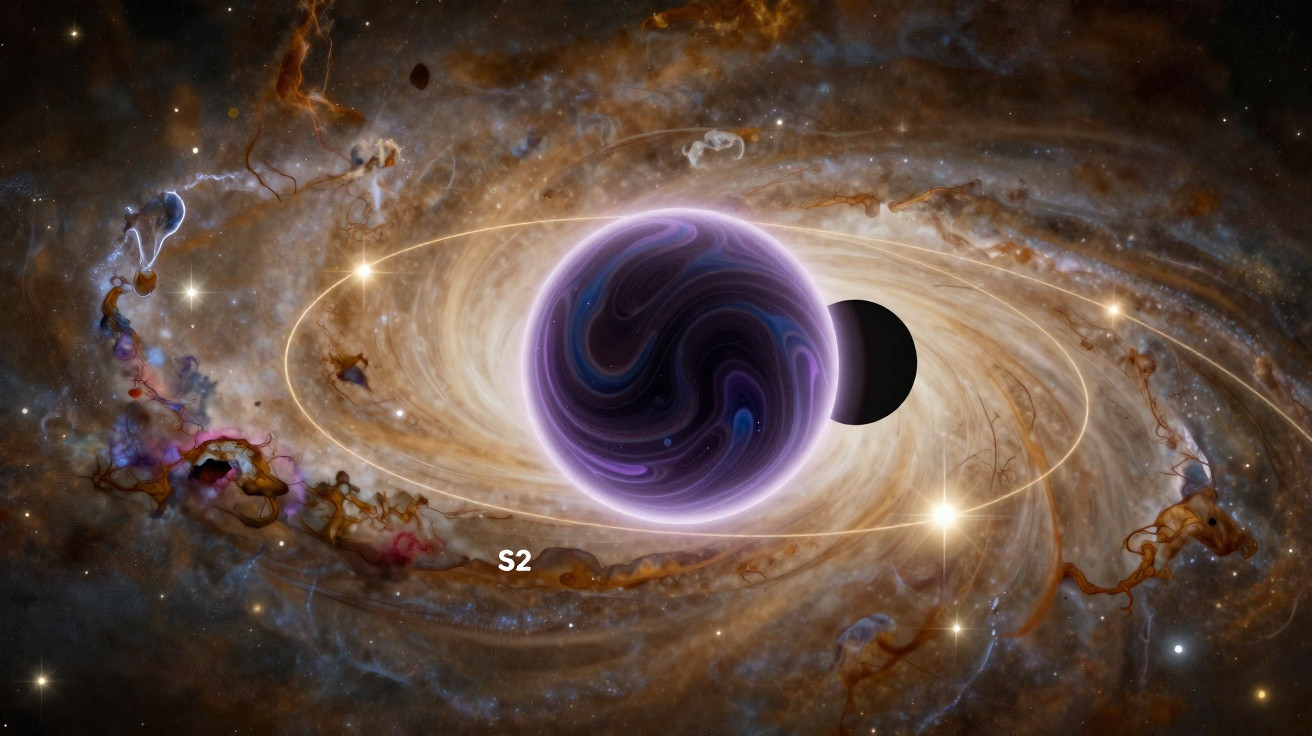
Every measurement of the galactic centre so far agrees with the presence of an exceptionally dense object with a mass roughly 4 million times that of the Sun. The new paper argues, however, that the same evidence could also fit a huge, compact concentration of fermionic dark matter with no event horizon.
Current observations are not precise enough to distinguish between the two possibilities. If the galactic nucleus is made of dark matter, though, astronomers could gain another means of understanding the dark matter distribution across the entire galaxy.
"We are not just replacing the black hole with a dark object; we are proposing that the supermassive central object and the galaxy's dark matter halo are two manifestations of the same, continuous substance," explains astrophysicist Carlos Argüelles of the Institute of Astrophysics La Plata in Argentina.
The mystery of dark matter
Dark matter remains one of the greatest unsolved mysteries in the Universe. Researchers can determine the quantity of ordinary matter in the Universe very accurately, but, after accounting for all of it, the measured gravity is still dramatically greater than that matter can explain.
The source of this additional gravity neither absorbs nor gives off light. Its existence is known only through its gravitational effects. This unseen material is dark matter, and it generates enough gravity to account for roughly 84 percent of the Universe's matter budget.
Gravity was also central to confirming the existence and calculating the mass of the huge object at the Milky Way's heart. Scientists followed the lengthy, curved paths and varying speeds of fast-moving stars orbiting the galactic centre.
The simplest account of that mass, requiring the fewest assumptions, is a supermassive black hole known as Sagittarius A* (Sgr A*). In 2022, an image captured by the Event Horizon Telescope (EHT) collaboration appeared even to reveal the black hole's 'shadow'.
That is not the only possible interpretation, however. Earlier work, for instance, found that an accretion disc glowing around a tightly packed dark matter blob might create a shadow strikingly like the one recorded by the EHT.
Can fermionic dark matter explain Sgr A*?
An international research team led by astrophysicist Valentina Crespi of the Institute of Astrophysics La Plata sought to take the idea further: might a dark matter core also account for the observed stellar orbits around Sgr A*?
Certain dark matter models describe it as thinly spread and diffuse, while one proposed candidate permits dense clusters: fermionic dark matter. These particles follow quantum rules that stop them from being compressed indefinitely, much as electrons and neutrons resist being forced together beyond a particular density threshold.
In theory, this produces an ultradense, gravitationally stable body comparable in principle with a white dwarf or neutron star, except that it consists of dark matter fermions rather than ordinary matter particles.
This raises a question: if such an object occupied the galactic centre, would it change the behaviour of the stars in orbit around it?
Several so-called S stars follow intricate paths around the galactic centre, mapping the gravitational potential of the mass located there. The key tracer among them is S2, which has a comparatively brief 16-year orbit that has been observed and characterised in exceptional detail.
The team simulated S2's behaviour under both the standard black hole explanation for Sgr A* and their fermionic dark matter blob model.
Each scenario matched the star's motion with almost identical levels of accuracy. This does not demonstrate that Sgr A* is dark matter; instead, it shows that it could be, while the available data remain inadequate to tell the two models apart.
Milky Way rotation and future observations
Fermionic dark matter has another advantage, however. The Gaia spacecraft's Milky Way map, the most comprehensive yet produced, indicates that the galaxy's rotation slows at larger distances from the galactic centre.
According to the researchers, this phenomenon, known as a Keplerian decline, is more readily accounted for by an enormous, extended halo of fermionic dark matter surrounding the Milky Way than by alternative dark matter models.
"This is the first time a dark matter model has successfully bridged these vastly different scales and various object orbits, including modern rotation curve and central stars data," Argüelles says.
Upcoming observations may help settle the compelling question of Sgr A's real nature. Long-term monitoring could uncover subtle features in stellar orbits that favour one explanation over the other. Stars orbiting nearer to Sgr A than S2 could offer further evidence as well.
Future Event Horizon Telescope observations may also expose more detailed features within the region where light bends around Sgr A*. If the central object is a dark matter core without a horizon rather than a black hole, some signatures of a black hole's intense gravity, including a clearly defined photon ring, might be missing or modified.
The research has been published in the Monthly Notices of the Royal Astronomical Society.






Comments
No comments yet. Be the first to comment!
Leave a Comment