
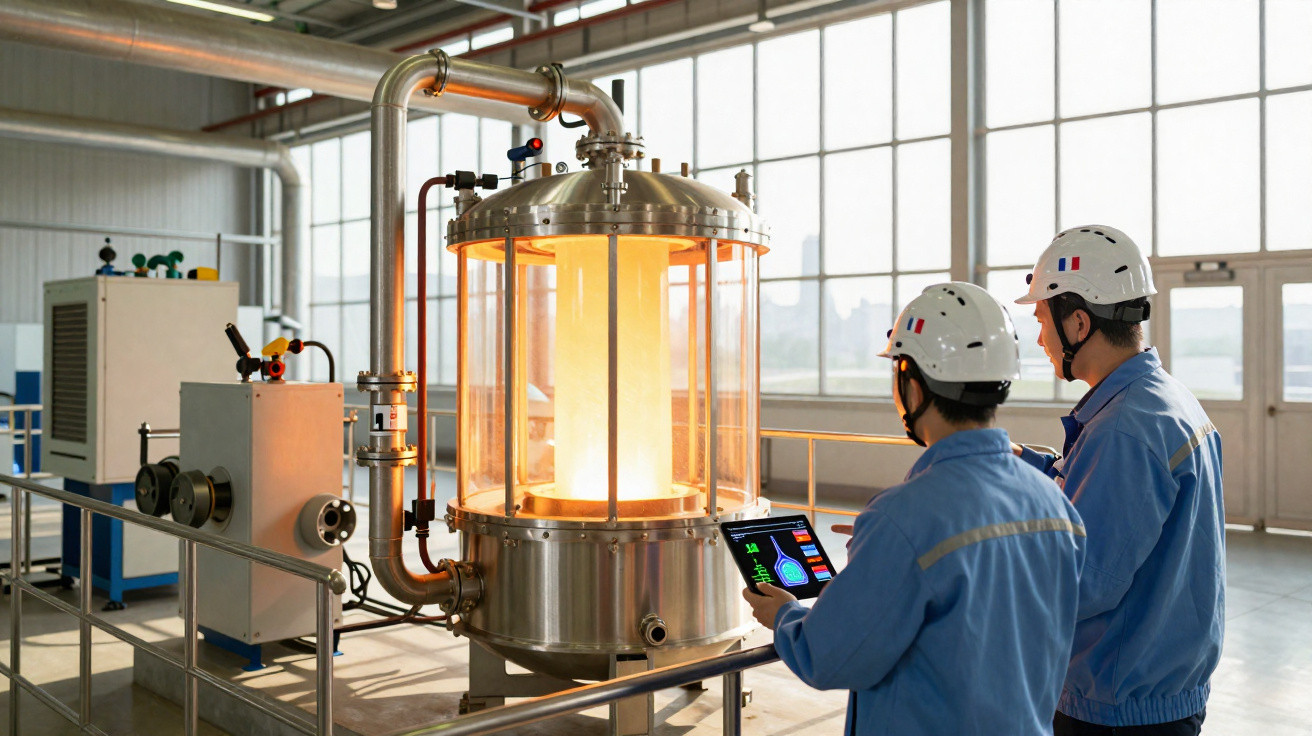
On the fringes of Paris, a small group of physicists is placing a quiet wager on compact nuclear heat becoming a practical energy source for heavy industry.
Rather than focusing on enormous reactors and national electricity networks, a French start-up is advocating a different application for nuclear technology: small modular units designed primarily to replace fossil-fuel boilers at industrial sites. France’s nuclear regulator has now received a second licence application for a mini reactor of this kind, suggesting that this specialist concept is becoming a genuine competitive race.
A different nuclear race takes shape in France
France has traditionally been associated with large reactors supplying a centralised electricity system. Yet that approach is now being questioned from within the country. Two young businesses, Jimmy and Stellaria, have submitted official applications to construct small modular reactors (SMRs) intended not for domestic electricity supply, but for industrial smokestacks.
These schemes have moved beyond laboratory research. In France, a licence application - an application for authorisation to create (DAC) - places a project in the same legal framework as the country’s major nuclear operators. That step in itself points to growing confidence in the technology.
France’s nuclear regulator now has two mini-reactor projects on its desk, both targeting fossil-fuel boilers in industry rather than the power grid.
The impetus behind this change is a stark fact: industrial heat is among the most difficult emissions sources to decarbonise. Steelworks, cement plants, glassmakers and chemical facilities burn coal and gas at high temperatures, frequently without interruption. Grid-scale renewable generation finds it difficult to provide that profile. Smaller, modular nuclear heat may be able to do so.
Stellaria: a start-up from a nuclear research hub
Stellaria is based in the Paris-Saclay research cluster, which hosts the French Alternative Energies and Atomic Energy Commission (CEA). The business was spun out of the CEA in 2022 by a purposefully lean group of nuclear engineers, physicists and fuel-cycle specialists.
That connection gives the start-up an unusual advantage: access to decades of advanced-reactor research and dedicated experimental facilities. Concepts previously confined to technical reports are now being developed into hardware for factories and industrial estates.
Rather than pursuing another EPR-scale generating station, Stellaria is seeking to create a system that resembles and operates like a highly capable industrial boiler, except that nuclear physics supplies the heat instead of gas.
Stellarium: a molten-salt mini reactor for industrial heat
At the centre of Stellaria’s plan is Stellarium, its flagship reactor design. It belongs to the Generation IV family, using molten salts and fast neutrons. This makes it fundamentally different from France’s current reactor fleet, which relies on pressurised water reactors.
In the Stellarium design, nuclear fuel is dissolved in heated molten salt. The salt has two functions: it contains the fuel and serves as the coolant flowing around the system. In other words, the reactor’s core is liquid.
This is more than an unusual engineering choice. For industrial customers, it offers three immediate benefits:
- Heat is spread more evenly through the core, reducing hot spots and thermal strain.
- The system does not operate at extreme internal pressure, removing the need for thick high-pressure vessels and eliminating certain associated failure modes.
- A conventional “meltdown” takes on a different form because the fuel is already liquid within a salt bath.
Stellarium is designed to deliver about 40 megawatts of thermal power. Although that is small beside gigawatt-scale nuclear stations, it is comparable with the large fossil-fuel boilers widely used at refineries, chemical facilities and materials plants.
A unit of this sort could operate continuously behind a factory boundary, supplying steam or hot gas directly to existing industrial processes.
Safety driven by physics rather than software alone
Stellaria emphasises a safety principle based on fundamental physics instead of complex electronic systems. Put simply, the nuclear reaction naturally slows if the reactor becomes excessively hot.
As temperatures increase, the characteristics of the fuel-salt mixture and the geometry of the core alter in ways that lower the reaction rate. This means the system has a natural tendency to stabilise without active action from pumps or electrically powered control equipment.
Instead of counting on complex back-up systems, the design banks on materials and geometry that cause the reactor to calm down as it heats up.
The salts are also non-flammable and chemically stable. They neither generate high-pressure steam nor carry the same explosion risk associated with water meeting extremely hot fuel. Such features matter to public authorities still shaped by past nuclear accidents.
Why 40 MW is significant for factories
A thermal output of 40 MW may appear modest at first glance, but it occupies a useful range for industrial planners. Many sizeable facilities already use boilers of roughly this capacity to generate process heat.
Replacing a gas-fired boiler of that scale with a nuclear module could allow one site to avoid hundreds of thousands of tonnes of CO₂ over its lifetime, while providing a much more stable fuel cost. Its comparatively small footprint could also allow installation on brownfield land or within industrial estates.
The modular model further enables components to be manufactured in factories before being transported and assembled at the site. This differs from the mega-project approach used for conventional nuclear power plants, where years of major civil engineering and bespoke construction are required.
A 2030 demonstrator and a demanding regulatory route
Stellaria has identified a specific target: an operating demonstrator around 2030. This first-of-a-kind installation would do more than provide heat. It would demonstrate to regulators that the design performs as intended and give industrial customers a tangible view of what they would be purchasing.
On 22 January, the company formally submitted its DAC to France’s nuclear safety authority. With that application, Stellaria entered the tightly regulated group of nuclear operators - a major step for a start-up.
Its submission must address an extensive set of issues, including core behaviour, containment barriers, accident-scenario management, waste management, resilience to external events and the ability to operate safely for decades.
For decades, only state-backed giants filed such applications in France. The arrival of start-ups at this level signals a deeper shift in nuclear culture.
Regulators are likely to challenge the plans, request clarification and require design changes. The process may take time. Stellaria is betting that joining the regulatory queue early will enable it to help shape future European standards for mini reactors.
France’s mini-reactor landscape: Stellaria and Jimmy
Stellaria is not the only contender. In early 2024, Jimmy became the first French start-up to submit a permit application for a small nuclear reactor dedicated to industrial heat. Taken together, the two projects are creating an emerging French ecosystem in this niche.
They are built around the same central proposition: instead of seeking large-scale electricity output, they offer high-temperature heat directly to factories. This area accounts for a significant proportion of emissions, yet it often receives less attention than transport or household heating.
Both businesses must still establish workable commercial models: determining who finances the unit, who operates it, how maintenance is arranged and how local communities gain confidence in the projects. Industrial customers must also compare nuclear heat with electrification, hydrogen and advanced biofuels.
Global competition in small modular reactors
France’s new entrants are joining an increasingly busy sector. Companies and state-backed organisations around the world are progressing SMR concepts for electricity, heat or both. Many are still at an early stage, but the direction of travel is clear.
The Stellarium concept forms part of a wider range of SMR programmes:
| Actor / project | Country | Technology | Typical power | Main use | Industrial heat | Status |
|---|---|---|---|---|---|---|
| Stellaria – Stellarium | France | Molten salts, fast neutrons | ≈ 40 MW thermal | Industrial heat | Core focus | Licence application filed, demonstrator targeted ~2030 |
| Terrestrial Energy – IMSR | Canada / US | Molten salts, liquid fuel | ≈ 400 MW thermal | Power + heat | Secondary use | Advanced pre-licensing |
| Kairos Power – KP-FHR | US | Molten salts, solid fuel | ≈ 320 MW thermal | Power, hydrogen | Yes | Demonstrator under construction |
| X-energy – Xe-100 | US | High-temperature gas-cooled | ≈ 200 MW thermal | Power | High-temperature heat | Industrial project stage |
| Moltex Energy – SSR-W | UK / Canada | Molten salts, fast neutrons | ≈ 300 MW thermal | Power | Potential | Concept development |
| Oklo – Aurora | US | Fast neutrons, liquid metal | < 50 MW electric | Off-grid power | Not primary | Licensing in progress |
| CNNC – HTGR | China | High-temperature gas | > 200 MW thermal | Power + industry | Yes | In demonstration / service |
| Linglong One | China | Pressurised water SMR | ≈ 385 MW thermal | Power + heat | Yes | Under construction |
For France, the existence of capable overseas competitors increases the pressure. Should domestic schemes falter, future industrial customers may import SMRs rather than adopt technology developed at home.
What compact nuclear heat could mean for heavy industry
For the manager of a steelworks or chemical facility, the proposal appears simple on paper: retain the same heat requirement but replace a gas boiler with a compact nuclear module on the same site.
Three possible advantages are particularly notable:
- Major emissions reductions without redesigning core industrial processes.
- Predictable long-term fuel costs with lower exposure to gas-price shocks.
- High availability because nuclear units can operate continuously.
In practice, matters will be more complicated. Operators will require personnel trained in nuclear safety, emergency arrangements and rigorous supervision. Some facilities may be reluctant to host nuclear installations on private industrial land, particularly near populated locations.
Local residents and environmental organisations will also influence outcomes. Public consultations, planning investigations and legal challenges may each delay projects. For mini reactors, public acceptance may prove as decisive as neutron physics.
Key terms and scenarios to watch
Two phrases will appear regularly as these programmes progress. “Small modular reactor” refers to a nuclear unit smaller than a conventional plant and intended for serial factory manufacture. “Generation IV” describes advanced technologies - such as molten salts and high-temperature gas - designed to improve safety, resource use and waste characteristics compared with current reactor fleets.
One credible outcome is that early demonstrators, including Stellarium’s 2030 target, are initially installed at state-backed or semi-public locations: research campuses, major industrial areas or military sites. After recording several years of operational experience, private industrial customers may be more willing to enter long-term agreements.
A different route could involve hybrid locations in which an SMR supplies both a factory and a local district-heating network, delivering hot water to nearby towns. Combining industrial and urban demand could improve utilisation and economics, but it would also bring nuclear technology physically closer to daily life.
The coming years in France will show whether this compact, heat-first nuclear approach can progress from ambitious PowerPoint presentations to unobtrusive, humming modules behind the boundaries of working factories.




Comments
No comments yet. Be the first to comment!
Leave a Comment