
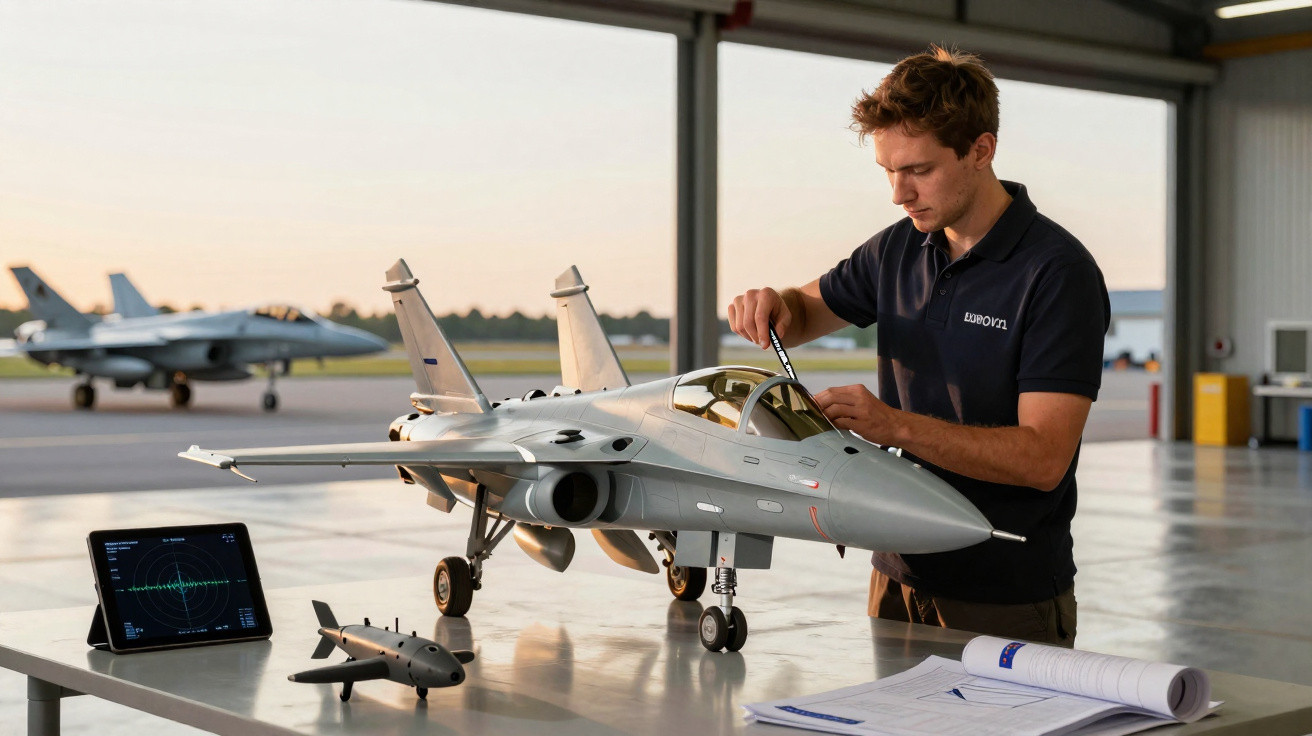
The Gripen E is gathering pace while sixth-generation programmes remain some way off, leaving European air forces with a difficult decision: continue depending on imported aircraft or develop an affordable fighter of their own before the pressure point of 2035.
Gripen’s new chapter puts pressure on Europe
Sweden has begun taking delivery of its first Gripen E fighters, opening a new phase for one of Europe’s most distinctive combat aircraft. The Swedish Air Force intends to build its Gripen fleet to roughly 120 aircraft, supported by substantial funding and thousands of personnel dedicated to flying and sustaining the jet.
This is more than a modest modernisation. Gripen E features a more capable radar, broader electronic warfare capacity and the ability to fire long-range strike weapons. Despite being a comparatively light single-engine aircraft, it offers considerable range and survivability.
The Gripen’s evolution exposes a missing link in Europe’s airpower: a modern, homegrown, single‑engine fighter sitting between basic light jets and ultra‑expensive stealth aircraft.
Export activity and upgrade efforts in Canada, Denmark and Thailand indicate that Saab sees continuing commercial potential for the aircraft. There is also discussion of fitting cruise missiles such as the German-Swedish Taurus, which could give the Gripen strategic impact well beyond what its weight category might suggest.
Why a new single-engine jet is back on the agenda
European discussions about air combat have largely revolved around two flagship schemes: the Franco-German-Spanish Future Combat Air System (FCAS) and the UK-led Global Combat Air Programme (GCAP, built around the Tempest fighter). Both programmes are intended to deliver sixth-generation fighters from around 2040.
These aircraft are likely to be highly capable, stealthy, network-centric and exceptionally expensive. They are expected to be acquired in relatively small numbers, alongside drones and existing aircraft. Until they enter service, however, Europe requires combat mass: sufficient fighters to defend national airspace, react to crises and discourage Russian pressure.
A growing gap between needs and fleets
Many of Europe’s current aircraft fleets will approach retirement as budgets come under strain and tensions with Russia and China stay elevated. Air forces will find it difficult to replace older aircraft on a one-for-one basis with costly, premium twin-engine platforms such as the F-35 or Eurofighter Typhoon.
- F-16s in several NATO countries are approaching the end of their operational lives.
- Earlier Eurofighter and Rafale variants will require mid-life improvements or, eventually, replacement.
- Smaller air forces cannot fund large numbers of top-tier stealth fighters.
This makes the debate around Gripen strategically important. Sweden has demonstrated that a contemporary single-engine fighter can stay competitive through intelligent avionics, sophisticated sensors and advanced missiles, without the cost associated with a stealth giant.
If Europe wants enough aircraft to defend its airspace and support NATO, it needs an intermediate solution: a sovereign, single‑engine fighter designed specifically for affordability and numbers.
Gripen as a benchmark, not the last word
The issue is not whether every country should purchase Gripen. Rather, it is whether Gripen E should remain Europe’s final single-engine design or serve as a foundation for a more ambitious multinational effort.
Saab has based the aircraft’s philosophy on dispersed operations, economical running costs and straightforward servicing from austere airfields. This approach stems from Sweden’s Cold War strategy for surviving a surprise attack. Other European nations could place greater value on different capabilities, including carrier suitability, increased stealth or closer connection to NATO’s future combat cloud.
What a new “intermediate” fighter could look like
| Feature | Role in an intermediate fighter |
|---|---|
| Single engine | Lowers maintenance and acquisition costs, making bigger fleets possible |
| Open architecture avionics | Supports fast software updates and national customisation |
| High-efficiency radar and IR sensors | Maintains competitive situational awareness without complete stealth |
| Long-range missiles and cruise weapons | Provides deterrence and deep-strike capabilities |
| Drone teaming capability | Enables the fighter to command less costly unmanned “wingmen” |
| Low operating cost | Allows intensive training and frequent sortie generation |
Such an aircraft would not seek to equal the F-35’s stealth characteristics. Its purpose instead would be to offer credible capability at a cost that lets air forces acquire 80 aircraft rather than 30. In a lengthy conflict, where endurance and losses matter, that difference could prove more important.
Industrial sovereignty versus off-the-shelf buys
The wider geopolitical context drives this argument. A large number of European states have opted for the US-made F-35 because of its stealth and interoperability. However, every F-35 order directs defence spending, employment and technical knowledge across the Atlantic instead of towards European factories and design bureaux.
A shared single‑engine fighter project would be as much about keeping Europe’s aerospace ecosystem alive as filling air force squadrons.
France, Germany, Italy, Spain, Sweden and the UK each possess advanced aerospace sectors, although they frequently compete rather than collaborate. Without a programme positioned below FCAS and GCAP, an entire generation of engineers and suppliers could be limited to maintenance work, while vital design expertise declines.
Setting 2035 as the target date for an intermediate fighter would require prompt choices on funding, partnerships and technology. It could also strengthen Europe’s hand when dealing with US suppliers: a credible European option would alter discussions over F-35 support, data access and future modernisation.
Can Europe move fast enough?
Developing and certifying a new fighter normally requires 15 to 20 years. That makes 2035 a demanding, though still achievable, objective if work begins immediately. The Gripen programme itself took a broadly similar period from early concept through to operational service.
To shorten the process, European partners would probably need to draw on technologies already available: engines in current production, proven radar architectures and established weapon interfaces. The principal innovation would lie in systems integration, software, digital engineering and whole-life costs, rather than radical airframe concepts.
Risk, cost and political headaches
Nobody suggests that this would be straightforward. Any new fighter programme would face cost overruns, competing industrial interests and national rivalries. Smaller nations may prefer to delay commitments and purchase readily available US aircraft, rather than risk backing a European prototype that could fall years behind plan.
But relying on foreign aircraft creates risks of its own. Operators may be subject to export restrictions, constraints on sensitive software and possible supply-chain disruption. In a major emergency, even an allied supplier would place its own armed forces first.
The strategic trade‑off is stark: accept dependence in exchange for short‑term convenience, or absorb the pain of cooperation to retain real autonomy in the skies.
What “electronic warfare” and “cruise missiles” really change
Two technical concepts repeatedly arise in discussion of Gripen: electronic warfare and long-range cruise missiles. Both would influence the way a future European single-engine fighter operates.
Electronic warfare (EW) includes equipment used to jam, deceive or interfere with hostile radars, radios and missiles. A manoeuvrable fighter equipped with effective EW systems can remain survivable without possessing the highest level of stealth. Rather than simply avoiding detection, it can blind or confuse threats.
Cruise missiles such as Taurus travel low and over long distances, enabling attacks against defended targets from hundreds of kilometres away. Fired by an agile and relatively inexpensive fighter, they allow smaller air forces to threaten vital infrastructure without requiring pilots to penetrate deep into enemy airspace.
Pairing capable EW with stand-off weapons can make a “light” aircraft a major strategic asset. A future European intermediate fighter could adopt this approach, functioning as a missile and drone launcher and coordinator instead of always entering the most heavily defended airspace.
Scenarios for 2035: crowded skies or capability cliff?
Consider two possible visions of European airspace in 2035. In one, a small group of countries operates limited fleets of FCAS, GCAP and F-35s, supported by shrinking numbers of ageing aircraft. Flying is costly, so training hours are constrained, while air-policing missions place increasing demands on crews.
In the other, these high-end fighters remain in service but work alongside larger fleets of a new European single-engine workhorse. This aircraft takes on routine patrols, presence missions over the Baltic and Black Seas, and many NATO air-policing duties. The most advanced platforms concentrate on the most difficult operations and command-and-control functions.
The latter scenario more closely reflects Sweden’s current Gripen model: retaining mass and resilience through a capable but affordable fighter. Expanding that national approach across Europe would require unusual political determination, quick decision-making and a shared recognition that airpower depends not only on flagship aircraft, but also on numbers and endurance.




Comments
No comments yet. Be the first to comment!
Leave a Comment