
At the rear of a busy café, a young woman flicks through her phone and acts as though she is checking her emails.
She wears an understated, reassuringly grey coat; her nails are without colour and her trainers nearly disappear into the floor. She glances up only long enough to offer a courteous smile before retreating into the scene again, as if she wants to remove herself from the picture.
At a table two places away, a man in a faded navy hoodie keeps his gaze down, pulling the sleeves over his knuckles. His outfit appears comfortable, yet it also seems to function as armour. These colours have not been picked to show who he is, but to conceal what he would rather not confront.
Psychology has a term for this kind of stylistic “disappearing”. It also draws attention, quietly, to three colours that repeatedly appear among people with low self-esteem.
The unspoken link between colour and self-worth
Colour psychology is about more than identifying the shade that flatters your complexion. It considers the ways our choices communicate what we privately feel we deserve. As self-esteem falls, the body can respond before the mind fully registers it. We often choose clothing that feels safe rather than clothing that feels authentic.
Researchers and therapists have observed a recurring pattern: several colours appear disproportionately often among people who feel insignificant, guilty or undeserving. This is not simply a one-day preference, but a sustained habit. A wardrobe can become a discreet record of the way a person speaks to themselves each morning.
Some insist that they are “just not into color”. But when they try on something more vibrant, their expression may brighten, only to fade as they return it to the rail. That pause can be revealing.
Consider black, the leading colour for low-visibility confidence. Fashion presents it as elegant, slimming and enduring. When black becomes virtually the sole option, however, psychologists may read something different. Black takes in light, and it can take in attention too. It suits anyone frightened of being noticed or of occupying space they quietly feel they have not earned.
Next is dirty grey: not the deliberate charcoal of a designer coat, but the weary greys found in old T-shirts and worn jumpers. People with low self-esteem can retreat into this haze. Grey says “neutral”, “don’t look at me, don’t ask me”. Emotionally, it is rather like speaking under your breath.
The third shade is less obvious: muddy brown. This does not mean warm caramel or deep chocolate, but flat, muted browns that can leave skin looking tired. Therapists sometimes hear clients call themselves “boring”, “plain” or “nothing special” while dressed in precisely these tones. It proves nothing on its own, but the resemblance is notable.
Any one of these colours can be stylish, purposeful or powerful in isolation. The warning sign is a wardrobe that resembles a black–grey–brown tunnel with no way out.
When black, dirty grey and dull brown reflect low self-esteem
A psychologist based in Paris told me about a client who turned up each week in almost identical clothing: a black hoodie, dark jeans and grey trainers. She was in her mid-20s, intelligent and amusing once at ease. Yet her opening line in therapy was: “I hate being noticed.” Her wardrobe was taking care of that for her.
Every week, she spoke of feeling “invisible at work”, “replaceable in relationships” and “not pretty enough for color”. She maintained that black was merely “practical”. One day, she arrived wearing a pale blue scarf. It was hardly dramatic, but everybody at her office remarked on it. She panicked, then left it unworn for a month.
That is the contradiction: people with low self-esteem often say they want to be seen, respected and valued. Yet they may use non-colours to protect themselves from the very attention they seek.
A UK workplace-style survey found that workers who described their confidence as “low” were twice as likely to call their wardrobes “monochrome, mostly dark”. Those who rated their confidence as “high” did not necessarily dress in rainbow colours. They simply reported considerably greater variety: a single strong shade, a print or a more daring accessory.
Across therapy notes and observational research, black, dirty grey and dull brown recur like a subdued refrain. They are not villains, but possible clues. They are frequently associated with thoughts such as “I don’t want to stand out”, “I don’t want to make a mistake” and “I don’t deserve bright things”.
The reasoning is harsh but straightforward: when you believe you are “too much”, you mute yourself. When you believe you are “not enough”, you attempt to vanish. Colour becomes a bargain struck with shame.
Using colour to slowly restore self-esteem
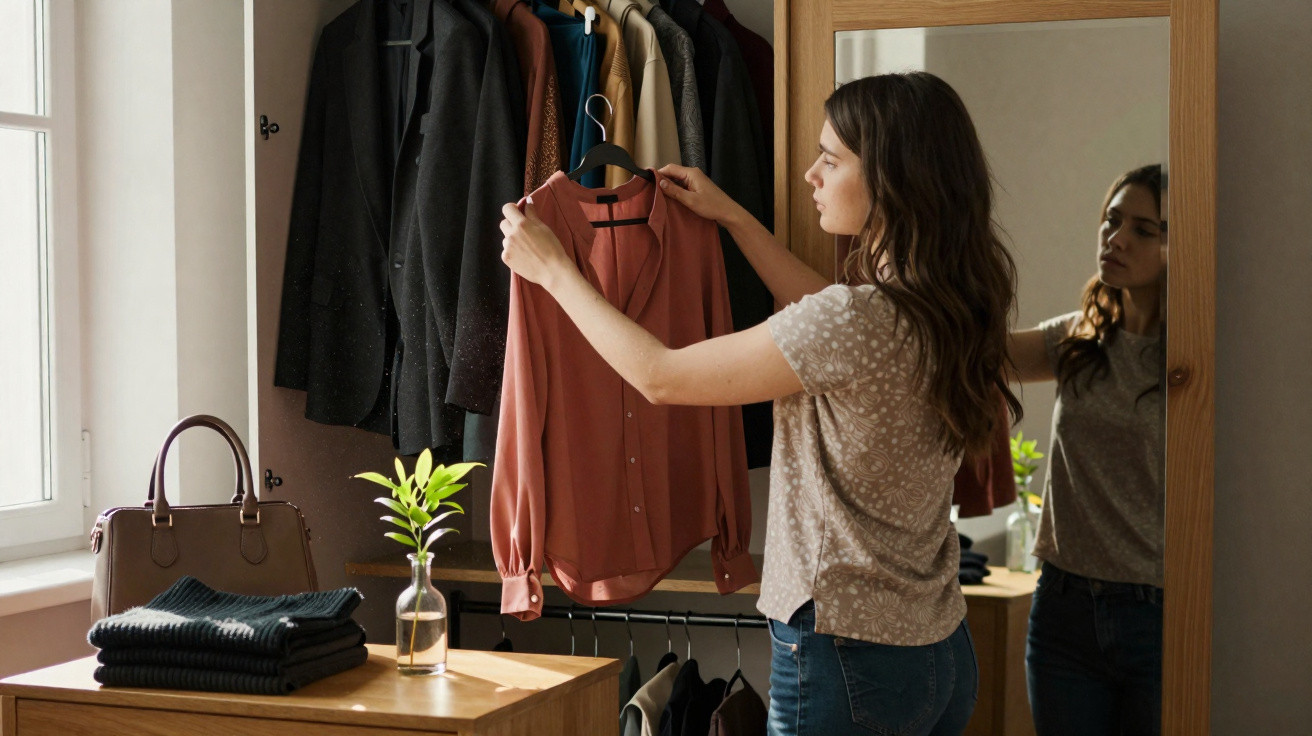
A modest, practical technique often suggested by therapists is the “one-step-up rule”. Keep the black, grey or brown pieces you love if they bring comfort. Then introduce only one feature that feels a step more alive: a brighter T-shirt beneath a black blazer, a coloured scarf with a grey coat, or socks that no one else will even notice.
This is not a makeover programme. It is exposure therapy for being visible. The aim is to try out a different belief: “I can exist in color and nothing terrible happens.” Begin with ten minutes, a quick errand or a work-from-home video call. Repeat these small experiments regularly.
Home can sometimes be the most accessible starting point. Try a coloured mug, a teal cushion or a green notebook on your desk. Gradually, your brain can learn to connect colour with safety rather than threat.
A frequent mistake is moving immediately from entirely black outfits to a vivid red dress from head to toe or a neon jacket. It is the equivalent of going from whispering to yelling in a quiet room. The nervous system pushes back, and you return to the black jumper convinced, “See, color isn’t for me.”
Another pitfall is reserving colour for “special occasions” while waiting for the ideal body, job or life. If you only wear color when you feel flawless, you’ll never wear it. Colour belongs on insecure days as well. In many cases, those are the days on which it matters most.
At a human level, this concerns permission more than fashion: permission to be visible, to occupy a little visual space and to say “I exist” without apologising through every shade you select.
“When someone starts reintroducing color into their life, it’s rarely about taste,” explains a clinical psychologist I interviewed. “It’s about self-worth. They’re saying to themselves, maybe for the first time: I am allowed to be visible.”
For a practical approach that does not turn your life upside down, use this brief colour-reset checklist:
- Open your wardrobe and count the items that are black, dirty grey or dull brown.
- Choose one piece you like with more colour, even if it currently feels “too much”.
- Put it on at home first, then wear it for a brief, low-pressure outing.
- Pay attention to your self-talk that day: is it more severe, gentler or simply louder?
- Do it once a week, making small adjustments rather than dramatic changes.
Three colours, yes – but the story behind them is yours
The three colours psychology flags in relation to low self-esteem – black, dirty grey and dull brown – are not judging you. They simply pose a quiet question: are you choosing them, or are they choosing you? That question alone may disrupt years of habits shaped by self-doubt.
On a difficult morning, pulling on the familiar dark hoodie can feel instinctive. It is faster and safer, with no choices required. At a deeper level, it may say, “Today, I won’t bother trying to belong.” Given enough time, such small choices can solidify into identity. You no longer ask yourself what you genuinely like.
We have all looked at an old photograph and thought, “Wow, I’d forgotten I once dressed like that.” Sometimes the reverse is more difficult: recognising that your style has not altered in ten years, not because you still love it, but because your self-esteem became stuck. Let’s be honest: nobody really carries out that kind of mirror-based self-reflection every day.
Colour cannot resolve trauma, bullying or years of criticism. What it can offer is a small daily choice: a gentle way to tell yourself, “Maybe I’m not as unworthy as I thought.” Perhaps you are allowed to wear a blue jumper on a Monday. Perhaps you are allowed a warm brown that brings out your eyes rather than making them look dull.
The three “low-esteem colors” are merely a starting point. The meaningful work starts when you ask why hiding in them feels safer – and what could happen, within you and around you, if you allowed in just a little more light.
| Key point | Detail | Benefit for the reader |
|---|---|---|
| Three recurring colours | Black, dirty grey and dull brown are linked to patterns of withdrawal | Gives a name and image to a vague feeling |
| The wardrobe as a mirror | Clothing habits can sometimes reveal low self-esteem | Helps identify everyday automatic behaviours |
| Practical micro-changes | The “one-step-up” rule and gradual experiments with colour | Provides simple actions for trying a new relationship with yourself |
FAQ:
- Are black, grey and brown always signs of low self-esteem? No. They become meaningful when they dominate your wardrobe, feel more like hiding than choice, and match a long-term pattern of self-criticism.
- Can someone with high confidence love wearing black? Yes. Confident people often use black as a bold, intentional statement, usually mixed with texture, shape, or a clear personal style.
- How do I know if my color choices come from fear? Ask yourself: “If nobody judged me today, what would I wear?” If the answer is very different from what you actually put on, fear is probably in the room.
- Is it enough to change colors to feel better about myself? No. Color is a tool, not a cure. It works best alongside therapy, self-compassion, and honest conversations about what hurt your self-esteem in the first place.
- Where should I start if I feel intimidated by bright colors? Start tiny: a scarf, a notebook, nail polish, or socks under your usual clothes. Let your nervous system get used to being “a little more visible” at a pace that feels manageable.





Comments
No comments yet. Be the first to comment!
Leave a Comment