
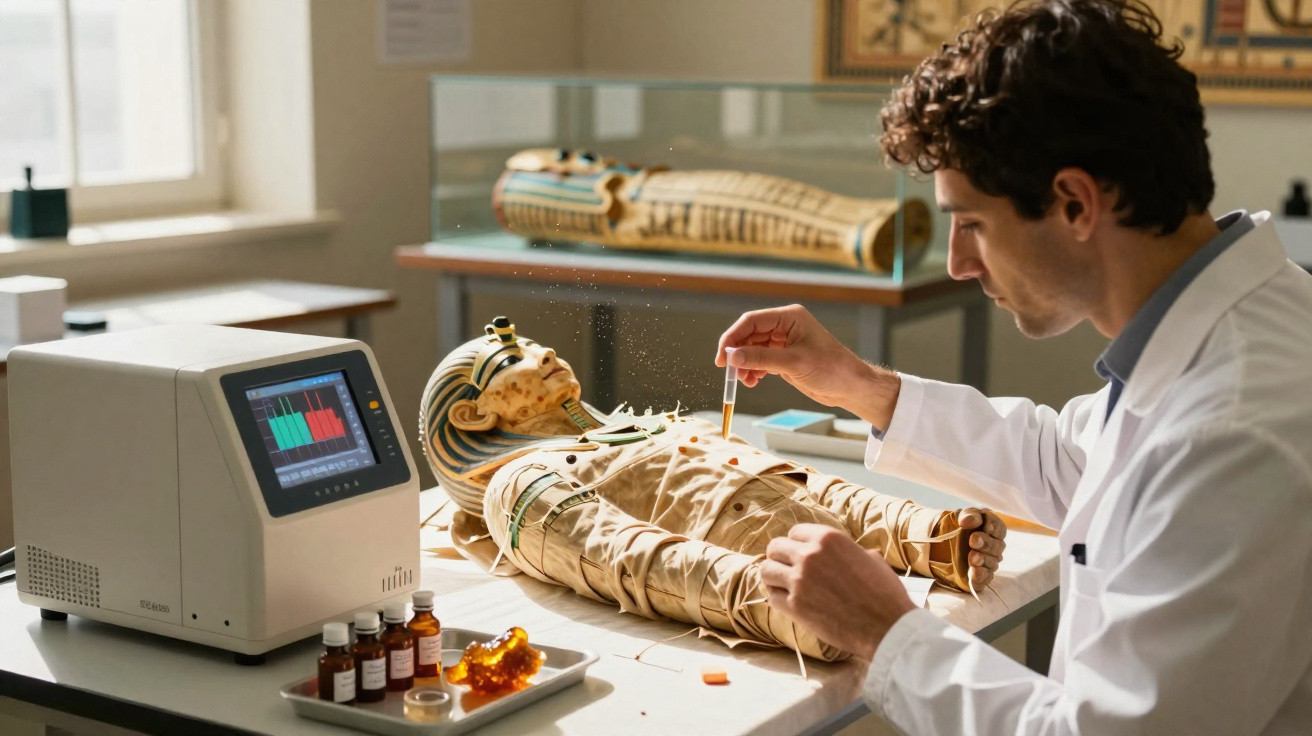
Ancient Egyptian mummies carry a distinctive odour familiar only to people who have come close enough to smell them. Scientists have now collected these unseen vapours in an effort to uncover how the bodies were embalmed.
Traditionally, archaeologists have examined mummies through a more intrusive method: removing a section of bandage and dissolving it to determine the molecular composition of the embalming substances.
That approach is, however, destructive by nature. Molecules can break down during the procedure, and only a limited number of bandage fragments can be removed before the mummy itself begins to come apart.
Analysing the odour of Ancient Egyptian mummies
A group of organic geochemists at the University of Bristol instead recognised that they could collect volatile organic compounds (VOCs) from the air around a mummy. VOCs are molecules that readily escape from their source and disperse through the air, reaching the nose as distinctive scent signatures.
"Scent played a vital role in Egyptian mythology and afterlife," the team explains in their published paper.
"Spices would have been valuable in the embalming process due to their strong aroma, masking the unpleasant odours associated with death. The aromatic components of embalming materials are also a defence against pests and microbial infections to the mummified bodies."
Scientists had already closely examined the scents of nine mummified bodies at the Egyptian Museum in Cairo in 2025, characterising their aromas as "woody", "spicy," and "sweet".
The Bristol researchers sought to take this work further by connecting those ancient odours directly with the organic embalming agents that produced them. On this occasion, a molecular scanner served as the ‘sniffer’.
VOCs reveal changing embalming ingredients
The researchers examined 35 physical specimens - small fragments of resin, bandage and human tissue - taken from 19 mummies. These were almost certainly significant individuals, dating from roughly 2000 BC to 295 AD and representing nearly the full span of Ancient Egypt’s mummification tradition. Every specimen came from mummies held in museums across Europe and the UK.
Small portions of the same samples had undergone analysis in 2006 with the dissolving technique. This gave the Bristol team a comparison point for testing whether its ‘sniffing’ approach was reliable and for identifying any additional information it could provide.
Each mummy fragment was placed in a chamber and allowed to ‘breathe’, releasing VOCs that may have persisted over the centuries. The captured gases were subsequently examined by gas chromatography and mass spectrometry. These methods separate and identify individual molecules in a sample, showing which fats, waxes and resins had been used in the embalming mixture.
The principal ingredients were most commonly fats and oils, beeswax, plant resin and bitumen. The research also showed, however, that the recipes developed over time.
During the earliest periods, Ancient Egyptians used relatively simple blends of fats and oils to embalm mummies. As time passed, the mixtures grew more elaborate, adding pricier substances such as resins and oils from plants including pine, juniper and cedar, alongside bitumen.
"Mummies from different historical periods exhibit distinct volatile compositions, indicating that volatile analysis may serve as a minimal invasive tool for differentiating the chronology of mummies," the authors write.
"Therefore, VOC analysis can be used as a rapid, non-destructive, preliminary screening method to obtain useful analytical information without compromising the integrity of the sample or to target samples for more convoluted and time-consuming analysis."
The research appeared in the Journal of Archaeological Science.






Comments
No comments yet. Be the first to comment!
Leave a Comment