
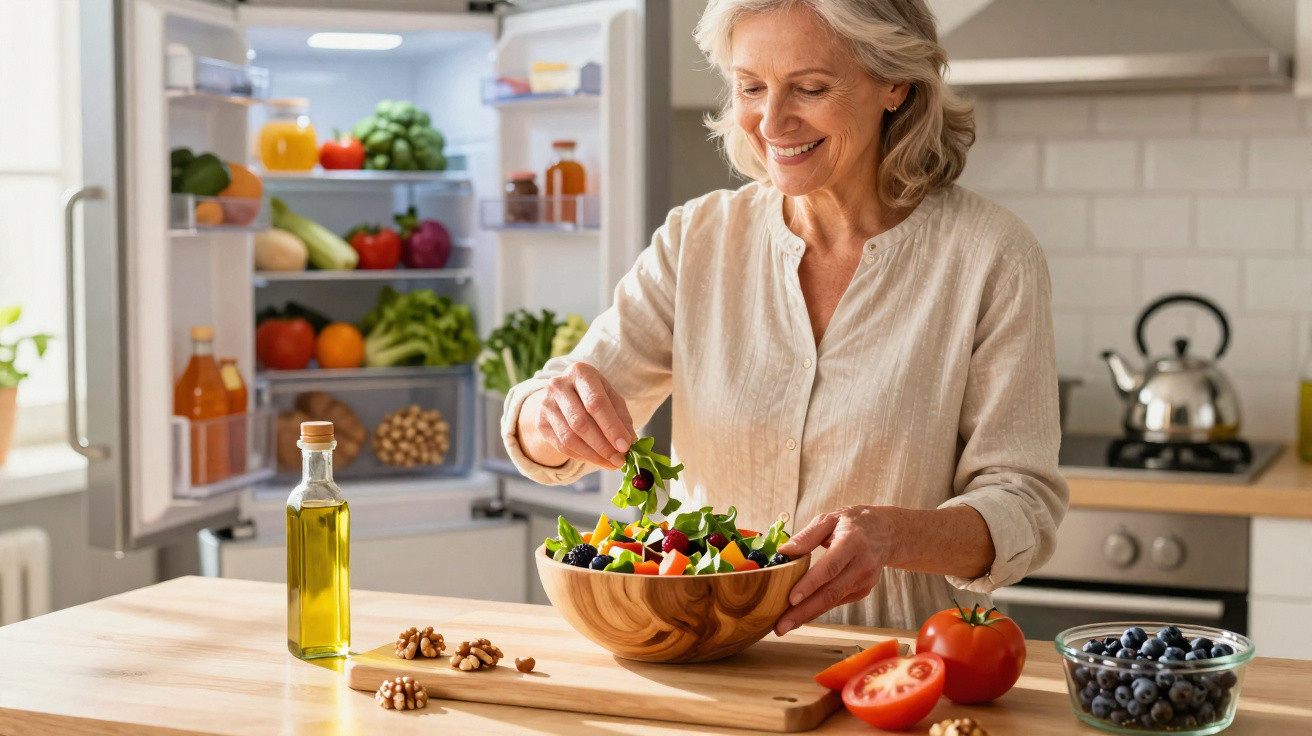
At Sunday lunch, the salad sits in the middle of the table, olive oil is placed beside the bread, and walnuts wait in a small bowl that nobody really thinks to finish. In many households, these habits seem ordinary, almost unnoticed. Yet researchers are taking a close look at what people eat day after day, because some brains appear to withstand ageing more effectively, even when biological signs of Alzheimer’s are present. The answer is not one miracle food or a secret recipe. It lies in the meals repeated over many years. And it may alter the way we view what is in our cupboards.
Brains that cope better: the surprising power of what is on the plate
We all recognise the situation: a relative looks for their keys, misses an appointment, then makes a joke to ease the concern. Growing older does not automatically mean developing Alzheimer’s disease, and scientists have found that some people retain a strong memory for a long time despite age-related changes. This phenomenon, sometimes called “cognitive resilience”, is intriguing. Diet is a recurring factor in the research, particularly when meals feature plenty of plant foods, healthy fats and minimally processed products.
One frequently cited study, involving almost 1,000 older adults as part of the Rush Memory and Aging Project, linked close adherence to the MIND diet with a substantially lower risk of Alzheimer’s, by as much as 53% among those who followed this dietary pattern most faithfully. The MIND diet combines Mediterranean eating habits with the DASH diet, which was designed to support cardiovascular health. It does not make impossible promises: it describes a pattern observed over several years. This distinction matters, because no eating plan can guarantee that someone will never develop Alzheimer’s.
The explanation may sound almost too straightforward, yet it relates to a very tangible process: the brain relies on a network of tiny blood vessels, well-regulated inflammation and a continuous supply of energy. Leafy greens, berries, pulses, oily fish and olive oil provide fibre, antioxidants and fatty acids that help support this balance. The brain is not nourished by a marketing promise; it is nourished by repetition. What goes on the plate on a Monday can sometimes matter more than one spectacular effort each month.
MIND diet habits in the kitchen matter more than miracle foods
The most useful step is often to make meals simpler rather than more complicated. A realistic foundation might include a vegetable at every lunch and evening meal, beans or lentils several times a week, a handful of unsalted nuts, and olive oil instead of an ultra-processed fat where possible. Researchers are interested in the overall dietary pattern, not an isolated superfood. A protective plate is built over time, using foods people genuinely enjoy cooking.
The challenge is not knowing the ideal list; it is dealing with evenings when the fridge is empty, children are hungry and tiredness makes the decision for us. Let us be honest: nobody truly manages this every day. Instead of seeking perfection, it is better to keep two or three back-up options ready: plain frozen vegetables, rinsed jarred chickpeas, sardines, wholemeal bread and frozen berries. These are everyday foods, sometimes less photogenic than a green smoothie, but they prevent every dinner from becoming a test of willpower.
A common mistake is to cut out everything enjoyable overnight, only to return to old habits ten days later. Scientific guidance supports gradual change, with a particular focus on reducing highly sugary products, frequent fried foods, processed meats and industrial foods high in salt.
“Measures taken throughout life to reduce cardiovascular risk factors may also help reduce the risk of cognitive decline and dementia.” - World Health Organization, 2019 guidelines
- Choose often: leafy green vegetables, beans, lentils, nuts, berries, olive oil and fish.
- Keep for occasional eating: commercially made pastries, fried foods, fizzy drinks and processed meats.
- Do not overlook: sleep, physical activity, social connections and medical follow-up also play a major part.
The real finding is not a recipe, but a way of life
What stands out in this research is that cooking never works in isolation. Someone who makes vegetable soup, goes for a little walk, sees friends, monitors their blood pressure and gets enough sleep is not ticking off a perfect checklist: they are creating a more supportive environment for their brain. Researchers refer to reduced risk, never immunity. Age, genes, education, access to healthcare and life events also weigh in the balance, sometimes heavily. That caution does not take away from the encouraging message: part of the groundwork can be shaped every day.
Genetics, particularly the APOE-e4 gene, can raise the risk of Alzheimer’s without determining a fixed future. Studies indicate that healthy lifestyle habits may be especially valuable for people with risk factors, although research is still refining this relationship. Nobody should feel guilty about a parent’s illness or their own lapses in memory. Memory is not a report card, and the contents of a cupboard do not sum up an entire life.
There is something reassuring about this approach too: it does not require ordering an expensive capsule or following an absurd protocol. Adding a handful of nuts to breakfast, cooking lentils once this week or swapping one serving of biscuits for fruit may be modest, but it is tangible. These actions do not draw attention. Even so, they can become a quiet form of care, shared around a table. Perhaps the question is not only “what should we eat to protect our brain?”, but also: with whom, at what pace and with what pleasure do we want to eat in the years ahead?
| Key point | Detail | Value for the reader |
|---|---|---|
| The MIND diet is being studied | It combines Mediterranean and DASH principles, including vegetables, pulses, nuts, berries and healthy fats. | A practical basis for changing meals without an extreme diet. |
| No food offers 100% protection | Studies identify lower risk, not an individual guarantee against Alzheimer’s. | Avoid misleading claims and miracle products. |
| Cooking is part of a wider picture | Physical activity, sleep, cardiovascular health and social life also contribute to cognitive protection. | Take a more accurate and reassuring view of prevention. |






Comments
No comments yet. Be the first to comment!
Leave a Comment