
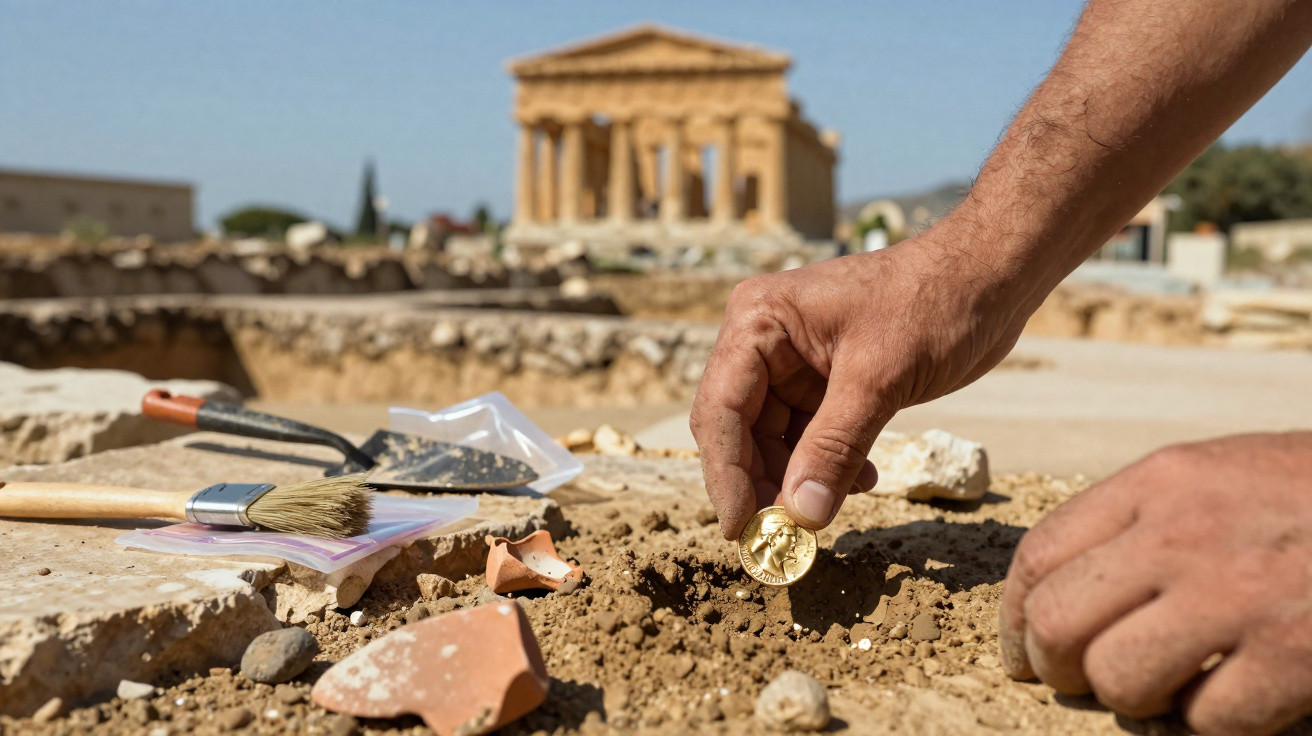
A small gold coin lay concealed for around 2,400 years in an ancient burial ground in Sicily. Unearthed in the Maddalusa necropolis near Agrigento, the object was struck in Syracuse during a war with Carthage and dates precisely to the final decades before Agrigento was destroyed in 406 BC.
Where was the gold coin discovered?
The find was made during an emergency excavation undertaken by the Agrigento Superintendency among the coastal dunes west of the mouth of the River Akragas. The coin was recovered from a cappuccina-type grave, a Greek burial constructed using large roof tiles and used in the area during antiquity.
This location forms part of the Maddalusa necropolis, a vast funerary area connected with ancient Agrigento. Extending for kilometres along the coast, the cemetery was in use from the city’s earliest Greek period in the 6th century BC until the closing decades of the 5th century BC.
What is engraved on this rare coin?
The coin bears imagery associated with Syracuse’s gold issues. One side depicts the head of Heracles wearing the skin of the Nemean Lion, an allusion to the first of the hero’s celebrated labours. The other side shows an incuse square divided into four sections, with a small female head at its centre.
- Heracles’ head faces left and is covered by the skin of the Nemean Lion.
- The reverse features a square split into four sections around a small central female figure.
- The inscription “Syra” identifies the issue as belonging to the city of Syracuse.
- Its outstanding preservation enables researchers to examine a gold issue regarded as rare.
According to details released by the Italian press and the archaeological team, coins of this kind were made during the Carthaginian invasion of Sicily. Rather than being merely a precious item, the piece retains evidence of an era in which money, warfare and political survival were closely intertwined.
Why did Syracuse mint gold during the war?
In the late 5th century BC, Greek cities in Sicily were confronted by Carthage’s advance. Syracuse and Agrigento both took part in this resistance, while gold issues helped to meet military costs at a time when troops, alliances and supplies required swift, dependable funding.
The Maddalusa coin belongs directly to this climate of conflict. It demonstrates how a small object can preserve traces of political choices made in response to an immense threat. Not long afterwards, in 406 BC, Agrigento was taken and devastated by Carthaginian forces following a prolonged siege.
What does the Maddalusa necropolis reveal beyond the coin?
Studied since the 19th century, Maddalusa preserves evidence of varied funerary traditions. Archaeologists have identified marble and calcarenite sarcophagi, stone-lined graves, cremations, tile-covered tombs and even child burials placed inside ceramic containers.
Much of this material helps reconstruct everyday life in ancient Agrigento, and some discoveries are associated with the collection of the Pietro Griffo Regional Archaeological Museum. Each burial contributes evidence about religious practices, social distinctions and the changes experienced by the community across generations.
How can a coin preserve the final years of a city?
The archaeological importance of this object lies in its combination of rarity, condition and context. It did not emerge as an isolated item from a collection, but from a necropolis active during one of the most turbulent periods in Agrigento’s history, when Greek cities and Carthage were competing for control of Sicily.
That is why a coin smaller than a palm can contain such a vast story. Before Agrigento fell, someone carried that piece to a tomb, where it remained for more than two millennia. Its discovery now provides a fresh opportunity to examine closely the final years of a Greek power threatened by war.






Comments
No comments yet. Be the first to comment!
Leave a Comment