
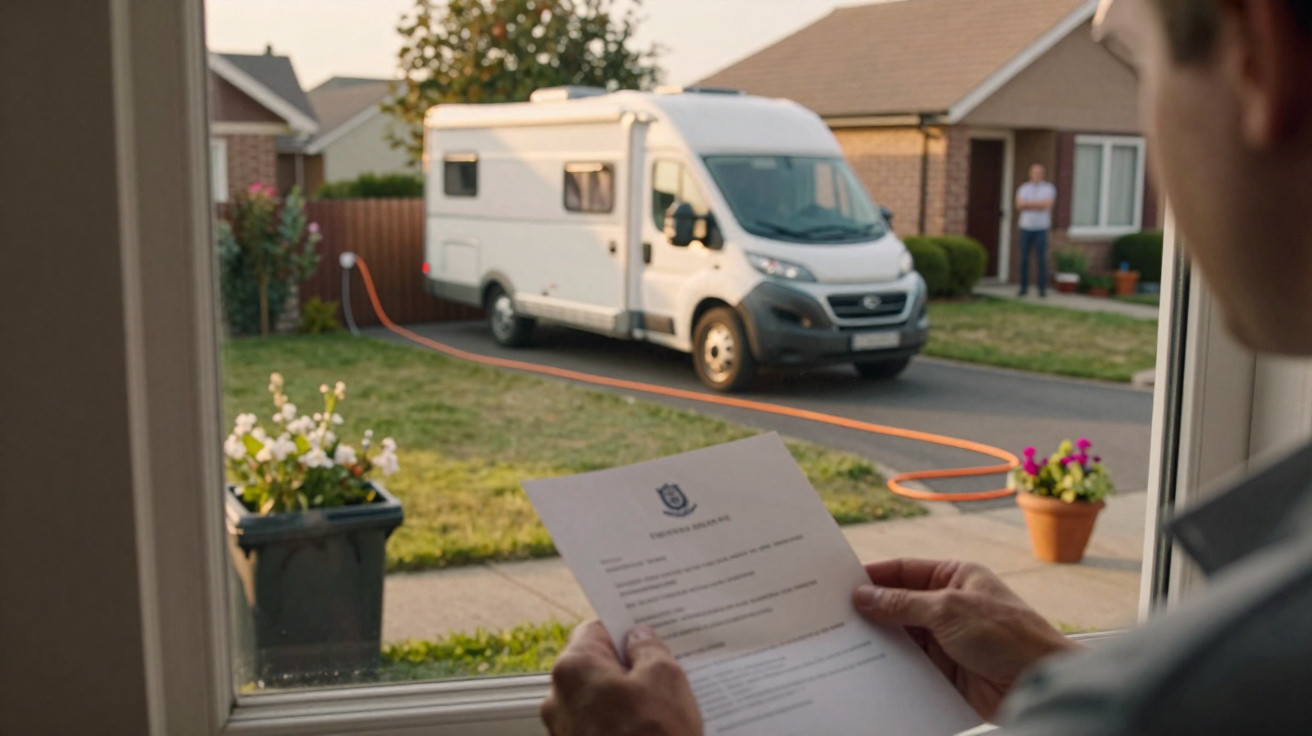
One Saturday morning, Bruno ran a 30-metre orange extension lead from a socket in his garage to his motorhome parked outside the house. He simply wanted to charge the battery, run a small portable heater and get the vehicle ready for a weekend away. From his window, the neighbour watched the cable run alongside the gate, skim the shared driveway and pass close to a pedestrian area. Concerned about safety and what he regarded as an obstructive use of the space, he quickly contacted the local council. It was an ordinary, almost domestic situation, yet one that can soon take an unexpected turn.
An extension lead in the driveway disrupts neighbourhood peace
At first, Bruno's arrangement looked unremarkable: a cable, a socket and a motorhome. In many housing developments, however, this sort of detail soon draws attention, particularly when an extension lead remains outside for several hours or crosses an area visible from the street. We all know the moment when a neighbour spots something unusual and wonders whether it is going to become permanent. Bruno believed he was simply helping his own vehicle; his neighbour saw a hazard for pedestrians, children on bicycles and even cars entering the cul-de-sac. Tension grew between the two men without either of them saying a word.
What prompted the neighbour's response was not really the motorhome, but the cable's route. A 30-metre extension lead may be useful, especially when the vehicle cannot be parked directly outside the garage, but it becomes more troublesome when it crosses a pavement, shared access route or runs beneath a gate. In some local authority areas, council services regularly receive reports about cables, hoses and objects left in circulation spaces. The risk of tripping is often the first concern raised, even before neighbourly issues are considered. A pedestrian who falls can turn a routine arrangement into an expensive dispute.
The electrical aspect also deserves attention: it is less obvious, but no less real. A standard extension lead is not always intended to supply a motorhome for a prolonged period, particularly when several appliances are operating inside: a battery charger, fridge, heater, kettle or air-conditioning unit, depending on the season. The longer the cable, the more likely it is to heat up if its conductor size is unsuitable for the power being drawn. A cable left coiled on its reel can quietly become a small thermal trap. Let us be honest: hardly anyone checks this every day, until the plug blackens or the circuit breaker trips.
What Bruno could have done before connecting his motorhome
The first safeguard is to check exactly where the extension lead runs. If it stays completely within private land, is shielded from damp and kept away from wheels and walking areas, the circumstances are already very different. Bruno could have had a dedicated outdoor socket installed nearer to where he parks, or used a cable designed for outdoor use with a suitable ingress-protection rating. The connection should also be protected by a residual current device, which cuts off the power if a fault occurs. It may not sound glamorous, but it is the kind of detail that prevents unpleasant surprises on a Sunday evening.
A common mistake is to assume that a sturdy extension lead is sufficient because it “has always worked”. Many householders use whatever equipment they have available, with no bad intention and without appreciating the difference between charging a drill for twenty minutes and powering a vehicle overnight. Bruno's neighbour might have rung his doorbell first instead of reporting the installation straight away. Yet Bruno would also have benefited from giving notice: “I am leaving the cable in place until tomorrow morning, and I will secure it.” In a neighbourhood, a few straightforward words can sometimes achieve more than a case file sent to the local council.
Before leaving a motorhome connected, it is better to follow some very practical habits, particularly if the vehicle will remain stationary for several days. A temporary arrangement may be useful in an emergency, but it should not become an improvised permanent solution.
“An extension lead is intended to connect an appliance temporarily; it does not replace a fixed electrical supply designed and protected for that purpose.”
- Select an outdoor cable with a conductor size suited to the power being used.
- Fully unwind the cable when an appliance will draw power for a long time.
- Do not route it across a pavement, shared entrance or carriageway.
- Shield connections from rain and splashing water.
- Ask a professional to inspect an outdoor socket if there is any uncertainty.
The neighbour's report is about more than just a cable
When a neighbour reports an extension lead, they are not necessarily trying to cause trouble. They may fear an accident, worry that the arrangement will become more frequent over time, or have already experienced inconvenience linked to motorhomes being parked in the street. The response may seem excessive to the person involved, since Bruno saw only a temporary connection. His neighbour, by contrast, saw a cable on the ground outside his home that anyone could potentially reach. Both views can exist at once, even when they clash. Neighbourly dialogue is often the best safeguard against escalation.
If the cable encroaches on public land or obstructs movement, the local council can be alerted and may require it to be removed. In a block with shared ownership or on a shared private road, the house rules, property manager or residents' association may also become involved. The issue is therefore not confined to the motorhome's electricity use: it concerns how communal spaces are used and the responsibility borne by everyone. Bruno might be asked to alter his arrangement without necessarily receiving an immediate penalty. It all depends on the length of time involved, the location, the danger identified and the local rules that apply.
This episode shows that small installations visible from the street can have an unexpected social impact. An extension lead laid out for one night may be viewed as a tolerable exception; the same lead left out every week can become a talking point and then a source of conflict. The wisest option is to arrange a fixed connection if the need is recurring, or to use a properly equipped site to prepare the vehicle. Motorhome owners know this well: self-sufficiency is appealing, but returning home quickly brings them back to the very ordinary constraints of the electrical socket, the gate and the neighbour opposite.
| Key point | Detail | Benefit for the reader |
|---|---|---|
| Extension lead route | A cable crossing a pavement, shared entrance or pedestrian area can obstruct users and increase the risk of a trip. | Makes it possible to identify immediately whether the temporary connection needs moving or removing. |
| Electrical equipment | An outdoor cable that is fully unwound, protected from water and correctly sized for the motorhome's appliances reduces overheating risks. | Helps prevent tripped circuits, damaged plugs and commonly underestimated electrical incidents. |
| Relationship with neighbours | Giving notice, explaining how long the connection will remain in place and avoiding encroachment on shared spaces reduces misunderstandings. | Encourages a straightforward solution before a report to the local council or property manager makes the matter more difficult. |






Comments
No comments yet. Be the first to comment!
Leave a Comment