
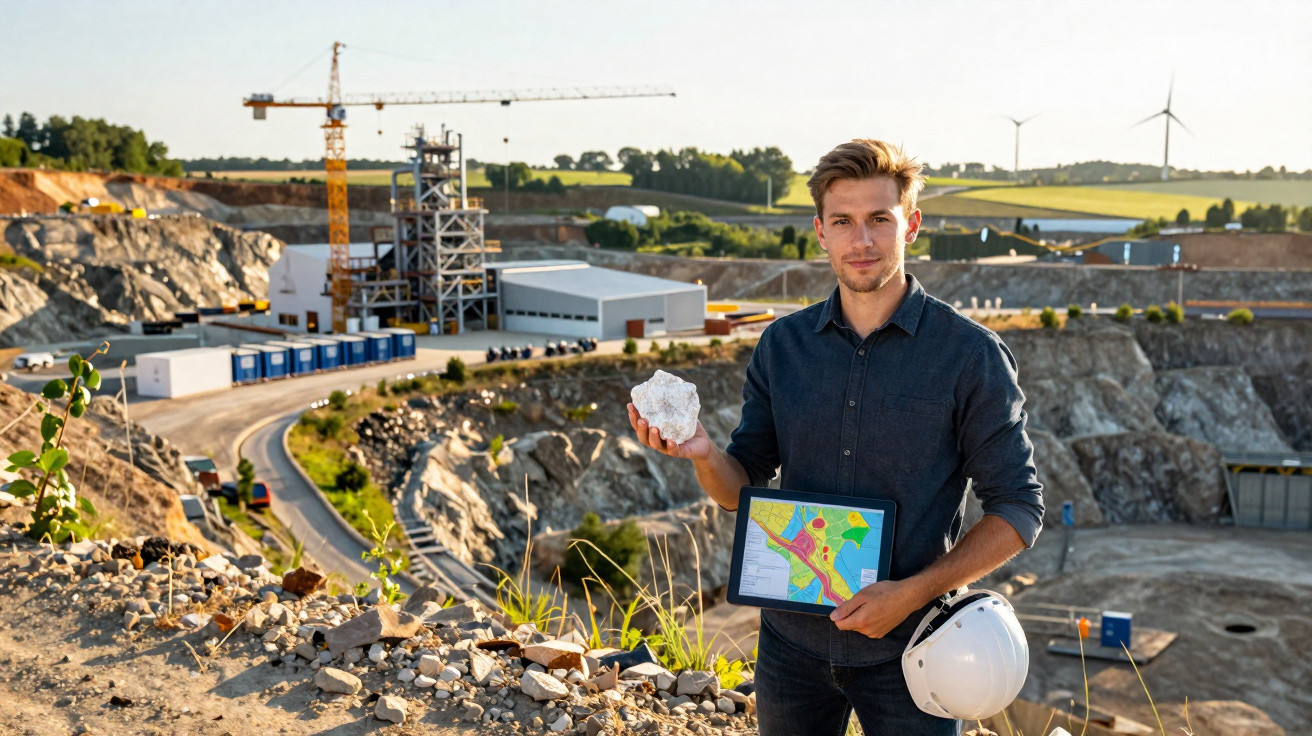
In Échassières, in the Allier department, roads winding through woodland and former mining sites hardly seem, at first glance, like the setting for an industrial revolution. Yet beneath the unassuming ground of the Ambazac hills, a project worth almost €1 billion is taking shape: Imerys’ Beauvoir lithium operation, scheduled to begin operating in 2028. In local cafés, it comes up between conversations about construction work, jobs for young people and fuel prices. There is hope, but also mistrust. This white metal, now essential for batteries, could put France back on a map it had nearly left. It is a story of rock, factories and sovereignty. Far from ordinary.
In Échassières, lithium could revive a forgotten mining area
The Beauvoir deposit is not an unexpected discovery: the area has long been known for its kaolin and rare mineral resources. What has changed is the strategic importance of lithium, the small metal that has become vital to phones, electric cars and energy storage. By 2028, the site could produce lithium hydroxide for batteries, a first on this scale in France. France’s underground resources are suddenly becoming very tangible again.
Imerys plans to invest around €1 billion in its EMILI project, short for “Exploitation of Lithium-Bearing Mica by Imerys”. Its stated ambition is considerable: eventually producing around 34,000 tonnes of lithium hydroxide each year, enough to equip the equivalent of several hundred thousand electric vehicles. The group refers to an operating lifespan of at least twenty-five years and the creation of several hundred direct and indirect jobs. For a village with fewer than a thousand residents, that figure is staggering.
However, it is important to use the right terms: the €1 billion does not represent the raw value of a deposit sitting in the ground. Above all, it refers to the industrial investment needed to extract, process and deliver lithium to battery manufacturers. Underground mines, ore processing, water management, energy and logistics routes all come at a high cost. The promise is therefore not one of easy treasure, but of rebuilding a supply chain, piece by piece, within France.
The Beauvoir lithium challenge goes beyond what lies underground
For local residents, elected representatives and businesses, the right approach is to monitor the project through clear, specific questions. Which jobs will genuinely be available to people living nearby? What share of processing will take place in France? How will water, dust and transport be monitored? A modern mining project can no longer rely simply on an impressive announcement or reassuring brochure. Public meetings, environmental investigations and monitoring data must remain accessible, even when the documents become technical.
A common mistake would be to assume that French lithium will immediately make French electric cars completely independent of foreign supply. The reality is less dramatic, but more helpful to understand: France will remain connected to global supply chains for many materials and components. Let us be honest: nobody really compares the origin of every metal hidden inside a battery every day. Nevertheless, having domestic lithium production could lessen a major vulnerability, especially in a market where geopolitical tensions are quickly felt by factories.
The EMILI project is also a full-scale test of whether mining can gain social acceptance in the 21st century. Local residents do not all want the same things, but many are seeking verifiable guarantees, clear information and certainty that the benefits will not all be carried far beyond the hills of Allier.
“The energy transition must not simply shift our dependencies: it must compel us to better understand what we extract, what we consume and what we leave behind.”
- Target production: around 34,000 tonnes of lithium hydroxide per year.
- Announced timetable: industrial production is planned to begin in 2028.
- Local issue: jobs, training, water, landscapes and lorry traffic.
- National issue: supplying part of France’s future battery supply chain.
€1 billion and a question that extends far beyond Allier
Beauvoir lithium tells a distinctly French story: the country wants lower-emission cars, battery factories and an industry capable of standing firm against major global markets, yet it is rediscovering that this ambition begins in quarries, tunnels and inhabited landscapes. The Échassières project will not instantly remove Europe’s dependencies. It can, however, provide a practical piece of an industrial puzzle that has remained incomplete for too long.
Its real success will not be measured solely by tonnage extracted or billions committed. It will depend on the quality of the jobs created, the ability to reduce impacts, transparency for local people and the genuine processing of ore on French soil. A mine can become a symbol of industrial renewal, or leave a lasting scar if it moves ahead without listening. Between those two paths lie very grounded decisions: water to protect, young people to train and commitments to honour.
| Key point | Detail | Value for the reader |
|---|---|---|
| The EMILI project | Imerys plans to extract lithium at the Beauvoir site in Échassières, with start-up planned for 2028. | Understand why Allier is becoming a strategic area for batteries. |
| An investment approaching €1 billion | This amount funds extraction, industrial processing, infrastructure and environmental measures. | Avoid confusing the presumed value of underground resources with the actual cost of a mining supply chain. |
| Production intended for batteries | The site is targeting lithium hydroxide, a material sought by electric vehicle manufacturers. | Assess the project’s practical importance for French and European industry. |




Comments
No comments yet. Be the first to comment!
Leave a Comment