
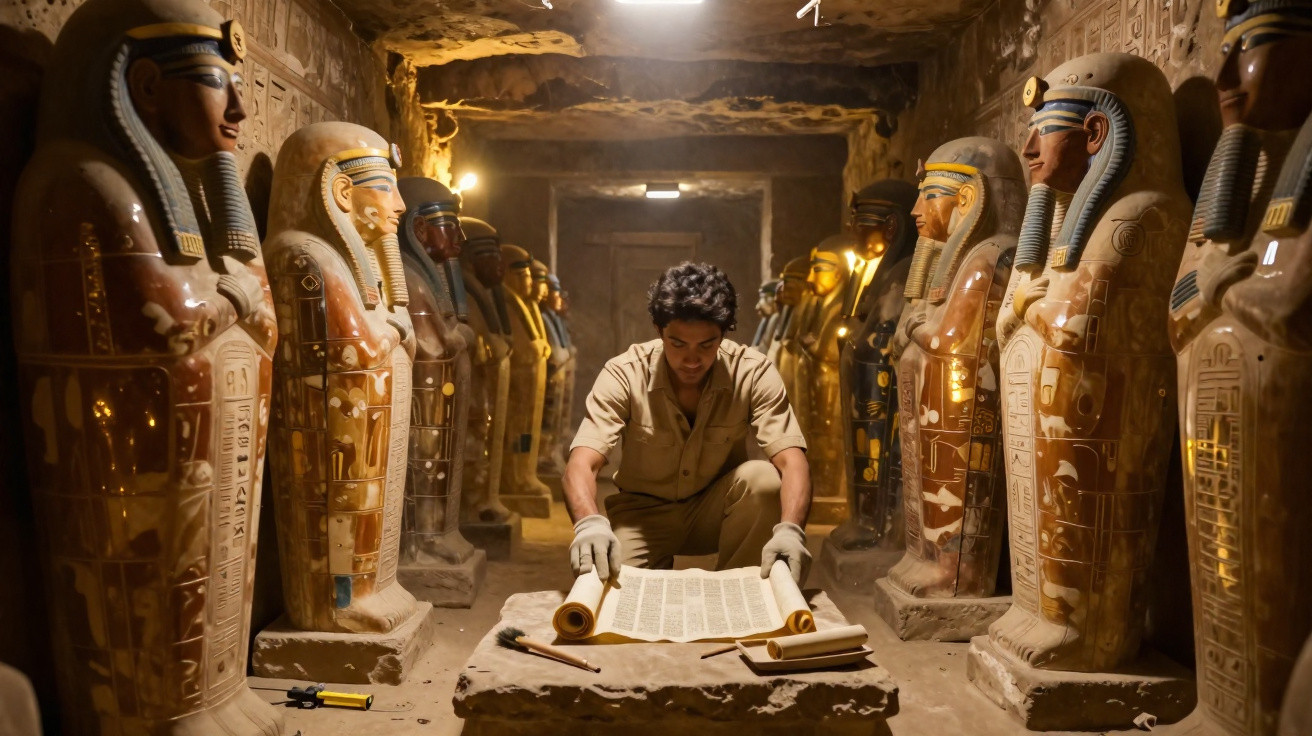
A large ceramic vessel concealed the most mysterious items in an already remarkable discovery at Luxor: eight papyri, some of which remain sealed with ancient clay stamps. Around the vessel, archaeologists uncovered 22 painted sarcophagi containing mummies, many associated with the so-called Singers of Amun, gathered inside a cramped rock-cut burial chamber.
What was found inside the Luxor chamber?
The find was made during excavations at the Tomb of Seneb, in the Qurna area on Luxor’s west bank. Egypt’s Ministry of Tourism and Antiquities stated that the assemblage dates to the Third Intermediate Period, spanning the 21st to 25th Dynasties, and includes painted wooden sarcophagi that still hold mummies.
The mission brings together the Supreme Council of Antiquities and the Zahi Hawass Foundation for Archaeology and Heritage. Archaeologist and former minister Zahi Hawass, who heads the work, described the discovery as “exceptional”, particularly because so many objects were preserved within such a confined space.
Who were the Singers of Amun?
The inscriptions themselves present one of the main difficulties. Many sarcophagi do not retain the deceased person’s name, instead bearing religious or occupational titles. Among the titles repeatedly recorded is Singer of Amun, a role linked to women who carried out religious duties connected with the worship of the powerful god Amun.
Hisham El-Leithy, secretary-general of the Supreme Council of Antiquities, said specialists are working to establish the identities of those buried there. The mummies may yield further information once examined, although no official details on the individuals’ ages, identities or biological characteristics have yet been released.
How did 22 sarcophagi fit into such a small chamber?
Cut directly into the rock, the rectangular chamber appears to have served as a funerary storehouse. Rather than keeping each sarcophagus assembled, those who used the space separated lids from coffin boxes and arranged the components at different levels, creating 10 horizontal rows to make use of every available area.
- Archaeologists identified 22 painted wooden sarcophagi containing mummies.
- The coffin components were arranged across 10 horizontal rows.
- Ceramic vessels were found among the funerary materials.
- Eight rare papyri were discovered inside a large container, with some still bearing clay seals.
Afifi Rahim, the excavation supervisor, explained that the team is still searching for the original tombs from which these coffins may have been moved. This indicates that the chamber may represent a later stage in the burial history, created when the objects were rearranged for reasons that remain unknown.
Watch the video shared by the YouTube channel Knowledge of Humanity, which explores Luxor’s temples.
Why are the eight papyri attracting so much interest?
The manuscripts are the most puzzling part of the find, as they have not yet been restored or fully translated. So far, no official information has identified their authors, owners or subjects. Several examples retain clay seals, a feature that heightens expectations surrounding texts that may have remained virtually untouched since Antiquity.
Other vessels recovered from the chamber may have contained substances used during mummification, but that interpretation still requires analysis. The official announcement provides no laboratory tests confirming what these containers held, so archaeologists are proceeding cautiously as they document and study every element of the deposit.
What might the Luxor discovery still reveal?
Because of the materials’ fragility, conservation became an immediate priority. Deteriorated wood and painted plaster had to be stabilised before the objects could be removed, while every item was photographed and documented in its original position. Minister Sherif Fathy said that scientific studies and conservation work will continue before the collection is eventually displayed.
For now, Luxor’s greatest secret remains literally sealed. Archaeologists already know the number of sarcophagi, the chamber’s arrangement and several religious titles, but the papyri have yet to reveal their answers. Following their restoration will be essential, since a few lines preserved inside a vessel could alter what is known about the people who lived, died and were buried there.




Comments
No comments yet. Be the first to comment!
Leave a Comment