
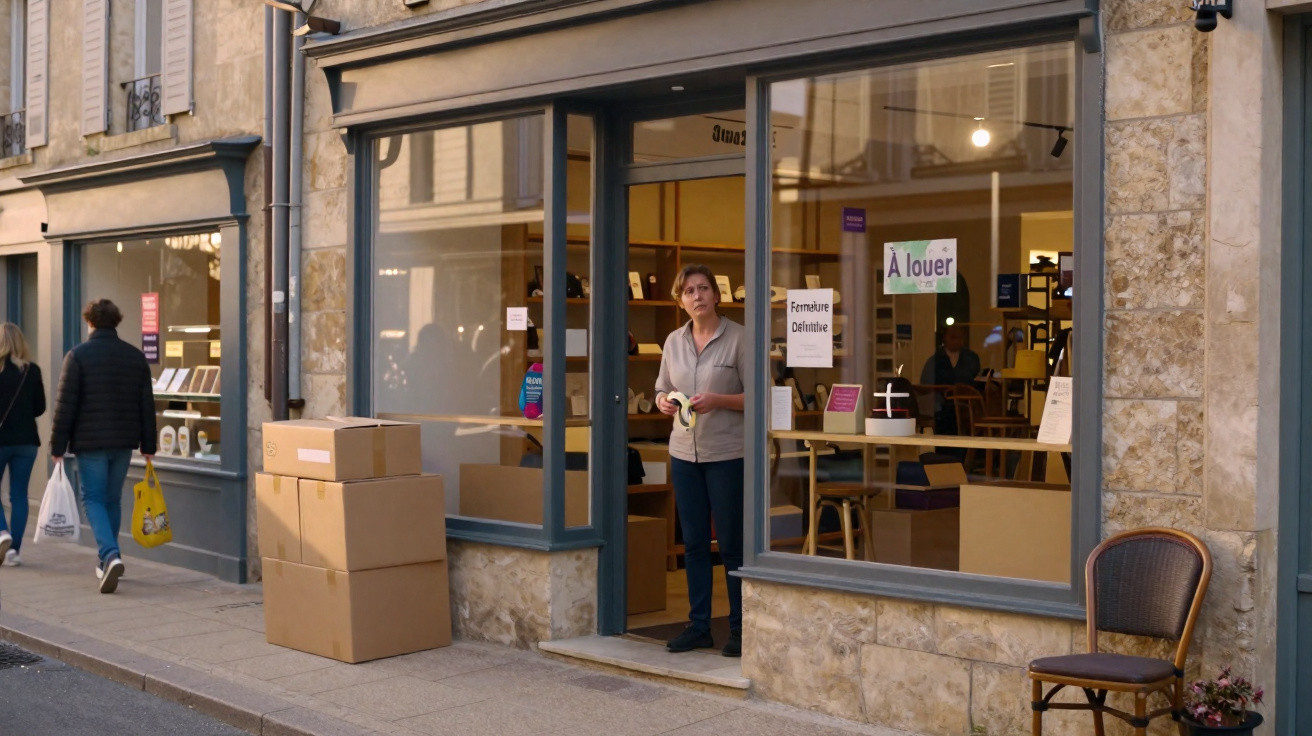
On a Saturday morning, the car park outside an out-of-town store fills up more slowly than it once did. Inside, staff still arrange the shelves with the same care and shoppers continue to compare prices, yet one question keeps coming up: “Will they stay here much longer?” For several months, long-established retail chains have been reshaping their networks, shutting some outlets or converting stores to franchises. From town centres to retail parks, this shift is quietly changing everyday routines. It is not simply a shopfront vanishing: it can mean longer journeys, insecure jobs and a neighbourhood losing some of its liveliness. The trend mainly affects stores considered too expensive to run or less profitable. Some towns are already under scrutiny.
Store closures are never merely an accounting decision
We all know the feeling of hearing that a familiar retailer is leaving a street we know well. At first, we assume we will order online, before remembering how useful that shop was: for an emergency purchase, a last-minute gift, shoes that needed trying on, or a few forgotten groceries. Retail groups are now looking to reduce their costs, especially in areas where rent, energy bills and payroll weigh heavily. Small urban outlets and some ageing hypermarkets are often among the first affected. Behind phrases such as “network optimisation” or “reorganisation” lies a far more tangible prospect: metal shutters that may stay down for good.
Auchan has already demonstrated this trend, announcing a wide-ranging restructuring plan at the end of 2024 that included job cuts and the closure of loss-making stores. Depending on the formats involved and developments at individual sites, towns including Clermont-Ferrand, Woippy and Épinay-sur-Seine, along with some municipalities in the Paris metropolitan area, have been mentioned in local discussions. The group has also stepped up its use of franchising in several areas. This approach may keep a shop open, but it substantially changes how it operates. Customers may retain their local store, whereas employees do not always keep the same protections. France’s retail map is shifting.
The issue extends well beyond food retail. In clothing, furniture, DIY and discount retail, chains are seeking to focus their resources on outlets that genuinely draw customers. Medium-sized towns are especially vulnerable where several retail parks compete within a few kilometres of one another. In Limoges, Béziers, Saint-Étienne, Mulhouse, Amiens and Perpignan, local elected representatives often closely monitor the future of large retail units, although closure is not automatically confirmed. Caution is still needed: a town named in a rumour is not necessarily a town facing closure. Even so, the warning signs are growing, from leases that are not renewed to thinner stock levels and shorter opening hours.
Towns to watch and warning signs for shoppers
For local residents, the first step should be to check information at its source. A notice at the entrance, a message on the retailer’s website, a statement from the local council or a report in the local press is more reliable than a social-media post shared hundreds of times. Announced closures may be temporary, caused by refurbishment, a change of owner or a conversion to a franchise. The date also matters: a list circulated in 2026 may refer to a decision made two years earlier. Let us be honest: hardly anyone checks this every day. Nevertheless, a few minutes spent verifying the facts can prevent a great deal of unnecessary worry.
Consumers should also plan ahead when a local shop appears vulnerable. For a significant purchase, it is sensible to keep the receipt, check the warranty terms and make a note of the customer service contact details. This becomes particularly important if the chain closes suddenly or the outlet is taken over by another company. A common mistake is to assume that a gift card or store credit will remain valid everywhere without reading the terms and conditions. That is not always true. When a shop disappears, there is rarely time to prepare calmly. For older people or those without a car, the consequences are even more immediate: the nearest store may not have a realistic replacement.
The towns most at risk are not necessarily the smallest ones. A major urban area can lose a store when two sites compete with each other or a shopping centre is ageing badly. Before any official announcement, residents may notice several signs:
“A closure is never just a shutter coming down: it often means an extra journey imposed on an entire part of the neighbourhood.”
- shelves that remain less well stocked, or unusual clearance promotions;
- reduced opening hours, particularly during the week;
- building works announced without a clear reopening date;
- the gradual departure of other nearby businesses;
- local communications referring to a takeover, franchise arrangement or sale.
When a store leaves, the whole neighbourhood has to adapt
In Paris, Lyon, Marseille, Lille, Toulouse, Bordeaux and Nantes, closures can sometimes be absorbed by the density of local retail. Another chain may be only a few streets away, alongside a market, delivery service or underground route to a better-equipped area. In medium-sized towns and suburban municipalities, the effect can be sharper. A former hypermarket, clothing shop or homeware retailer also brings customers to the nearby bakery, pharmacy or café. When that anchor closes, footfall falls around it. Neighbouring businesses are often the first to absorb the impact.
Local councils sometimes try to turn these departures into opportunities: bringing in an independent shop, creating a health centre, opening a gym, or splitting one large empty unit into several smaller premises. Such schemes require time, funding and a dependable new operator. In the meantime, an empty frontage can become the symbol of a struggling shopping centre. Residents of Saint-Étienne, Roubaix, Calais, Châteauroux and Carcassonne know this waiting period well, even though every case has different causes. It would be too simplistic to blame online retail alone. Prices, car access, parking and the condition of buildings also influence the outcome.
The shrinking presence of major retail chains ultimately reflects a broader change in our habits. We want low prices, fast deliveries, nearby shops and lively town centres: these are legitimate expectations, but they can sometimes be difficult to reconcile. Towns already affected, or potentially affected, will need to devise more than a simple logo replacement on a shopfront. A closed store can become derelict space. It can also become a useful place: smaller, more local and better suited to its neighbourhood. The real question is not only which retailer will leave tomorrow, but what residents want to see return in its place.
| Key point | Detail | Value for the reader |
|---|---|---|
| Retail chains undergoing reorganisation | Closures, franchises and sales affect several retail sectors. | Better understand why a store can disappear without apparent warning. |
| Towns to watch | Large urban areas and medium-sized towns can both be affected, depending on site profitability. | Avoid confusing a local rumour with an officially confirmed closure. |
| Sensible steps | Check announcements, retain proof of purchase and monitor gift-card terms. | Protect purchases and prepare for a change to a local store. |






Comments
No comments yet. Be the first to comment!
Leave a Comment