
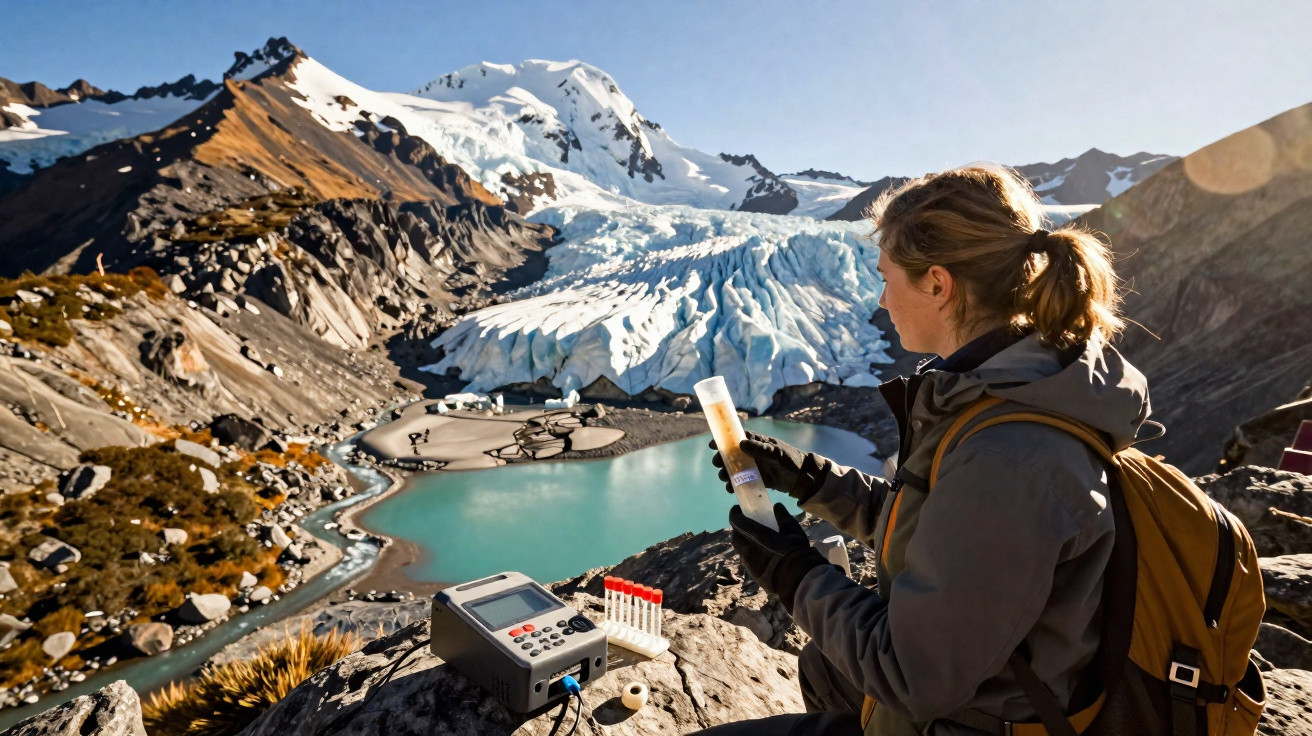
Around one in four people worldwide relies on freshwater originating in glacial areas, which cover 10 percent of Earth’s surface.
Yet this vital resource is under severe pressure, and fresh research illustrates the speed at which these frozen environments are now set to transform.
Tropical glaciers are retreating faster than forecast
An international group of scientists has found that tropical glaciers are melting more quickly than predicted, shrinking to dimensions that researchers did not expect to observe for years.
"This shocked us, frankly," University of California, Berkeley paleoclimatologist Andrew Gorin told New Scientist. "I think this is clear evidence that at least one region in the world has now departed the hospitable climatic conditions that have fostered the development of human civilization."
Gorin adds, "We're quickly blowing past climate milestones that we thought were decades away."
His team identified an unexpectedly small amount of beryllium-10 and carbon-14 isotopes in minerals along the edges of glaciers in the Andes. This indicates that these rocks were last exposed to the Sun’s warmth at least 11,700 years ago.
That finding suggests that some areas of the mountain range have not experienced glaciation at such a low level since before the Holocene, the era that represented a major shift in the course of human civilisation.
Glaciers store winter snowfall and release it as they melt in summer, supplying water to billions of people. As they recede, however, the amount of freshwater available downstream declines.
The Andes are already facing record-breaking droughts and water scarcity as a result, alongside deadly floods when meltwater pools burst through ice that previously contained them.
Glacier loss threatens water supplies worldwide
The Andes are not alone: earlier research has documented accelerating glacier melt from the Himalayas to Alaska.
"Glaciers are very sensitive to the climate system that they live in," explains University of Wisconsin–Madison geoscientist Shaun Marcott. "They really are the place you would look to see some of the first big changes resulting from a warming climate. You can look to these glaciers and imagine what we might be looking at going into the future in other places like the Western United States, which is a no-ice scenario."
Falling meltwater supplies from retreating glaciers, combined with saltwater intrusion caused by rising seas, will severely reduce the flows of major rivers including the Magdalena and Ganges. UN Secretary-General António Guterres warned in a statement last year that this could force whole populations to move in search of water.
"In Asia, for example, 10 major rivers originate in the Himalaya region, supplying freshwater to 1.3 billion people living in its watershed," explained Guterres.
A separate recent study, conducted by another research team, has shown how dramatically local environments can alter once their ice cover disappears.
New ecosystems emerge as ice retreats
A research group led by Monash University glaciologist Levan Tielidze examined factors including soil characteristics, microclimates and biodiversity identified through environmental DNA. They found that when ice recedes, new life rapidly arrives to take the place of what was there before.
The effects of losing established species and creating new ecological interactions remain uncertain. Since this pattern is likely to spread from the tropics across the world as the planet warms, more needs to be understood about how environmental change affects nearby ecosystems.
"Across the globe, from the Alps to the Arctic, glaciers are shrinking, leaving increasingly larger areas exposed both in mountainous regions and around polar ice caps," says Tielidze.
"The retreat of glaciers is one of the most evident signs of climate change."
These studies were published in Science and Nature.



Comments
No comments yet. Be the first to comment!
Leave a Comment