
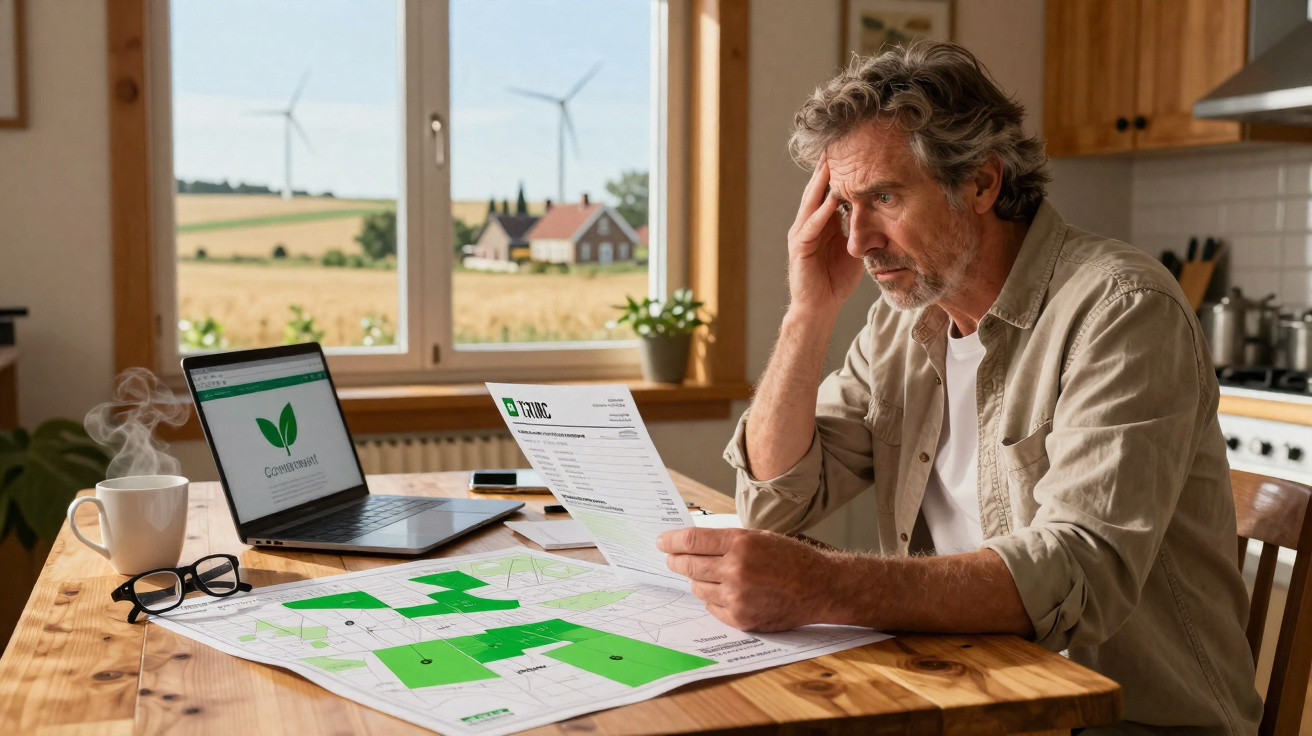
On a grey Tuesday in Lower Saxony, the letter appeared no different from any other sent by the local tax office. It was printed on thin paper and tucked into a long window envelope, with that faintly coarse feel you can almost sense before opening it. Helga, 63, opened it in her kitchen while potatoes steamed on the hob and her dog barked to be let outside. She anticipated the usual minor adjustment - perhaps a few euros extra, but nothing alarming.
Then she saw the figure at the foot of the page, and could scarcely breathe: her property tax was set to rise to almost triple its previous level.
The cause was a “green” reclassification of the narrow meadow strip behind her home: land she had never cultivated, requested or wanted.
Somewhere between climate targets and administrative reasoning, rural Germany has found itself balancing on an extremely fragile tightrope.
When a green tax affects people who have never farmed
Throughout rural Germany, thousands of homeowners are finding that the new eco-tax approach no longer regards their back gardens simply as gardens. Unused parcels, ageing orchards and grassy strips on the village edge are now, in some cases, categorised as productive agricultural land. The tax rate changes, and the bill increases.
For many older people, the distress is not solely about the sum demanded. It is also the sense that they have been quietly assigned a new identity. One year, they are retired teachers with generous gardens; the next, the state’s computer system has effectively labelled them landowners expected to shoulder the same tax burden as farmers.
The climate-related label may make the wording sound gentler. It does nothing to reduce the monthly payment.
In the small Bavarian village of Riedenburg, for instance, council meetings have unexpectedly become tense. Several homeowners have arrived holding their tax assessments, with yellow highlighter marking the new agricultural-land classification.
One man in his seventies spoke angrily. He had inherited a thin strip behind his house, used mainly by local children as a shortcut to the bus stop. He had never cut it regularly and had never planted a single seed. Nevertheless, the environmentally driven reassessment system classified it as agricultural land, placing it in a higher tax band.
His experience is far from unique. Municipalities report a surge in appeals, largely from residents who say: “We are not farmers. We never wanted to be.”
On paper, the thinking behind the reform is uncomplicated. Germany wants to shift tax pressure towards land that might, at least in theory, generate value or provide ecological benefits. Previously idle land has suddenly acquired importance: it can be taxed, encouraged and directed.
From Berlin’s standpoint, applying the same treatment to every potentially productive plot encourages owners either to make better use of land, lease it or sell it to someone who will. In policy documents and spreadsheets, the approach can appear sensible, even elegant.
At ground level, however, matters are more complicated. Ownership records can be old, borders unclear and some plots reachable only through a neighbour’s garden or along a muddy farm track. Those receiving the demands are frequently the people least able, either financially or physically, to turn land that exists on paper into genuine production.
How rural landowners can act before the confusion takes hold
For people suddenly faced with these new eco-style assessments, the first response should not be a loud protest. It should be paperwork - quiet, dull and absolutely essential paperwork.
The key issue is the classification of the land itself, because that determines the rate. Homeowners may ask for the cadastral records to be reviewed, including mapped boundaries, past use, access routes and even soil quality. Requesting the local authority to review evidence of land use may sound technical, but it is often the only route to having the tax basis reconsidered.
One practical measure is spreading quickly through villages: neighbours sit together, place all their letters on the table and establish who else faces the same problem. It is easy to dismiss an individual complaint. A coordinated group of appeals has a very different impact.
In situations like this, shame can become an emotional trap. People may feel foolish for not understanding tax terminology, failing to read earlier notices or signing old inheritance documents without checking every boundary. We have all known that moment when official language makes us feel insignificant in our own homes.
This is where rural Germany begins organising quietly. Local associations, pensioners’ groups and even volunteer fire brigades can suddenly become informal legal advice points. They circulate templates for challenging classifications, identify supportive solicitors and clarify deadlines. The greatest error is to wait until frustration erupts, only to discover that the appeal deadline has passed without notice.
Let’s be honest: almost nobody reads every page sent by the tax office. Yet failing to open that envelope can now have a real financial cost.
In one Thuringian village, residents began inviting a retired surveyor to the community hall once a month. He arrives with old maps, a thick file of regulations and the measured voice of someone who has endured decades of bureaucracy.
“The system doesn’t hate you,” he told the room at one recent meeting, “but it doesn’t know you either. If you don’t speak up, the file speaks for you.”
They have written a set of practical actions on a whiteboard:
- Confirm whether the land genuinely has road access throughout the year.
- Collect evidence of non-agricultural use, including photographs of play areas, sheds and natural meadows.
- Ask the municipality whether local exemptions or hardship provisions are available.
- Join together to arrange a collective meeting with the tax office rather than making only individual visits.
- Keep records of every telephone call and letter, noting dates, names and short summaries.
None of this feels especially “green” or visionary. It feels like trying to survive the small print.
Between climate ambition and village reality, a new divide emerges
Germany is attempting to remake itself as a climate leader without damaging its social fabric. That is the official account. Yet these new eco-tax rules are landing as a political stress test in communities that already feel overlooked by Berlin.
For many rural homeowners, the message is painfully plain: quiet pieces of land that everyone ignored for years have abruptly become targets of policy. This is not because the owners have done anything differently, but because the state has changed how it categorises them.
Some people will adapt by leasing plots to nearby farmers or local nature initiatives. Others will sell, unwilling to continue paying for soil they rarely even visit. A determined group will contest the decisions, not only because of the money but because they refuse to be reduced to a line on a sustainability spreadsheet.
The question hanging over these communities is both simple and weighty: how green can a policy truly be if it brings vulnerable communities closer to breaking point?
| Key point | Detail | Value for the reader |
|---|---|---|
| Eco-tax reclassification | Unused rural plots are charged at agricultural-land tax rates | Helps you see why your property tax bill may have risen abruptly |
| Right to appeal | Owners may challenge cadastral records and land-use classifications | Provides a clear route for disputing unfair assessments |
| Local collective action | Villagers organise to exchange information and legal support | Shows that you are not alone and where practical support may be found |
Frequently asked questions
- Question 1: Can an unused garden or meadow genuinely be taxed in the same way as farmland?
- Question 2: Which documents should I collect if I intend to challenge the new rate?
- Question 3: Is any assistance available to pensioners or low-income homeowners affected by this change?
- Question 4: Can neighbours organise a joint appeal or a shared meeting with the tax office?
- Question 5: Could classification as agricultural land affect my ability to sell the land or build on it in future?






Comments
No comments yet. Be the first to comment!
Leave a Comment