
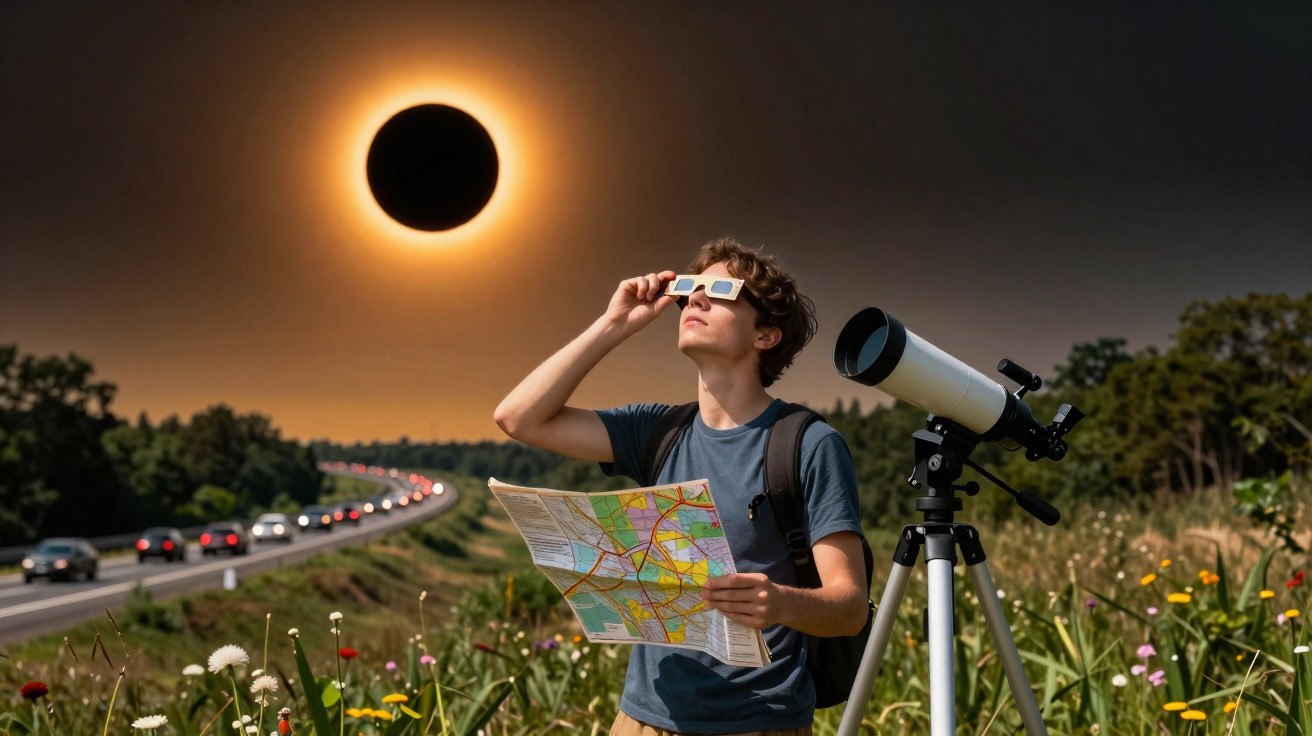
There is something profoundly unsettling about the moment when the Sun seems to be switched off. Anyone who has experienced an almost total solar eclipse knows that collective intake of breath. Birds fall silent, the temperature drops, and the world suddenly feels wrong in the middle of the day.
A whole society is now dividing around the “eclipse of the century”: six minutes of daylight darkness. Astronomy enthusiasts and adventurers are organising trips, while entire towns are preparing for an exceptional situation. Hospitals, transport operators and emergency services are all anticipating pressure, congestion and risks.
Somewhere between goosebumps and health warnings lies the decision about what this event will become for us.
A wonder.
Or a disaster.
When midday turns into midnight
Imagine it is just after noon, streets are busy, children are leaving school – then, in under a minute, it becomes as dark as twilight. Not because of a thunderstorm or power cut, but because the Sun itself simply vanishes. There is something brutal about this scheduled loss of control.
The forthcoming eclipse, offering more than six minutes of totality, is an astronomical jackpot. For many, it is the ultimate bucket-list experience. Others wonder whether traffic jams, travel disruption and eye hazards are truly worth it. A remarkably heated argument has emerged between “once in a lifetime” and “just stay at home”. And it reveals plenty about how we deal with risk today.
The 2017 eclipse in the United States already showed how wild such a day can become. Small towns beneath the path of totality turned into huge events overnight, petrol stations ran dry, and hotels were fully booked months ahead. Police described it as “traffic like ten holiday getaway weekends happening at once”.
For the forthcoming, even longer eclipse, authorities expect millions of travellers along the shadow path. Campsites on the line of totality? Sold out for months. “Eclipse road trip” routes are circulating on TikTok, while medical professionals warn that even a brief unprotected glance can cause irreversible retinal damage. We all know that pull: FOMO versus common sense.
Why is there such excitement over a few minutes of darkness? Psychologists describe it as a “collective exceptional moment”. Nature shows us how small we really are, while millions of people share the same sky, the same silence and the same shiver across the skin.
Astronomers are excited by an almost perfect alignment: the Moon covers the solar disc so precisely that the corona becomes visible – the ghostly ring of light otherwise lost in the glare. It is invaluable for research, measurements and images. For everyone else, it is an exceptionally rare, raw moment of wonder. The sober reality is that eclipses like this will happen again. But one this long, so well positioned and so easy to observe is far less likely.
Planning for a total solar eclipse
Anyone wanting to experience the spectacle needs a plan, not an impulse. First: location. The difference between 95 per cent coverage and full totality is like watching a cinema trailer instead of the film. Those who can should travel directly into the path of totality. Anyone who does not want to travel should check in advance how much of the Sun will be covered where they live. Interactive maps from astronomical societies can help.
Second: equipment. Certified eclipse glasses are essential. Not sunglasses, not darkened glass, and not a selfie with a camera pointed directly at the Sun. Children need clear rules: glasses on, look only with protection, and never look through binoculars or a camera directly. However dry that may sound, this is exactly where wonder can turn into an emergency.
The most common mistake on these days is also the most impulsive: “Just a quick look without glasses.” Our retinas have no pain receptors, so we do not notice the damage straight away. Hours later comes the unpleasant realisation – distorted vision, black spots and, in the worst cases, permanent damage. Doctors regularly report precisely these cases after eclipses.
There is also the opposite extreme: people who are so worried about chaos, crowds and dangers that they pull down the blinds and try to ignore the day. That is understandable, particularly for anyone with children, relatives requiring care or a fear of crowded places. Yet it would be a shame to voluntarily cut yourself off from one of nature’s rarest events. Between panic and recklessness lies a surprisingly straightforward middle ground.
“A total eclipse is like a live update on our own insignificance – and that is precisely what makes it so liberating,” says an astrophysicist who has chased eight eclipses around the world.
- Plan, do not panic: Deciding early whether to travel or stay local prevents stress on the day itself.
- Eyes first: Buy certified glasses (ISO 12312-2), rather than relying on questionable online offers at the last minute.
- Stay put or watch on the move? People with children are usually more relaxed when they choose a fixed, safe viewing location.
- Allow for traffic: Both journeys may take significantly longer – water, snacks and a power bank are not luxuries but stress reducers.
- Manage expectations: Clouds are part of reality. The moment can still feel special – sometimes especially because of the tension beforehand.
Ultimately, this eclipse touches on a much larger question: how much disorder are we willing to let into our lives when something genuinely extraordinary beckons? One side says: “No natural phenomenon is worth hours of traffic jams, overcrowded hotels and a risk to my children’s eyes.” The other says: “These minutes pull me out of a daily life that has become far too smooth and controlled.”
Perhaps both sides are more honest than they give each other credit for. The sober truth is that nobody spends hours travelling across half of Europe in a relaxed state, keeps children patiently wearing certified glasses and carefully documents everything for later. That is simply not how it happens in real life every day.
And yet there are rare days when we feel that, later, we will want to say: “I was there.” Whether that happens at your window, on a country lane beneath the path of totality or on the sofa watching a livestream, it is your story. These six minutes of darkness will be talked about either way. The only question is: from which perspective?
| Key Point | Detail | Added Value for the Reader |
|---|---|---|
| Choice of viewing location | Path of totality versus partial eclipse, travel and local conditions | Readers can realistically decide whether a trip is worthwhile or their own location is sufficient |
| Eye protection | Certified glasses, common mistakes and risks for children | Specific health risks are explained clearly, without causing panic |
| Managing chaos and expectations | Traffic, crowds, cloud risk and emotional preparation | Readers feel mentally prepared and can make more considered decisions |
FAQ
- Question 1: Is a total solar eclipse really more dangerous for the eyes than the normal Sun? The Sun is always dangerous to the retina, but an eclipse is more tempting to look at directly. That makes it effectively riskier because more people stare at the Sun without protection.
- Question 2: Are ordinary sunglasses sufficient protection? No. Sunglasses reduce brightness only, not harmful radiation. Only certified ISO 12312-2 eclipse glasses or specialist filters for equipment are safe.
- Question 3: Is travelling into the path of totality genuinely worth it? For anyone seeking the greatest “wow” moment, yes. The emotional difference between almost completely covered and fully covered is enormous. Those who hate travel chaos can still have a special experience from home with a partial eclipse.
- Question 4: How can I introduce children to the event safely? Practise beforehand by looking towards the Sun while wearing the glasses, set clear rules and always stay nearby. Children understand surprisingly well when it is explained as “superhero glasses for the Sun”.
- Question 5: What if it is cloudy in the end? The feeling of shared anticipation remains. The light, temperature and atmosphere will still change. And yes, disappointment is part of it – that is often what makes the stories we tell later more human.

Comments
No comments yet. Be the first to comment!
Leave a Comment