
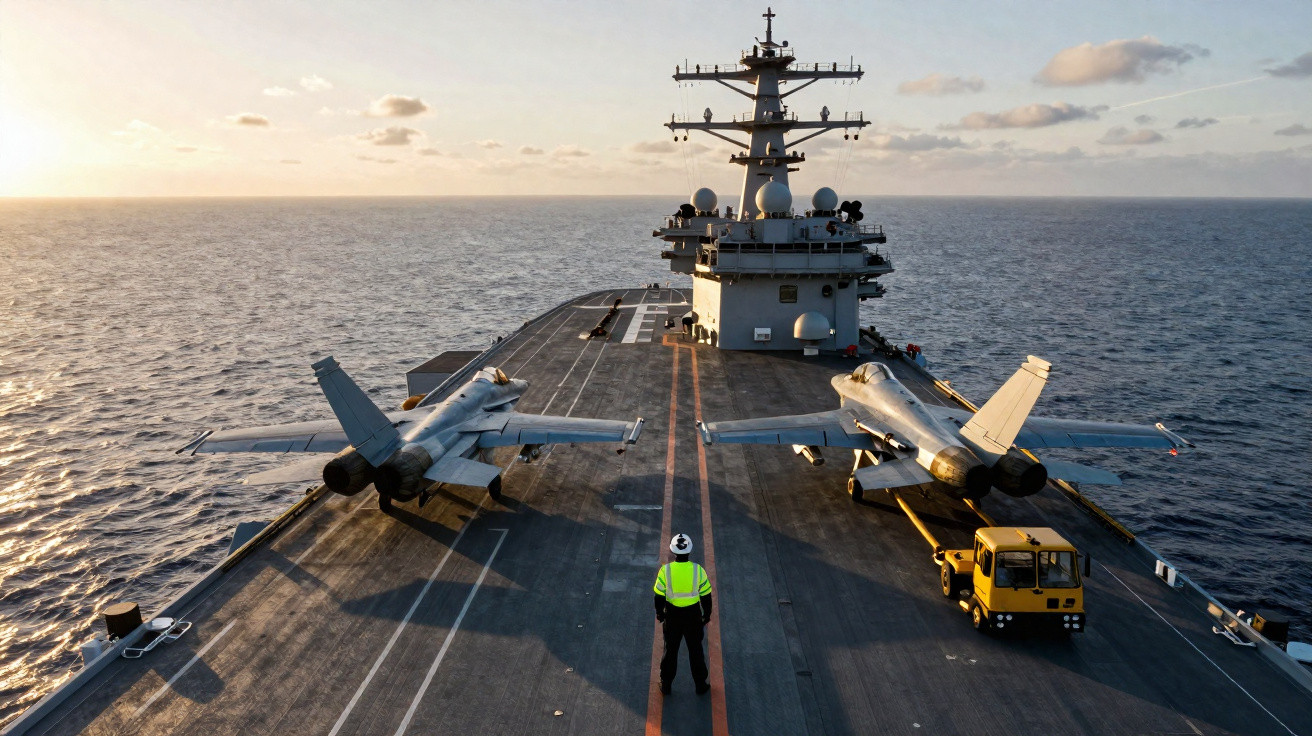
Metal hums beneath the boots: 337 metres of steel, engines and people. A young sailor pauses for a moment as a jet thunders overhead, shooting into the evening sky in a blinding flash. No phone photograph in the world can capture that instant: the roar of the turbines, the smell of kerosene, the quiet fear mixed with pride. Before him lies a floating piece of territory, larger than some villages – and heavier than an entire city.
The name of this giant sounds almost matter-of-fact: USS Gerald R. Ford. Yet behind it stands a colossus, 337 metres long and weighing around 100,000 tonnes, a steel monument that reshapes the balance of power at sea. Anyone who sees this ship senses immediately: this is not where states negotiate theory; this is where they negotiate presence. Without saying a word.
A steel giant as a floating display of power
For those seeing the Gerald R. Ford at close range for the first time, the reaction is often identical: they tip their head back for a second and swallow. Its scale defies everyday reference points. From bow to stern, it is longer than three football pitches placed end to end. Below deck are corridors that feel like a labyrinth of steel, where more than 4,500 people live, work, argue and laugh.
In photographs, vessels like this can appear almost abstract. In person, they are physically intimidating. The hull rises from the water like a wall, while the flight deck, seen from the harbour, looks like a separate level suspended above the sea. Yet it ultimately consists of countless small actions: layers of paint, bolted plates, cables and welds. This giant is the work of thousands of anonymous hands.
A tangible sense of how forcefully such a ship affects reality comes when it is due to call at a port. A European naval officer once explained that a visit by a US aircraft carrier occupies an entire city for weeks. Harbour depths are checked, tugboats coordinated, exclusion zones established and security levels raised. Hotels fill up, while bars and taxis enjoy a brief gold-rush atmosphere. One ship alone can knock the local economy out of its usual routine for a while.
Something similar occurs at the strategic level, though it is less visible. Wherever a carrier appears, the tone of discussion changes. Neighbouring states suddenly respond more cautiously, alliances are emphasised in public, and old conflicts sound quieter for a few weeks. An aircraft carrier in the background makes every press conference more political, even if nobody mentions it directly. Power sometimes reveals itself simply by waiting there, wordlessly.
To understand why the Gerald R. Ford is regarded as the “largest” and most modern aircraft carrier in the world, it is enough to look inside. Its nuclear propulsion, powered by two reactors, provides sufficient energy to operate for years without refuelling. That enables the ship to function almost like a self-contained ecosystem. No continual fuel stops, no dependence circus around supply stations. In a world of fluctuating fuel prices and increasingly insecure sea routes, that is a quiet trump card to hold in reserve.
There are also the new electromagnetic catapults (EMALS), which launch aircraft with less wear but at a faster rate. More sorties, less downtime. In the sober language of military planners, that means applying more pressure in less time. For those aboard, it means a tighter tempo, more concentrated workloads and fewer opportunities to catch their breath. Let us be honest: nobody can sustain that pace mentally every day without difficulty.
How the USS Gerald R. Ford projects power – and where its limits lie
The straightforward formula behind the Gerald R. Ford is this: it takes combat aircraft to places without an airfield. But that is only where its real effect begins. A carrier strike group – destroyers, cruisers, submarines and supply ships around the carrier – acts like a mobile piece of home territory. For the United States, it is something akin to a floating embassy that does not ask permission to be present.
Put plainly, when this group enters a crisis region, the room for negotiation shifts. No-fly zones can suddenly be enforced, sea lanes protected, humanitarian missions secured and threats reinforced. All without firing a shot. The actual message is: we could – and that is often enough.
This is the familiar pattern in many crises: tension around a strategically important strait, threats against merchant vessels and nervous markets. A few days later, reports circulate that a US aircraft carrier strike group has arrived in the region. Markets react, diplomats become more frantic and military blogs overflow with analysis of whether “red lines” have now been drawn. Almost casually, other actors step back from their maximum demands.
The Gerald R. Ford’s presence then becomes like an additional, silent participant at every negotiating table. Everyone knows that, within minutes of flying time, jets could launch, gather intelligence and, if necessary, strike. This could hangs like an invisible subtitle over every note, telephone call and informal meeting in the hotel lobby of a conference city. Anyone who has spoken to military diplomats quickly notices that they use sentences suggesting more than they explicitly say.
Even so, the limits of that power are real. Modern anti-ship missiles, hypersonic weapons and cyber-attacks all erode the myth of invulnerability. No admiral anywhere sleeps entirely soundly when their flagship is within range of hostile systems. The Gerald R. Ford is high-tech, but it is not a magic shield. Behind the confident image of an untouchable steel giant lies a sensitive, vulnerable infrastructure in which a single wrong decision can prove costly.
That is why escort vessels operate as close to the carrier as safety allows. They form a tight defensive shield of sensors, missiles and protection systems. Exercises rehearse what happens when everything suddenly goes wrong: a missile alert, radio failure or simulated strike. To outsiders, the images look spectacular; for the crew, they are demanding routine. Many of them would readily admit, if asked, that amid all that steel they sometimes simply feel homesick.
Between fascination and unease: what this giant does to us
To place the Gerald R. Ford in its true context, it helps to change perspective. Imagine seeing it not in the news, but suddenly off your own coast. A dot on the horizon grows larger every day until a floating high-rise stands where only freighters usually pass. Suddenly, the familiar sea feels narrower, stranger and more charged. That moment shows just how powerfully symbols affect our instincts.
We all know the feeling when blue lights appear in the rear-view mirror: even if we have done nothing wrong, our behaviour changes at once. An aircraft carrier is the blue light of world politics. Even those acting correctly feel its presence. Presence alone is enough to alter routes, tones and priorities. Many sailors in smaller navies say that, upon their first encounter with a carrier strike group, they instinctively speak more quietly.
“A ship like that is not a neutral object,” an experienced naval officer once told me. “It is a floating statement. Anyone who says they feel nothing around it has never truly been out there.”
At the same time, we tend to romanticise such high-tech monsters. Films, games and series show the flight deck at sunset, the helmets of the deck crew and heroic launches. Far less visible are the night shifts in the engine room, the noise that consumes sleep and the cramped cabins. Let us be honest: almost nobody dreams about shift rotas when they think of an aircraft carrier.
- The carrier as everyday life: shift work, heat, noise, maintenance, then shift work again.
- The carrier as a symbol: a flag in the wind, jets flying in formation and political headlines.
- The carrier as a risk: a target for the most modern weapons, permanently vulnerable.
- The carrier as an employer: training, career opportunities and pressure on families.
- The carrier as a mirror: it reveals how much a society is prepared to invest in security and status.
A ship as a mirror of our times
The Gerald R. Ford is more than a collection of figures for length, width and tonnage. It is the product of a world unable to agree on doing without military displays of strength. Every weld tells of budget debates in Congress, geopolitical war games and fear of falling behind in the next wave of technology.
At the same time, it embodies a desire we are reluctant to acknowledge: the wish for clarity in a confusing world. Cyber-attacks, disinformation and subtle influence operations are all out there. An aircraft carrier, by contrast, is brutally unambiguous. It says: here is our power, cast in steel, with jets on the deck and nuclear reactors beneath it. Some people find that thought reassuring; others find it unsettling.
Perhaps it is worth looking for a moment longer the next time you see a photograph of this colossus. Look not only at the jets in the foreground, but at the small figures along the railings, the technicians in the background and the signalmen on the deck. Behind every symbol are people carrying fatigue, room for error and hopes for the next shore leave. And behind every spectacular image of a launch sits the quiet question: for how much longer can we afford steel giants like these – financially, environmentally and politically?
Whether this carrier will be seen in 30 years as a milestone or as the final great resurgence of an old military logic, we do not know. Only one thing is certain: as long as ships like these cross the oceans, they will shape how we view security, power and vulnerability. Perhaps that is why we speak so often about their size – because we are avoiding their significance, just a little.
| Key point | Detail | Value for the reader |
|---|---|---|
| Carrier dimensions | 337 metres in length, around 100,000 tonnes, nuclear propulsion | Provides a clear picture of the physical and symbolic force of this ship |
| Political effect | Changes negotiating room in crisis regions and acts as a “silent participant” | Helps explain why a carrier’s arrival moves headlines and markets |
| Human perspective | More than 4,500 people living and working in confined spaces | Makes the abstract giant tangible and emotionally understandable |
FAQ:
- Question 1 Is the USS Gerald R. Ford really the largest aircraft carrier in the world? Under the current classification, it belongs to the absolute top tier, at around 337 metres long and with displacement of roughly 100,000 tonnes. Some new Chinese vessels are approaching these figures, but the Ford class remains the benchmark.
- Question 2 How many aircraft can be stationed on the Gerald R. Ford? Its air wing generally comprises around 75 aircraft – fighter jets, helicopters, reconnaissance aircraft and specialist machines. The precise number varies according to the mission.
- Question 3 Why does the US Navy use nuclear propulsion for aircraft carriers? The reactor delivers enormous range without refuelling and also supplies power for catapults, radar systems and future high-tech weapons. This makes the strike group more independent and flexible.
- Question 4 Is such a large carrier not an easy target in modern conflicts? It is an extremely valuable target, but it is heavily protected by escort ships, submarines, air defence and electronic warfare. Nevertheless, a residual risk remains and is considered in all operational planning.
- Question 5 What does it cost to build such a giant? Construction costs for the Gerald R. Ford are usually put at around US$13 billion, excluding its aircraft. Including operation, maintenance and modernisation over decades, the total is considerably higher.





Comments
No comments yet. Be the first to comment!
Leave a Comment