
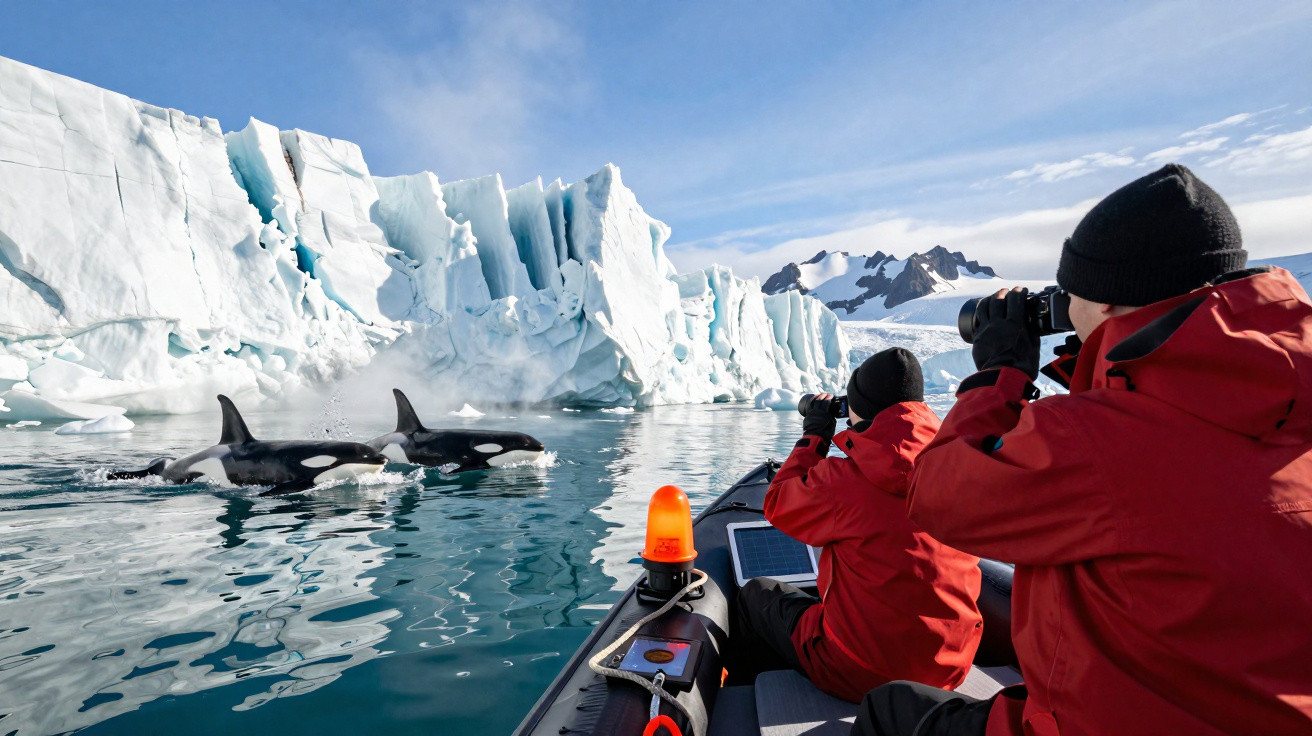
The first killer whale broke the surface just beyond the fractured ice edge, its dark dorsal fin slicing through the grey Arctic water like a warning. Along the coast of a small Greenland settlement, people paused and watched. Children gestured towards it. Experienced hunters became silent, interpreting the sea as others might scan a busy street. Orcas were not expected here. Not so near the shore. Not beneath cliffs where the ice shelves were already creaking and slumping.
By the time a second and then a third whale emerged, local police had contacted the government office in Nuuk. Hours later, officials announced an unusual civil emergency - prompted not only by the whales themselves, but by what their arrival revealed about the ice and a world beginning to tip.
The Arctic had issued a different kind of distress call.
Greenland’s sudden emergency as killer whales reach the crumbling edge
On Greenland’s west coast, close to communities that still use sea ice as a route, the terrain has started to feel unreliable. Residents say ice shelves that previously remained intact for months are now disintegrating within days. Against this unstable backdrop, a pod of killer whales moved unusually close to collapsing ice fronts. For local authorities, this compounded an already difficult situation: dense, shifting floes, erratic meltwater currents, and apex predators circling areas where fishing boats attempt to come ashore.
The government alert was not intended to create panic. Its purpose was to gain time, clear access routes and keep people away from the unstable ice slabs where the whales were surfacing and diving.
A fisherman from a settlement near Disko Bay described the morning as something out of a nightmare. He had guided his small boat along a well-known route, where thick sea ice had once protected vessels from large swells and large animals. This year, however, the ice broke up early and left stretches of open, dark water.
From one of these openings, an enormous dorsal fin passed quietly alongside his bow. A second followed, then a third. These were killer whales far inland, moving between the remains of ice shelves that local people remembered as firm platforms safe enough to walk across. “This has never been observed before,” a glaciologist later confirmed after examining drone footage recorded at the site. The film showed orcas threading through pillars of shattered ice like visitors in a flooded city.
Researchers and emergency officials understood the same warning in different terms. Scientists see the whales as a mobile sign that the Arctic ecosystem is being rapidly reorganised. Warmer seas, thinner ice and changing prey movements are creating new passages for species that once remained much farther offshore. Emergency teams face a more immediate threat: sudden ice failures driven by warmer air and water. The substantial weight of orcas pushing against ice edges can cause abrupt breaks, sending blocks the size of lorries calving into the sea.
Add a small fishing boat, a hunter’s sledge or an inexperienced sightseer to that setting, and the danger can become serious with very little warning.
What lies behind this “never seen before” moment in Greenland
Greenland’s practical response began with something simple and almost traditional: communication. Authorities broadcast radio warnings in Greenlandic and Danish, telling fishers, hunters and tour operators to avoid particular ice shelves and fjords where whales had been reported. Local councils urged residents not to take sea-ice shortcuts that generations had relied upon. Each morning, police and rescue teams used satellite imagery and local reports to define fresh “no-go” zones.
On certain days, village WhatsApp groups proved faster than official communication routes. Pictures of fins beside broken ice could circulate within seconds.
For many Greenlanders, the emotional impact extended beyond immediate risk. It came from watching familiar reference points disappear. A hunter in his fifties told a Danish journalist that, as a child, his father had taught him about “the safe ice” and “the risky ice”. That understanding had travelled through countless generations. Now, as killer whales cut through waters that had once formed a solid, protective frozen sheet, he said he no longer trusted the map he carried in his mind.
We’ve all been there, that moment when the rules you grew up with stop working and nobody has written the new ones yet. In the Arctic, that moment just happens to involve ice, predators, and the thin line between sea and home.
Glaciologists note that Greenland’s shelves and fjord ice have faced pressure for decades, but the orcas are an obvious and compelling sign of change that is difficult to dismiss. Warmer Atlantic currents have been travelling farther north and wearing away ice from beneath, while hotter summers melt it from above. This two-sided assault does more than reduce the ice: it undermines its structure, leaving waves and large animals better able to break pieces away. Let’s be honest: nobody really follows every scientific report or temperature anomaly chart every single day.
Yet the sight of a black fin against splintered white ice conveys the story in one unforgettable picture.
How Greenland is adapting on the ground - and what the rest of us can learn
In practical terms, Greenland’s emergency has become an intensive lesson in coping with a shifting landscape. Local authorities and scientists are producing updated risk maps almost in real time. They bring together satellite images, drone recordings and the knowledge of hunters familiar with every ridge and crack. The maps determine where boats may travel, where sledges can cross and where people should not remain close to the ice edge.
It may sound highly technical, but its central purpose is straightforward: remain adaptable when the environment no longer acts as it once did.
From outside Greenland, it is tempting to treat this as a remote curiosity. Killer whales, ice shelves and emergency warnings can seem like events from another world when viewed on a phone between meetings. But the pattern beneath them is painfully recognisable. Systems assumed to be stable are being pushed into new states while human habits fail to keep pace. A common error is to choose either denial or drama: acting as though nothing has altered, or giving in to hopelessness. Neither response enables action.
A more practical approach begins with small changes: revise the maps in your own life. Consider your energy consumption, travel, vote and conversations with children who will inherit this reshaped Arctic.
In Nuuk, a young climate researcher summed it up simply: “The whales are not villains. They’re just following the food. The emergency is about us learning to live with the consequences of what we’ve already done.”
- Notice the signals close to home
Pay attention to subtle changes in seasons, local wildlife or weather, rather than waiting for dramatic disasters. - Support the people on the front line
Arctic communities, small island states and low-lying areas are experiencing today the future that many others may face tomorrow. - Ask better questions
When images show Greenland’s ice collapsing, look beyond “How bad is it?” and ask “What can this teach us about changing our own course?” - Talk about it without lecturing
The plain truth is, most people tune out when climate talk turns into a sermon. Tell stories, rather than relying only on statistics. - Stay curious, not paralysed
Curiosity helps you continue moving, learning and adapting - paralysis merely leaves you frozen as the world changes around you.
A new Arctic story that’s not just about Greenland
Images of killer whales passing through a maze of crumbling Greenland ice shelves are already travelling around the world. The scene appears almost cinematic: predators at the edge of a collapsing stage. But the more profound story is quieter and harder to face. A government has declared an emergency because the former rhythms of ice, ocean and life can no longer be relied upon. Families are reconsidering routes they once followed without thought. Scientists are saying they have never witnessed behaviour like this, while working urgently to understand it.
This is not a tidy story of heroes and villains. It is an unfiltered glimpse of a planet in transition, where even its oldest landscapes are changing themselves in real time.
What occurs in Greenland does not remain there. Meltwater flowing from its shelves influences ocean currents, sea levels and weather patterns thousands of kilometres away. Orcas pursuing newly available prey routes form part of a global chain of effects reaching from fisheries to coastal property markets. Meanwhile, people in a distant Arctic settlement must confront the daily fact that the ground beneath them - or, more accurately, the ice beneath their sledges - has ceased to be a certainty and has become a question.
You do not need to stand on a Greenland cliff to encounter that question in your own life: How do we adapt when the rules change while we’re still playing?
Greenland’s emergency, prompted by a pod of killer whales and a stretch of collapsing ice, is both a warning and a rehearsal. It is a rehearsal for cities responding to floods, farmers confronting failed seasons and families reconsidering where “home” can safely be. At the ice edge - engines switched off, people silent, observing dark fins in waters once ruled by thick ice - there is a shared moment of recognition. The plot has changed, and we are already in the next act.
What each person does with that recognition, quietly and repeatedly, will determine whether future emergencies remain local stories or become the new normal everywhere.
| Key point | Detail | Value for the reader |
|---|---|---|
| Greenland’s unusual emergency | Authorities responded after killer whales approached unstable ice shelves, a pattern that scientists say they have never previously observed in this form. | Helps you understand how quickly Arctic change is moving from abstract data to tangible emergencies. |
| Whales as climate signals | Orcas are reaching new Arctic areas as warming water, shifting prey and weakened ice create unexpected routes. | Transforms a striking news image into a clear sign of wider climate changes affecting everyone. |
| Lessons for everyday life | Greenland’s local adaptation - revised maps, flexible routines and shared information - reflects choices that individuals and cities can make elsewhere. | Offers practical ways to link a distant Arctic story with your own decisions and conversations. |
FAQ:
- Is this really the first time killer whales have been seen near Greenland’s ice shelves? Orcas have been present in Arctic waters for a long time, but local observers and researchers say this close, repeated movement towards collapsing ice shelves in particular fjords is new in their recorded experience. That is why phrases such as “this has never been observed before” are being used.
- Why are killer whales moving into these areas now? Rising water temperatures, less sea ice and changing prey patterns are opening routes formerly blocked by thick, stable ice. The whales are following food, including seals and fish, into areas that were inaccessible for much of the year.
- What made Greenland declare an emergency over this? The emergency concerns less the prospect of whales attacking people than the combination of unstable ice shelves, new animal behaviour and human activity. Sudden ice collapses near small boats, sledges or coastal settlements can be fatal, so authorities decided to act early and limit access to certain places.
- Does this event affect sea level rise directly? The individual collapses of coastal ice shelves and fjord ice highlighted in this event largely involve floating or already-loosened ice, so they do not contribute as greatly to sea level. However, they are closely connected to the wider melting of Greenland’s ice system, one of the main drivers of long-term sea level rise.
- What can people outside Greenland realistically do about this? Individually, people can lower their climate footprint, back policies and leaders committed to reducing emissions, and amplify the voices of frontline communities such as those in Greenland. They can also remain informed and discuss these changes in everyday language, making distant Arctic headlines part of their own social and political choices.



Comments
No comments yet. Be the first to comment!
Leave a Comment