
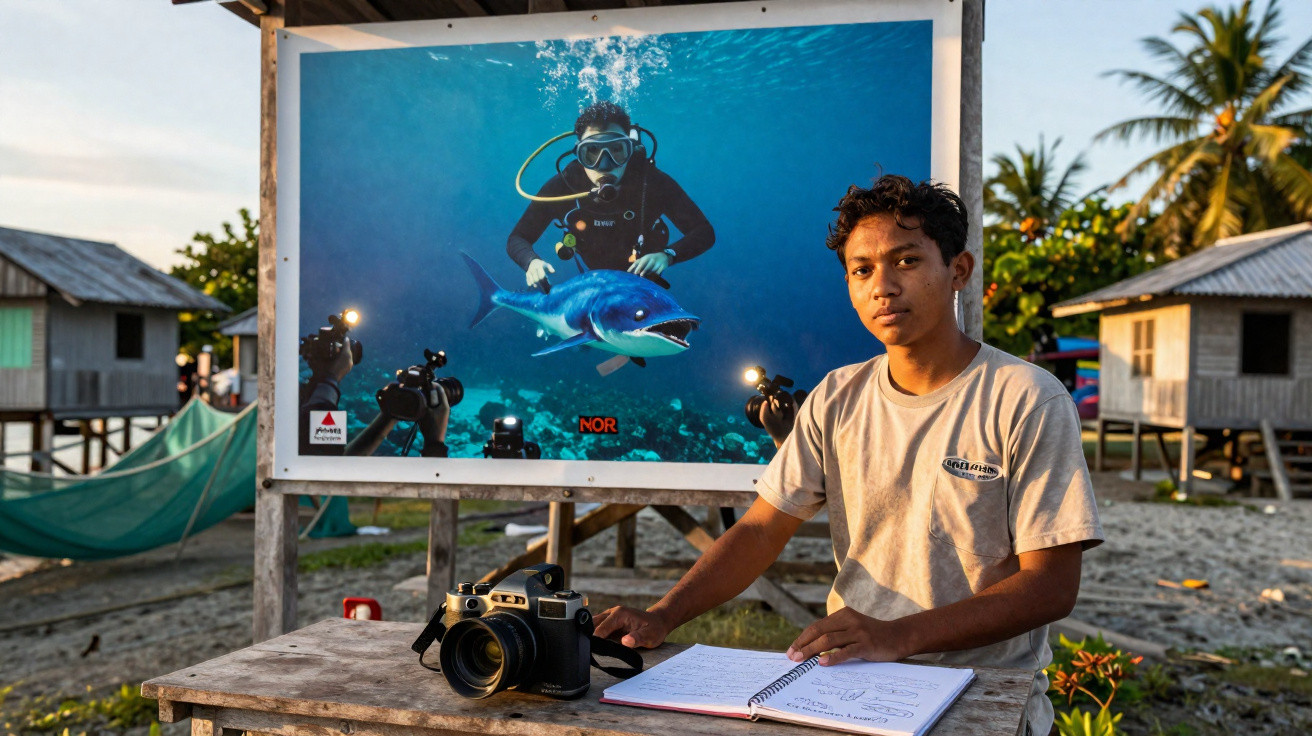
On Weda Bay’s fractured harbour jetty, the sun had only just risen above the mangroves when word spread through the village: “We’re on French TV.” Young Indonesian divers clustered around a scuffed smartphone to watch a polished segment made by visiting French filmmakers. In sharp high definition, their familiar nocturnal companion drifted across the screen - Indonesia’s elusive prehistoric-looking coelacanth, the “living fossil” - presented like a newly found planet belonging to somebody else.
The youngsters celebrated briefly. When the footage finished, however, the ensuing quiet conveyed more than translation ever could.
All at once, the world cared about their fish.
It simply did not care about the people who had protected it for decades.
How a French camera made a village secret a global “discovery”
For years, fishers and volunteer conservationists in North Maluku had discreetly reported sightings of unusual large-finned fish rising from the depths at night. They called them raja laut, “kings of the sea”, and, whenever possible, returned them alive to the water. There were no lights, drones or diving cylinders - only hands, nets and long-established practice.
A French diving team then arrived with professional lighting equipment, stabilised cameras and a feature-length narrative ready to market: Western explorers searching for Earth’s last dinosaur fish in “uncharted” Indonesian waters. In a single night, an animal local people had worked to safeguard became an international celebrity - because it had been filmed in French.
The fish was unchanged; the camera was not.
A marine guide from Ternate often recounts “the night we became extras in our own film.” A European crew had arrived to film the legendary coelacanth in a deep underwater cave. Local divers took them to the precise location at exactly the right tide, relying on knowledge handed down by their fathers. They remained in the background as the visitors entered the darkness with full equipment and support boats.
Several months later, the documentary appeared on streaming platforms. It featured soaring aerial views of the archipelago, dramatic music and solemn narration about the “last frontier”. Its closing credits acknowledged government permits, European backers and branded diving equipment. The local conservation group that had recorded sightings for a decade received one line: “Local support.”
Their information sustained the film, but their names did not sustain its narrative.
This is not a random pattern. Western media structures are designed to favour the familiar: recognisable languages, established networks and validated institutions. French divers arrive with press officers, broadcaster partnerships and an entire system equipped to sell “living fossil rediscovered” to international audiences. Indonesian campaigners working with unreliable Wi-Fi and very small grants rarely possess a comparable platform.
Editors in Paris or London place confidence in crews that resemble them and speak their language. They understand the production company, format and pacing. They may not even know how to spell Halmahera. The narrative therefore slips, almost imperceptibly, into an old colonial comfort zone: heroic outsiders, mysterious tropics and appreciative local people at the edges of the frame.
What appears to be discovery on a French screen can feel like erasure on an Indonesian coastline.
How local coelacanth voices are pushed aside - and how that can change
In practice, those living closest to the coelacanth usually have the least influence over its story. Local conservationists are occupied repairing damaged boats, challenging mining companies and persuading relatives not to sell deep-sea fish to travelling traders. Telling stories must follow survival. Camera batteries come second to school fees.
French and other overseas teams arrive with funding timetables, release schedules and social-media plans. They have the space to shape an epic account of deep time and “living fossils”, pursuing the perfect blue image with viral potential. When filming begins and you are holding the torch, it is very easy to become merely “the assistant” rather than a co-author.
Who is permitted to speak on camera quietly determines who exists in global memory.
Another recurring problem is the portrayal of local people as folklore alone. A village elder describes the fish in his own language, gesturing broadly like the sea, yet the subtitles reduce his account to: “Fishermen believe this animal brings luck.” Its subtleties, ecological understanding and warnings about falling numbers disappear in the edit.
We have all experienced that moment: watching a story we understand intimately and realising that the part meaningful to us has been removed. For Indonesian researchers who have documented coelacanth sightings for years, seeing their work labelled “local legends” while foreign divers are called “pioneers” is not merely frustrating. It affects where future funding is directed, whose data is treated as credible and who is invited to scientific panels.
What seems to be a straightforward on-screen translation problem becomes an off-screen question of power.
Let’s be honest: hardly anyone reads every line of the credits every day. That is why shared credit must be prominent, explicit and embedded in the story from the outset. One Indonesian biologist I spoke to described his strongest collaboration with an overseas film crew. The team insisted that he co-narrate. They recorded first in Bahasa Indonesia and dubbed it afterwards. Before publication, they screened unedited cuts for the village.
“Anytime a coelacanth image goes viral without us, the fish becomes a brand and we become background,” he said. “The only way out is to build stories where the ocean and the people are both protagonists, not one chasing the other.”
- Identify local groups clearly in on-screen graphics, rather than relegating them to tiny end credits.
- Return raw footage and data to communities so that they can publish material themselves.
- Co-write press releases with local scientists or NGOs before major announcements.
- Fund local storytelling workshops so villagers can film and edit their own short documentaries.
- Push back when editors favour “mystery” over genuine Indonesian voices.
Beyond the “living fossil”: whose future is actually at stake?
The French divers did achieve one thing: they reminded the world that the coelacanth still survives in Indonesian waters after 400 million years. Such attention can release funding, put pressure on governments and create a shared sense of wonder across borders. The difficulty begins when the narrative ends with wonder and never returns to the people who live beside it every day.
The coelacanth is not simply a cinematic creature from the deep. It tests whether international conservation can finally leave behind its outdated frontier fantasies. It asks whether a fish can be both a “living fossil” and a living neighbour, safeguarded by people raised alongside it rather than only by those who fly in to film it.
If we really care about a species that outlived dinosaurs, we have to care just as much about the coastal kids who might not outlive their own reefs.
| Key point | Detail | Value for the reader |
|---|---|---|
| Media attention is unequal | French divers arrive with networks, budgets and narratives that global platforms immediately recognise | Helps you view viral “discoveries” with a more critical, informed perspective |
| Local knowledge is fundamental | Indonesian fishers and conservationists have monitored the coelacanth for decades with little recognition | Explains why elevating local voices is vital to meaningful conservation, not a secondary concern |
| Fair storytelling can be created | Shared credit, co-narration and returning footage/data are straightforward, practical measures | Offers practical standards for assessing whether a project is extractive or genuinely collaborative |
FAQ:
Why are French divers receiving so much credit for the coelacanth?
Because they have cameras, distributors and media connections that suit Western news practices, their images and names travel farther and faster than those of local conservationists.Have Indonesians known about this “living fossil” for a long time?
Yes. Fishers and researchers across several regions have documented coelacanth encounters for years, but their reports often circulate in local languages, small journals or NGO bulletins that international media seldom cover.Is foreign filming always harmful to local communities?
Not necessarily. Where crews share credit, consult communities and support local research, international exposure can bring funding, legal safeguards and pride. The issue lies in how the collaboration is structured.What could international media do differently?
They could co-author scripts with Indonesian specialists, name local organisations prominently, include them in interviews, and invest in training and equipment that remains with the community after filming.What can readers and viewers actually change?
You can ask “Who’s missing from this story?”, follow and support Indonesian scientists and NGOs directly, and reward media outlets that centre local voices rather than repeating the same explorer narrative.




Comments
No comments yet. Be the first to comment!
Leave a Comment