
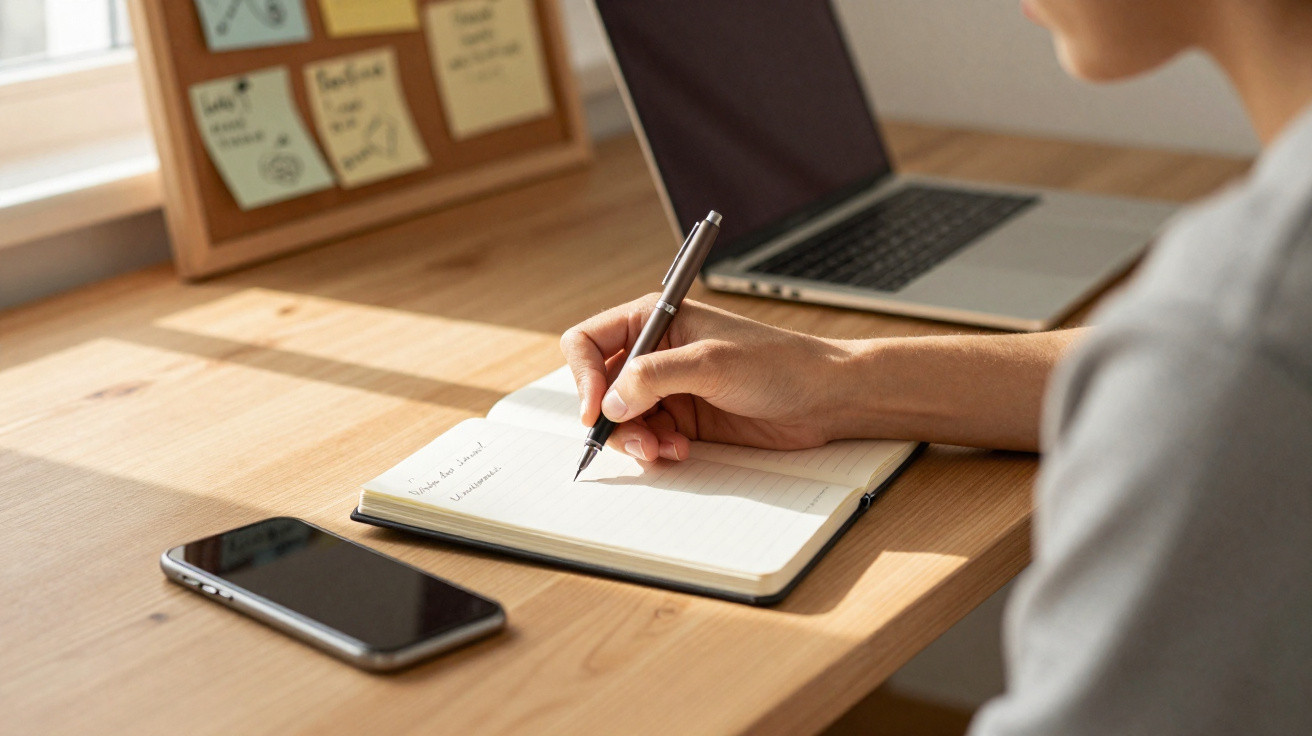
The yellow sticky notes attached to her monitor had stopped sticking several days earlier.
Her tasks were spread between three separate apps, hidden in unopened emails and lingering somewhere at the back of her mind. At 10:43 a.m., holding a coffee, Emily launched yet another productivity tool. Then she did something almost absurdly straightforward: she moved the keyboard aside, picked up a pen and wrote her to-do list on paper.
The mental noise changed. Rather than a haze of “I should really…”, she saw lines, shapes and ink pressing into the sheet. One task immediately seemed pressing. Another appeared ridiculous when it was written in large blue letters. She struck through an item she had been “carrying” for three weeks.
By lunchtime, her workload had not somehow vanished. Yet her brain plainly responded to those handwritten words differently from digital ones. The list seemed weightier. More tangible. Almost like a commitment.
Something unusual occurs when your hand starts moving before your brain has time to conceal.
When ink changes what your brain cares about
Observe somebody writing a task by hand and a tiny drama plays out. Their eyes tighten. The pen hovers while they choose the right wording. The brain is already evaluating: “Do I really want to do this?” A typed bullet point looks tidy and impersonal. A handwritten sentence is rougher, more individual and almost resembles a small agreement with yourself.
For years, neuroscientists have quietly pointed out that handwriting activates more of the brain than typing does: motor regions, visual processing and memory pathways. On a keyboard, your fingers repeat much the same movement. On paper, your hand creates every letter in its own rhythm. Consequently, your brain labels that information as more significant.
This is why an ordinary paper to-do list can feel more substantial than an endless stream of app-based tasks. Writing something down is itself an initial choice. Your brain is effectively asking: “Is this important enough to deserve ink?”
A University of Tokyo study made that contrast clear. People who organised tasks in paper planners instead of digital planners showed greater brain activity in regions associated with memory and spatial processing. They planned more quickly too, and later recalled details more effectively. For the researchers, paper was not a nostalgic choice; it was an efficient one.
Consider your own experience. Perhaps you once scrawled “Call mum” in the corner of a receipt and instantly felt a slight jolt of urgency. Or you wrote “Quit job?” in a notebook and recognised that the question became real as soon as it appeared in your handwriting. On a screen, the very same sentence could have remained in a forgotten note, easy to swipe away.
With paper, the friction is important. You notice the pen dragging, the modest effort in your fingers and the little mess created when you reconsider something and cross it out. Those flaws signal to your brain: this is not merely data. This is you taking action.
Psychologists describe this as embodiment: the notion that the body influences the mind. When your muscles help create a task, the brain regards it as more immediate and relevant. It is almost as though your future self is reaching back through your hand to say: “Don’t ignore this one.”
Neural networks respond strongly to patterns. If most of your life is typed, anything you write physically becomes a distinct signal. Your brain automatically raises its priority.
How to use handwriting to make your brain care more
There is an easy way to use this bias in your favour. Before you open a task app each morning, take an inexpensive notebook and handwrite just three tasks. Not ten, and not every possible task. Write only the three things that truly matter today. Put each one on a separate line, slowly enough to notice your hand shaping the words.
Next, stop and examine the page. Ask which line makes your stomach tense slightly. That is often the task your brain has been attempting to avoid. Underline it. It is now your “must-do” task: the job to complete before any screen-based busywork. You have used handwriting as a filter, changing a vague mental list into a physical shortlist your brain cannot easily evade.
At a neurological level, those brief seconds linking pen, paper and thought create a small yet powerful loop. Your motor system feeds back to visual and emotional centres: “We’re doing this. This is real.”
Now for the honest part: nobody keeps a flawless handwritten system every day for their entire life. Paper planners are purchased in January and left behind by March. Apps still have a place. The point is not to replace digital tools, but to use handwriting when you want your brain to care more rather than less.
Do not let your notebook become a cemetery for impossible lists. If people write down twenty tasks, the brain quietly categorises the entire list as “fantasy”. Make the handwritten list uncomfortably short. Start afresh each day instead of transferring everything indefinitely. Rewriting is a filter in itself: tasks you are fed up with writing often no longer merit your energy.
On a difficult day, a single sentence may be sufficient: “If I only do this, today is a win.” Seeing that line on paper can feel gentler than any push notification.
“Writing a task by hand is like looking it in the eye. You can’t pretend it’s invisible anymore, but you can also decide whether it deserves a place in your day.”
To make the practice more tangible, build it into a small ritual. Use the same time, the same place and the same notebook. Sit down, take one breath and write your three tasks. Keep your phone off the table and your laptop closed. Show your brain that this is not simply another interaction with a screen.
- Choose one notebook, so every task occupies one physical place.
- Write with a pen you like; a little pleasure helps a habit take hold.
- Keep your paper list to a maximum of 3–5 tasks each day.
- Strike through finished tasks with one line, leaving them legible.
- Every morning, star one “if nothing else, do this” task.
Eventually, the notebook becomes a quiet record of what genuinely mattered, beyond all the noise your devices directed at you.
What happens to your priorities when the ink dries
Handwriting cannot create extra hours. What it can do is alter the emotional weight of what is already on your list. Some people find that, once a task is clearly present on paper, it no longer lurks in the background of their thoughts. The brain settles because the job has been “parked” somewhere physical. That alone may release attention for more focused work.
We have all experienced a small, irritating job draining energy throughout the day because it never finds a proper place. Handwriting it can reduce it to its proper scale. Meanwhile, larger and more intimidating projects often begin to look like a run of smaller actions when set down in your own handwriting. “Write report” becomes “Draft first page”, then “Outline three points”. Every line is a modest pact between your present and future selves.
There is another curious effect: after people begin writing tasks by hand, they occasionally discard items they had considered essential. Seeing “Reply to Slack messages from last week” in ink may expose the absurdity of spending emotional energy on something that is already out of date. The page becomes a quiet, unsparing editor of your life.
This is not nostalgic magic. It is more like an exploit based on how human cognition developed. For most of human history, leaving a mark in the physical world - through carving, painting or scratching symbols - was a consequential act. The body had to exert effort. Resources were consumed. Our brains evolved to treat marks in the physical environment as signals worth attending to.
Typing bypasses that process. Taps and clicks are so inexpensive and reversible that they do not always feel real. This is excellent for speed and flexibility, but less useful when you are trying to decide what genuinely matters today. Handwriting brings back a little friction, enough to make your priorities feel firm beneath your fingers.
So, when your task manager next feels like a slot machine, step away from the screen for five minutes. Pick up a pen. Select three tasks. Allow the ink to dry. Notice which ones your brain will not let you ignore.
| Key point | Detail | Benefit for the reader |
|---|---|---|
| Handwriting activates more brain areas | Motor, visual and memory circuits engage when you physically form letters | Helps tasks feel more meaningful and memorable than typed items |
| Short handwritten lists change priorities | Limiting yourself to 3–5 tasks forces the brain to choose what really matters | Reduces overwhelm and increases follow-through on important work |
| Daily rewriting acts as a filter | Tasks you are tired of rewriting often do not deserve your attention | Prevents endless carry-over and removes false “must-do” items |
FAQ:
- Does writing tasks by hand really boost productivity, or is it just a trend? Research suggests that handwriting improves memory and engagement, while many people say they feel more focused and intentional. It is not a miracle cure, but it can often clarify your priorities.
- How many tasks should I write by hand each day? Between three and five tasks works well for most people. Beyond that number, your brain tends to regard the list as unrealistic and motivation falls.
- Should I abandon digital to-do apps completely? No. Use digital tools for storage and long-term planning, while reserving handwriting for the few tasks you want your brain to see as urgent and real today.
- What if my handwriting is terrible or slow? That is perfectly fine. The advantage comes from the movement and attention rather than calligraphy. Messiness is acceptable. Speed is not the aim.
- When is the best time to write tasks by hand? Many people prefer first thing in the morning or at the end of the preceding day. What matters is creating a small, repeated time when you leave screens behind and decide on paper what truly matters.




Comments
No comments yet. Be the first to comment!
Leave a Comment