
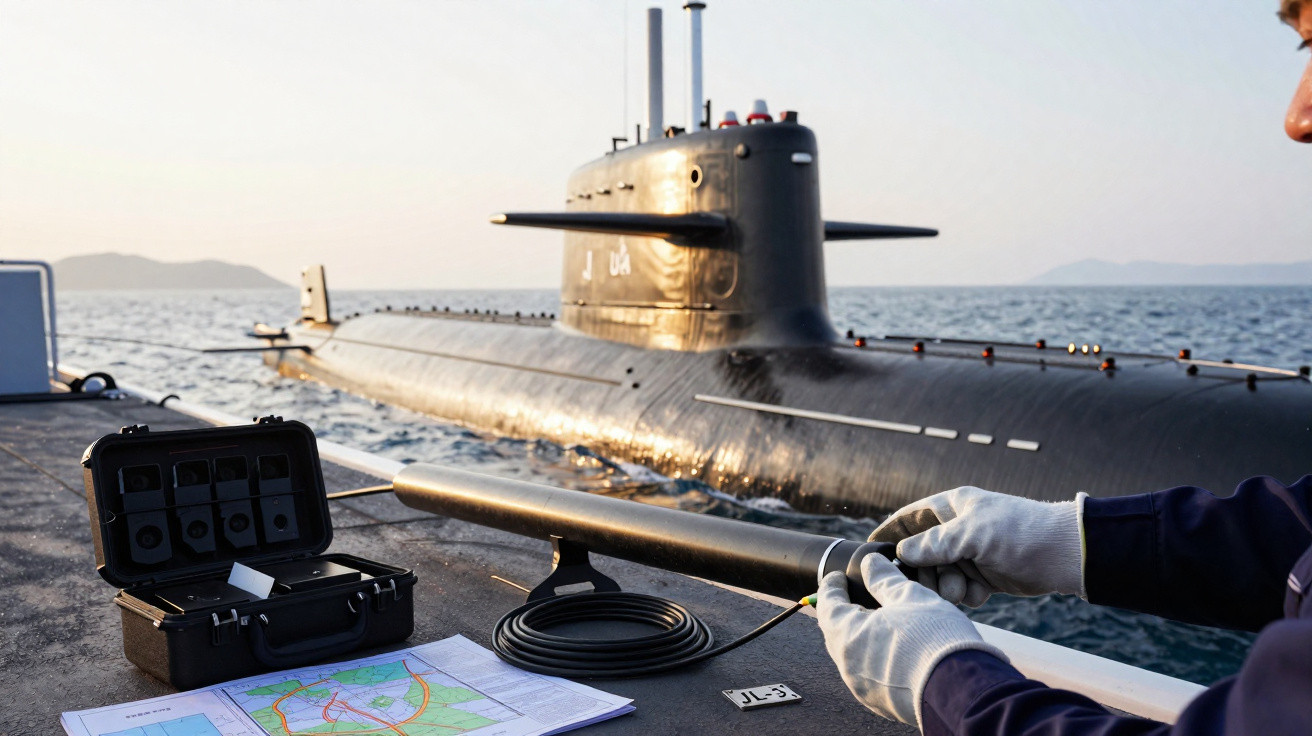
Beijing’s next-generation Type 096 “Tang-class” ballistic missile submarine is taking shape as the cornerstone of China’s long-term nuclear strategy, prompting serious questions for Washington, its allies and the stability of future crises.
China’s new flagship of undersea nuclear power
Information published by Chinese state media in January 2026 has provided new insight into the Type 096, which for years has been known largely through speculation and indistinct satellite imagery. Although the figures have not been officially verified, they broadly match longstanding Western intelligence assessments of the direction of China’s nuclear submarine programme.
The Type 096 appears designed to give China a continuous, survivable nuclear force at sea for the first time.
With an estimated submerged displacement of 15,000–20,000 tonnes, the Tang-class places China in the same broad size bracket as the U.S. Navy’s Ohio-class and the forthcoming Columbia-class ballistic missile submarines. Its greater dimensions offer more than additional missile capacity: they also give designers space for advanced noise-reduction equipment that was difficult to incorporate into earlier, smaller Chinese classes.
A quieter submarine that is harder to find
For a ballistic missile submarine, noise can determine survival. The louder a boat is, the more readily it can be located and, during a crisis, possibly neutralised. China’s early nuclear submarines were widely considered noisy and exposed to detection.
The Type 096 seems intended to alter that assessment. Chinese sources indicate that the new submarine may operate at 95–100 decibels, substantially quieter than the existing Type 094 “Jin-class”. This would not place it on a par with the most advanced Western boats, but it would make the task harder for U.S., Japanese and Australian anti-submarine warfare forces.
Reportedly, the design incorporates raft-mounted machinery and improved hull isolation to reduce vibration, alongside a modern propulsion arrangement optimised for quiet cruising rather than outright speed. Analysts further suspect it will use a pump-jet propulsor, conceptually similar to systems fitted to modern Russian and Western submarines. Such a system sacrifices some maximum speed in return for quieter operation and smoother water flow.
A relatively modest drop in acoustic signature can translate into a major increase in survivability during a crisis.
Western officials and specialists have suggested that Russian technical support, especially in propulsion quieting and vibration control, may have enabled China to narrow the gap faster. Some also identify visual and design similarities with Russia’s Borei-class strategic submarines in computer-generated images of the Tang-class.
Extended “eyes and ears” under the ocean
China’s efforts are not limited to making its submarines less audible; it is also seeking to detect other vessels before they are detected themselves.
Leaked Chinese information suggests that the Type 096 may carry sonar able to identify targets at distances of up to approximately 300 miles in favourable conditions. Such claims depend heavily on water temperature, salinity and ambient noise, but they point to an advanced sonar package and sophisticated onboard signal processing.
The submarine is also anticipated to connect with China’s expanding network of underwater sensors and sea-bed arrays in important coastal areas. Combining its own sensors with external systems could allow the Tang-class to remain within comparatively secure “bastions” close to China’s coastline while monitoring surface ships and enemy submarines over long distances.
Why the sonar matters for deterrence
For a nuclear-armed submarine, superior sonar is not solely a means of pursuing opponents. It is essential to surviving long enough to launch its missiles if conflict begins. By identifying approaching threats sooner, a crew can evade detection, move silently to another position and preserve a credible second-strike capability.
The JL‑3 missile: reaching the U.S. from near home waters
The Type 096 becomes especially consequential because of its missile payload. Reports indicate that the Tang-class may carry between 16 and 24 launch tubes for the new JL‑3 submarine-launched ballistic missile.
The JL‑3’s range means Chinese submarines could target the U.S. mainland without leaving relatively safe patrol zones near China.
The JL‑3 is estimated to have a range of roughly 14,000 kilometres, enabling it to reach most of the continental United States from patrol zones in the South China Sea or Bohai Gulf. This differs from the earlier JL‑2, whose shorter reach frequently required Chinese submarines to move closer to U.S. missile-defence and tracking networks in order to threaten American cities.
Each JL‑3 is thought to carry multiple independently targetable reentry vehicles (MIRVs), potentially six to ten warheads for each missile. In total, a fully armed Tang-class submarine could deliver a nuclear strike comparable to that of several regiments of land-based missiles while remaining concealed beneath the sea.
How the Type 096 compares at a glance
| Submarine class | Country | Estimated missile tubes | Main SLBM range |
|---|---|---|---|
| Type 094 Jin-class | China | 12 | JL‑2, ≈7,000–8,000 km |
| Type 096 Tang-class | China | 16–24 | JL‑3, ≈14,000 km |
| Ohio-class | United States | 20 (post‑treaty loadout) | Trident II, ≈12,000 km |
From coastal bastions to global patrols
In the past, China’s ballistic missile submarines seldom operated far from home. Their relatively high noise levels and shorter-range missiles confined them to closely guarded “bastion” areas in nearby seas, protected by shore-based aircraft, surface vessels and coastal defences.
The Type 096 seems designed to ease those restrictions. Its quieter performance and long-range JL‑3 missiles could allow future patrols to keep the United States and its allies within striking distance without venturing into the open Pacific.
This shift nudges China closer to the continuous at‑sea deterrent posture long practised by the United States and United Kingdom.
Chinese naval research has also pointed to ice-strengthened hull characteristics, indicating that Beijing is at least examining operations in or close to Arctic waters. Deployments of this kind would make tracking more difficult for the United States and NATO, while extending the geographical reach of China’s nuclear deterrent.
Persistent limitations and remaining gaps
Despite these improvements, the Type 096 is not expected to equal the acoustic sophistication of the newest U.S. or UK submarines. The conspicuous missile-compartment “hump” frequently visible in models of Chinese SSBNs may produce hydrodynamic drag and added turbulence, increasing noise. Chinese naval reactors are likewise generally assessed as being one generation behind the most advanced Western systems in efficiency and compactness.
The central issue, however, is progress rather than perfection. The U.S. Navy’s long-held undersea advantage is diminishing at a point when American submarine construction and maintenance capacity are already under pressure.
Why the U.S. Navy is paying close attention
For Washington, a force of quieter Chinese SSBNs carrying high-MIRV, long-range missiles presents a multi-layered challenge.
- Monitoring these submarines may demand a larger deployment of U.S. attack submarines in the Western Pacific.
- Chinese missiles with greater range lessen the value of constrictions such as the first island chain as surveillance chokepoints.
- U.S. early-warning and missile-defence systems could confront more complicated flight paths and larger salvos.
The United States has traditionally depended on a broad combination of sea-bed sensors, maritime patrol aircraft and stealthy attack submarines to follow Russian and Chinese ballistic missile submarines. As China deploys more capable SSBNs, these established networks may no longer guarantee dependable tracking, particularly in a crisis involving numerous submarines from several countries moving at the same time.
Escalation risks and nuclear signalling at sea
The emergence of the Type 096 also affects Beijing’s political calculations. A more survivable sea-based force may give China greater confidence that it could endure a nuclear attack and retaliate. In principle, that confidence can lessen the pressure to make rapid “use‑or‑lose” choices during a crisis.
However, nuclear-armed submarines operating near sensitive flashpoints - the Taiwan Strait, the South China Sea and the Korean Peninsula - also create additional dangers. Misreading an opponent’s SSBN movements, or attacking a submarine thought to be conventional, could set off a perilous escalatory sequence.
Once nuclear-armed submarines are in the mix, every sonar contact and every torpedo run carries heavier political baggage.
Key concepts: deterrence, second strike and MIRVs
Three concepts help explain why the Type 096 is so significant.
Deterrence: The principle that the certainty of retaliation prevents an adversary from launching a nuclear attack in the first place. Ballistic missile submarines support deterrence because they are difficult to locate and destroy.
Second strike: A state’s capacity to retaliate with nuclear weapons after absorbing an initial attack. Submarines are crucial because they can remain hidden well beyond the reach of enemy bombers and missiles.
MIRVs: Multiple independently targetable reentry vehicles enable one missile to carry several warheads, each directed at a separate target. This complicates missile defence and enables a smaller submarine force to place more locations at risk.
Future scenarios and potential flashpoints
Analysts regularly assess capabilities such as the Type 096 against credible crisis scenarios. One commonly examined example is a confrontation over Taiwan. During such a standoff, China’s leadership might discreetly send several Tang-class submarines to sea, signalling that a conventional conflict carried an underlying nuclear dimension. U.S. officials, knowing that those submarines could strike American cities from Chinese bastions, would face greater pressure when deciding how closely to operate carrier groups and patrol aircraft.
A further scenario involves the Arctic. Should China eventually conduct SSBN operations beneath or near polar ice, its submarines could approach North America along unexpected routes, evading some early-warning radars and shortening decision-making time in Washington and Ottawa. Arctic passages would also raise coordination issues for NATO members, Russia and Asian allies, whose attention is currently concentrated largely on the North Atlantic and North Pacific.
The Type 096 will not by itself reshape the global nuclear order, but it introduces a powerful new factor into already complicated calculations. As additional submarines quietly enter service during the next decade, their covert patrols will influence how Beijing and Washington assess risk, red lines and restraint beneath the waves.






Comments
No comments yet. Be the first to comment!
Leave a Comment