
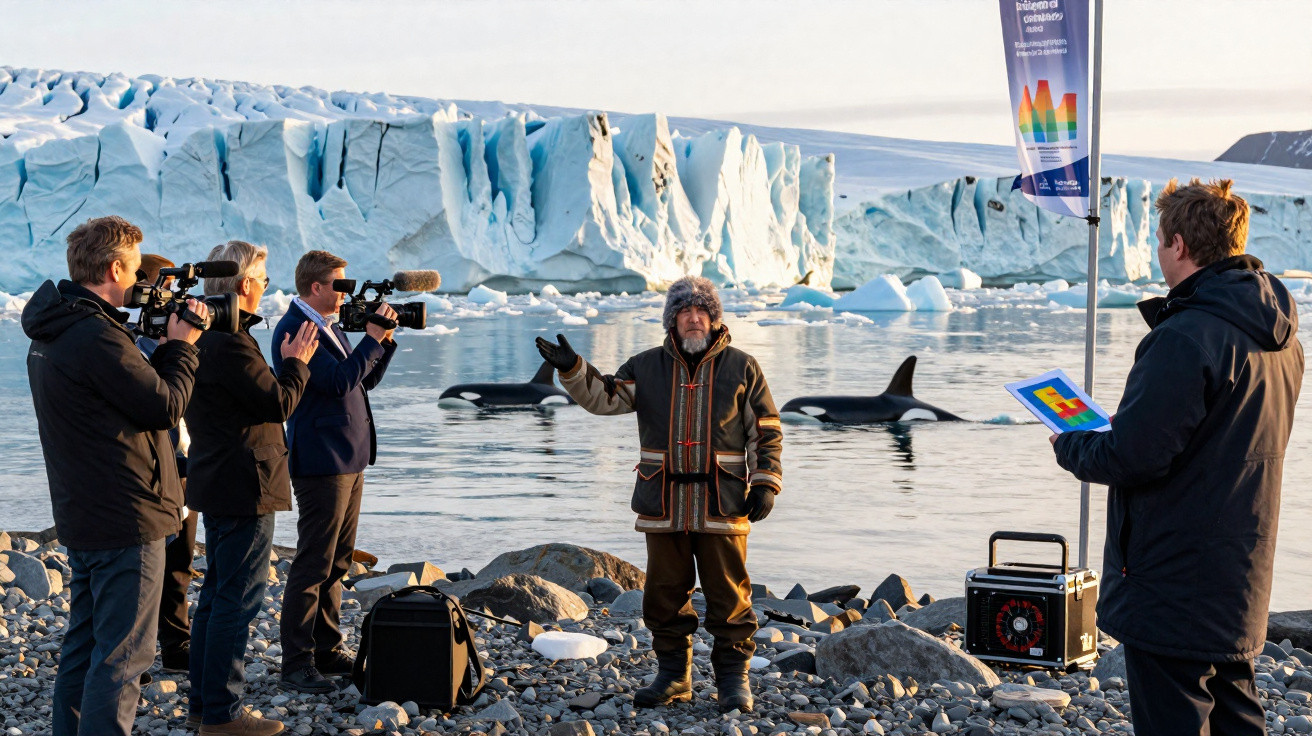
The sea ice splintered like aged porcelain whenever the boat pressed ahead. Along the horizon, black dorsal fins sliced through steel-grey water, looping around a fragment of broken ice shelf which local people said had once been “solid as a church floor.” Jon, a Greenlandic fisherman, rested against the rail with narrowed eyes, following the orcas along the floe’s edge as they waited for a seal to make a mistake. A visiting film crew recorded it all behind him, collecting punchy lines about an “apocalypse at the top of the world.”
Ashore, election posters rattled on metal posts in the wind, each carrying some variation on a shared message: climate chaos, vote for order.
That is the contrast people here are truly debating.
When ice becomes a backdrop for other people’s stories
On a clear August afternoon in Ilulissat, the brightness can seem almost artificial. The bay is packed with fragmented ice, resembling a city after a bombing, while orcas glide through the spaces between floes and draw tourists’ phones as though by magnetism. Whenever a fin breaks the surface near a calving front, somebody gasps, somebody records it, and somebody murmurs “climate change” as if invoking a ghost.
For many Greenlanders, however, this spectacle increasingly feels like a production scripted by outsiders. Their homeland has become scenery, and their lives have been reduced to B-roll for alarming headlines.
Speak to people around the harbour and the sentiment soon emerges. Peter, a young hunter, shrugs while lifting seal meat from his boat as a foreign documentary crew interviews a scientist only metres away. The researcher talks about “imminent collapse” and “tipping points”, motioning towards the ice as though it has already disappeared.
Later, over coffee in a compact kitchen scented with fish and laundry soap, Peter flicks through his phone. He shows a social-media clip from the same bay: orcas circling “a dying glacier”, captioned with text about “Greenland on the brink.” He laughs, though his jaw is tense. “They talk like we’re the first ones who will vanish,” he says. “We’re still here. We’re not props.”
Local people say the most irritating part is not the fact that the climate is shifting. They witness it themselves in thinner ice, less predictable seasons and unfamiliar species entering the fjords. It is the catastrophic language applied to every microphone, the countdown-style rhetoric suggesting that nothing in their world can outlast the next news cycle.
Words such as “collapse” and “doomsday” provoke an uneasy reaction. The routine process of adapting, and the hard work of learning the sea anew, does not fit into a 90-second news item. The story that spreads is invariably the one containing the greatest panic per minute.
Between fear and survival: how Greenlanders live with melting ice
Spend several days in a coastal settlement and another narrative becomes visible. People adapt, improvise and cautiously test fresh routes across thinning ice, using long-held knowledge. A boat engine may be started a month earlier than it was ten years ago because a winter sled route across the sea now feels too dangerous. Children learn to interpret weather apps alongside learning to read the wind.
The practical response seen everywhere is continual reassessment. Where is it safe to hunt today? Where can people fish? How can satellite imagery, elders’ advice and the current colour of the water be brought together?
According to local people, the greatest error is treating the situation as an extreme choice between all-or-nothing apocalypse and complete denial. Many Greenlanders occupy a more complicated middle ground. They do not reject climate science, yet object when it seems to be a narrative imposed over their heads.
Anna, an older woman in Nuuk, recalls appearing on a television panel. She described her family’s move from dogsled hunting to small boats, their trials with new fisheries, and her grandson learning coding as well as seal-skin work. “They cut all that,” she says. “They kept the part where I cried about the old days.” Then she adds, quietly, “We’re not only losing things. We’re learning new ways, too.”
What scientists describe as “early warning signs” may also be somebody’s route to work or their hunting area. That double reality informs the frustration with what some call fearmongering. When an orca pod beside a crumbling ice shelf is presented as proof of collapse on international television, those navigating boats through the same channel ask who has the right to define risk, and according to which timescale.
In truth, nobody lives as if each day is the final day before a tipping point. People live expecting another school run tomorrow, another fishing trip and another election poster to remove or hang. The central strain lies precisely between survival mode and alarm mode, and it does not translate neatly into a tweet.
How politics feeds on panic while people seek something else
During an election campaign in Nuuk, climate messages appear everywhere, although their meanings vary. One party vows to “defend Greenland from foreign green colonialism”, accusing external NGOs and researchers of turning the island into a moral billboard. Another promotes polished plans for green hydrogen and rare-earth mining, framed by talk of an “urgent transition” and a “last chance for prosperity.”
The mechanism is subtle: concern over melting ice can readily become anxiety about being left behind. Politicians understand how to convert collapsing shelves and circling orcas into cases for votes, contracts or speedier permits.
People in Greenland describe a particular sort of weariness. They are not weary of hearing about climate change; they are weary of being told panic is the only responsible response. A teacher in Ilulissat says pupils scroll past another video of blood-red sunsets over fractured ice and ask, “So what are we supposed to do, just be scared?”
A quieter resistance develops at that point. It means declining to turn every groan of a glacier immediately into a dramatic narrative. It means refusing to make fear the sole currency of public debate. Greenlanders understand urgency: they experience it when a storm arrives sooner than predicted or a hunting season changes without warning. What they reject is having their everyday exposure to risk recast as somebody else’s never-ending cliffhanger.
One local activist, who frequently works with scientists, expressed it this way:
“We don’t want less science, we want less theater. Tell the truth, but stop talking like we’re already ghosts.”
At kitchen-table conversations, three requests are repeated so often that they resemble a short checklist:
- Local voices featured when ice, orcas or “collapse” are discussed
- Clear explanations of what is known, what is estimated and what remains uncertain
- Climate funding and research schemes that leave behind practical tools or training
These are not theatrical requests. They concern respect, and a move away from fear as spectacle towards risk as something communities can genuinely address.
Living with a slow crisis in a fast-news world
Watch a calving front for long enough and an aspect absent from most viral videos becomes clear: there are lengthy, uneventful periods when nothing occurs. Then comes a sudden crack of thunder, a sheet of ice buckles, and everyone nearby reaches for a phone. Human attention is drawn to drama, and Greenland’s climate story has been shaped around that instinct.
Those living here cannot switch off between the dramatic incidents. Their children still require internet access, their boats still require fuel and their elders still need food transported over changing ice. They want the world to grasp what is at stake without converting their home into a permanent disaster film.
Many Greenlanders I spoke with do not dismiss the science; they object to its soundtrack. They want a more measured, consistent account that respects both danger and resilience. In that account, orcas circling a collapsing ice shelf are not merely signs of doom, but part of a complex ecosystem in transition that people attempt to understand every day.
They recognise that the ice is changing, and they are not asking anyone to ignore it. They want a way of looking that can accommodate panic and patience simultaneously, without automatically choosing the most dramatic term. It is a more difficult story to tell, but a more truthful one to inhabit.
| Key point | Detail | Value for the reader |
|---|---|---|
| Local anger at “fear talk” | Greenlanders believe their lives are used as disaster scenery in climate campaigns and media coverage | Encourages readers to question sensational climate narratives and seek local perspectives |
| Politics using climate chaos | Parties use melting ice and orcas to argue for votes, mining agreements or nationalist messaging | Demonstrates how climate anxiety can be weaponised in democratic debates around the world |
| Beyond panic vs denial | Communities balance adaptation, tradition and modern tools rather than existing in permanent apocalypse mode | Provides a more relatable framework for considering life with long-term climate change |
FAQ:
- Are Greenlanders denying climate change? Most are not. They observe the changes every day, including thinner ice and changing animal patterns. Many instead criticise the exaggerated tone and constant claims of total collapse, which erase their work to adapt and endure.
- Why are orcas suddenly part of the story? Orcas offer a striking visual: black fins against breaking white ice, ideal for dramatic headlines. They do signal changing ecosystems, but local people say attention on orcas frequently obscures more fundamental everyday shifts in fisheries and hunting routes.
- Do scientists really “fearmonger,” or is that media framing? Some researchers employ very forceful language, particularly in interviews, although much of the amplification occurs in editing suites and newsrooms. Greenlanders commonly hold the entire chain responsible: funding bodies, media outlets, NGOs and, only after that, individual scientists.
- How are politicians exploiting the situation? They connect climate anxiety to pledges of fast money, tighter borders or “saving” Greenland through mining and mega-projects. Melting ice is turned into a talking point for policies that may not truly assist local communities with adaptation.
- What do Greenlanders say they want instead? They call for shared decision-making on research, candid discussion of uncertainty, investment in local capabilities and narratives that show both loss and resourcefulness. Less drama, more partnership – and recognition that they are not simply victims on a melting stage.

Comments
No comments yet. Be the first to comment!
Leave a Comment