
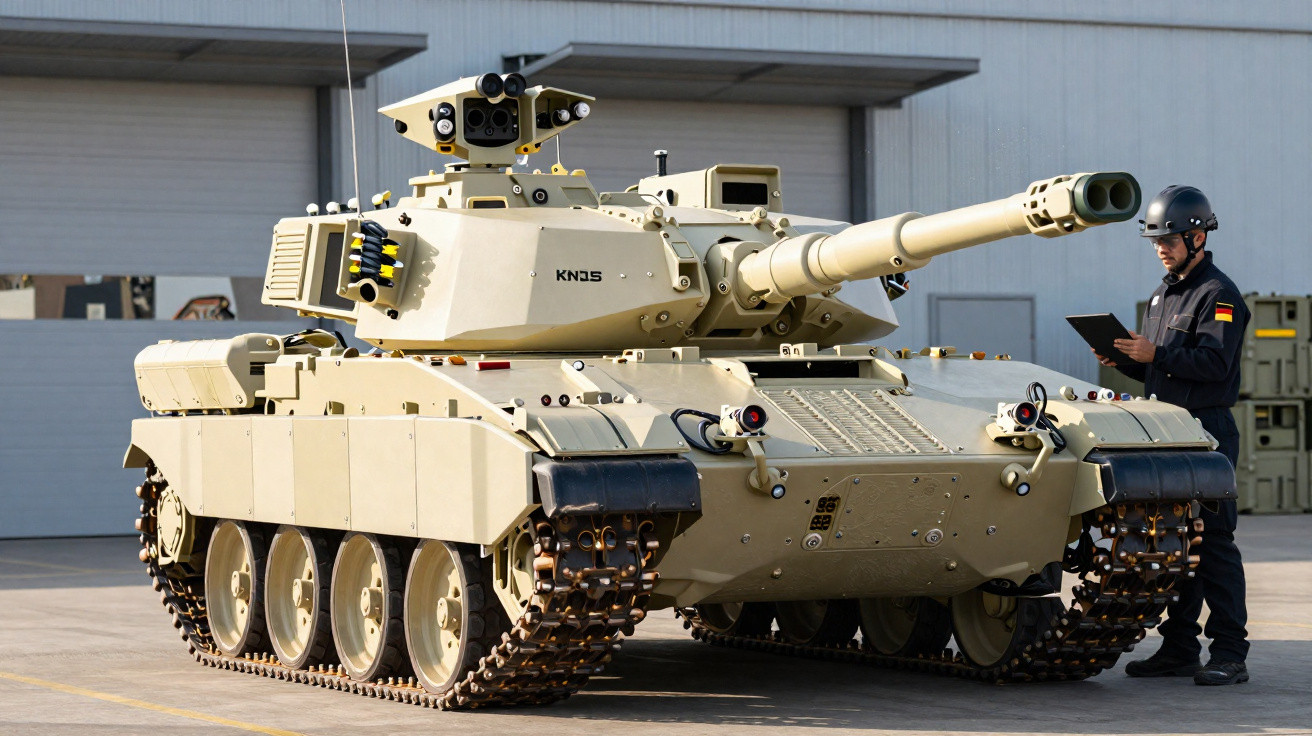
Germany’s KNDS group has unveiled the Leopard 2A8, an entirely newly manufactured version of its well-known main battle tank family and the first new production batch since the early 1990s. Its arrival comes during a fraught period for European security, as NATO members rearm while monitoring Russia’s war in Ukraine.
Germany’s first newly built Leopard since 1992
In contrast with previous Leopard modernisation programmes, which rebuilt and updated vehicles already in service, the 2A8 will be manufactured from the ground up. German defence officials describe it as the first newly built Leopard since 1992, restoring large-scale tank production after 30 years in which stockpiles and upgrades were relied upon.
The German army is due to take delivery of 123 Leopard 2A8 tanks. Deliveries are expected to begin in 2027 and finish around 2030, providing the Bundeswehr with a defined schedule for introducing the new armoured vehicles.
The Leopard 2A8 signals a shift from incremental upgrades to a new production generation of European main battle tanks.
At almost 70 metric tons, the 2A8 remains in the heavy-weight class occupied by earlier Leopard versions and is intended for high-intensity operations against comparable opponents. It also maintains the Leopard family’s standing as a NATO standard, already fielded by several European armies and forming an important element of Western backing for Ukraine.
What is actually new on the Leopard 2A8?
Active protection as standard equipment
The principal enhancement is an active protection system derived from Rafael’s Trophy, which was originally developed in Israel. Trophy is intended to identify incoming anti-tank munitions and destroy them before they strike the tank.
German engineers have developed a German-made version of Trophy adapted for the Leopard platform and German industrial requirements. Trials on older Leopard variants persuaded officials to fit the system as standard on the 2A8, rather than offering it as an optional extra.
The 2A8 incorporates an indigenous version of the Trophy system, turning active protection from an experiment into baseline equipment.
As current battlefields are increasingly filled with anti-tank guided missiles and loitering munitions, active protection is becoming almost as important as armour thickness. The 2A8 configuration indicates that Germany expects tanks to operate under an unrelenting missile threat, whether facing state militaries or heavily equipped irregular forces.
Enhanced armour and crew awareness
The new model also receives improved armour alongside Trophy. Officials have not revealed its complete composition, but the objective is evident: greater protection against kinetic projectiles and shaped-charge warheads alike.
The crew’s capacity to recognise threats has been comprehensively updated as well. The A8 has a redesigned range of situational-awareness equipment and fire-control systems, intended to enable crews to find, identify and engage targets more quickly in every weather condition and level of light.
- Improved sensor suite for 360-degree observation
- Updated fire-control algorithms for higher first-round hit probability
- Revised internal displays for commander and gunner
- Connection to modern digital command networks
Together, these changes move the Leopard family closer to a networked “sensor-shooter” model, in which the tank is not merely an isolated gun on tracks but one part of a connected battlefield network.
Proven firepower stays in service
The main armament is one aspect that remains unchanged. The Leopard 2A8 retains Rheinmetall’s 120mm smoothbore cannon, an established NATO standard already used throughout Europe and further afield.
That decision simplifies training and logistics. Existing 120mm ammunition stocks remain usable, while gunners experienced with earlier Leopard variants will recognise much of the system despite the revised fire-control interface.
A tank designed for NATO’s eastern flank
The first Leopard 2A8 vehicles are allocated to a new German armoured formation in Lithuania. The deployment will be Germany’s first permanent posting of combat troops beyond its own borders since the Second World War.
Berlin is pairing its first new-build tanks in decades with its first permanent armoured deployment abroad in modern history.
The Lithuania-based brigade is intended to achieve full operational capability in 2027, matching the planned start of 2A8 deliveries. Expected to comprise roughly 5,000 personnel, it is designed to serve as a central component of NATO’s deterrence posture on the alliance’s eastern frontier.
Positioning front-line armour so near Russia and Belarus carries a clear political signal. It shows Germany moving away from an approach centred almost wholly on homeland defence and overseas missions, towards a strong forward-defence role within the alliance.
European demand for the Leopard 2A8
Germany is not the sole customer. A number of European allies have either expressed interest in, or ordered, the Leopard 2A8, reinforcing industrial and military links across NATO.
| Country | Status | Role in national plans |
|---|---|---|
| Germany | Firm order for 123 tanks | Core of heavy brigades and Lithuania-based formation |
| Lithuania | Planning to add Leopard 2A8 | Upgrade of national armoured capability alongside German brigade |
| Netherlands | Intent to procure | Deepening joint German-Dutch armoured cooperation |
| Czech Republic | Planning to acquire | Replacement of Soviet-era platforms |
| Norway | Planning to buy Leopard 2A8 | Modernisation for Arctic and northern defence |
This group of European buyers improves KNDS’s order book and reinforces the Leopard family’s position as a key foundation of NATO armoured forces. Common platforms enable simpler combined exercises, shared training arrangements and more efficient maintenance.
Why build new tanks after years of upgrades?
The decision to resume new-build production should be viewed in a broader strategic context. Russia’s full-scale invasion of Ukraine has overturned long-held assumptions in European capitals about the prospect of high-intensity land warfare.
For many years, European armed forces managed with reducing fleets, gradual upgrades and limited reserves. With a three-figure order placed from the beginning, the Leopard 2A8 reflects a different approach: preparing for the possibility of a large and lengthy war instead of short crisis deployments.
Fresh production brings industrial advantages too. It preserves heavy-manufacturing expertise in Germany and throughout the KNDS supply chain. Such capabilities are more difficult to rebuild than retain, and they support any future next-generation tank programme involving European partners.
How the Leopard 2A8 fits modern combat scenarios
In present-day warfare, a tank such as the 2A8 would be unlikely to fight alone. It would normally operate with drones, artillery, infantry fighting vehicles and electronic-warfare formations.
In a hypothetical engagement on NATO’s eastern border, a Leopard 2A8 company could move forward under artillery cover and drone surveillance. Drones would identify enemy anti-tank teams, while the Trophy system protects against missiles that are nevertheless launched. Digital links would feed target information directly into the tank’s fire-control system, reducing reaction times by seconds.
Such a scenario requires computing capability as well as armour and firepower. The 2A8’s upgraded electronics suite has been designed specifically to support this more networked form of warfare.
Key terms and practical implications
Two technical concepts can often be misunderstood: “active protection” and “situational awareness”. Put simply, active protection systems such as Trophy are defensive systems that attempt to physically destroy a threat in flight, rather than depending only on heavy armour. They use radar or other sensors to detect incoming munitions before firing countermeasures.
Situational awareness includes every tool that helps a crew interpret events around its vehicle. This covers panoramic sights, thermal cameras, battlefield maps, information from other units and warning systems. For tank crews, stronger awareness may determine whether they detect an enemy first or are caught in an ambush.
For NATO governments, adopting the Leopard 2A8 brings risks as well as advantages. The cost is substantial, and concentrating heavily on a single platform creates a degree of industrial and political exposure. However, standardised equipment can reduce long-term maintenance costs and improve interoperability during any coalition operation.
As further orders are placed, the Leopard 2A8 is emerging not only as a German programme, but as a collective European commitment that heavy armour continues to be vital for deterring large-scale war on the continent.





Comments
No comments yet. Be the first to comment!
Leave a Comment