
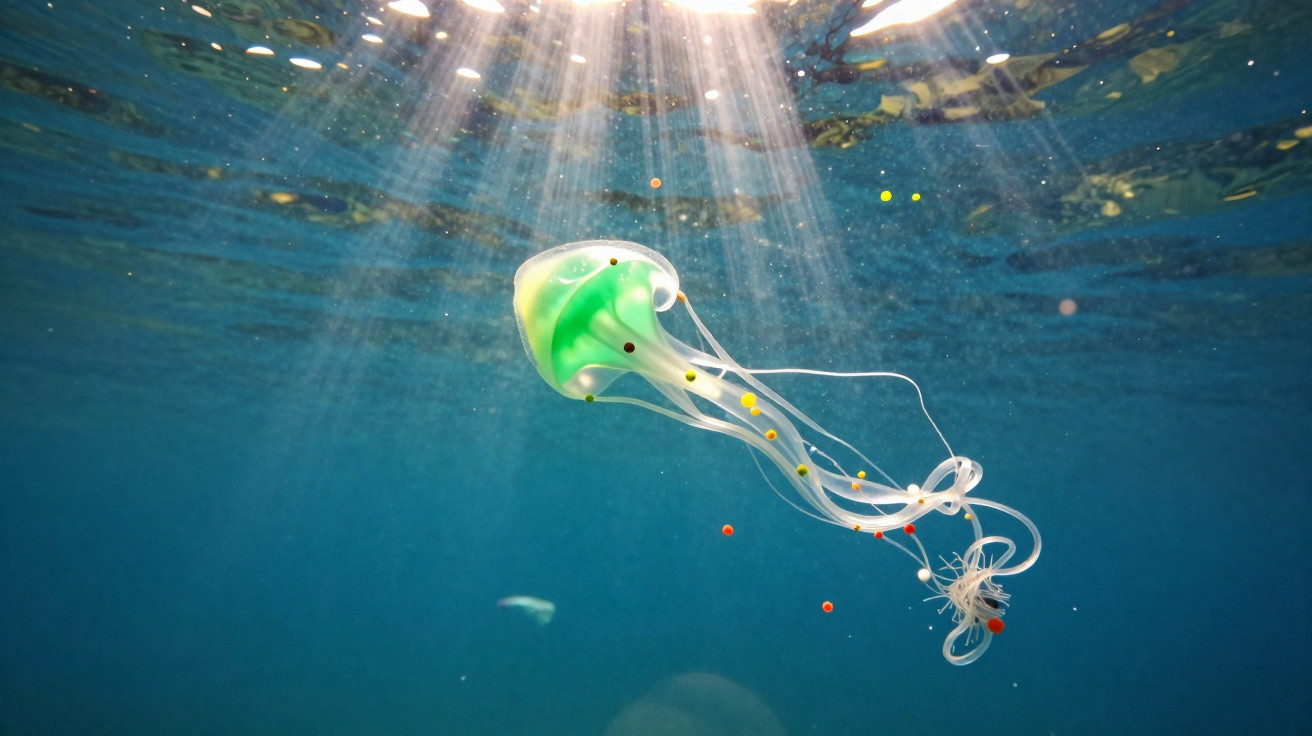
Between one-quarter and one-third of the carbon dioxide produced by people each year is taken up by the ocean. This is not the work of human-made machines or planted forests: it is simply the ocean carrying out a natural function it has always performed.
A major part of that process depends on organisms too small to be seen: phytoplankton.
These single-celled algae float through the sea’s surface waters, using photosynthesis to turn sunlight and CO2 into oxygen and sugars.
Phytoplankton rank among the planet’s most important organisms. Yet they now inhabit an ocean alongside something that interferes with them.
Microplastics have now spread throughout the ocean, reaching even Earth’s most isolated expanses of open sea.
A new study, led by the Norwegian University of Science and Technology (NTNU), investigated a key question: what is all this plastic doing to the ocean’s capacity to absorb carbon?
Francesca Verones of NTNU’s Department of Energy and Process Engineering led the research.
Small particles, multiple problems
Researchers gathered phytoplankton information from climate regions worldwide, then paired it with laboratory findings on the effects of microplastics on algal growth.
Using those results, the team estimated how varying plastic concentrations influence carbon uptake at regional and global scales.
“The ocean plays a crucial role in absorbing carbon from the atmosphere. Between 25 and 30 per cent of all human-generated CO2 is absorbed by the ocean,” Verones said.
“Phytoplankton plays an important role in this process. So, what happens if marine microplastics affect the plankton?”
The answer is that several things happen, and none are beneficial.
Certain plastics, particularly PVC, are directly toxic to algae. Others prevent sunlight from reaching deeper water, restricting photosynthesis.
Microplastics may also cause physical damage to algal cells or induce oxidative stress, disrupting their normal functions.
Microplastics hit the most vulnerable areas hardest
The study’s most concerning result relates to geography.
The places where microplastics inflict the greatest harm on carbon uptake are also those where that uptake is most crucial: arid and tropical regions.
For these locations, the researchers estimated that microplastics could cut carbon absorption by 25,000 tonnes annually in arid areas and 48,000 tonnes in tropical areas.
“We must bear in mind that the amount of microplastics in the ocean is increasing all the time,” Verones said.
“All the plastic that is discarded in the natural environment will eventually end up in the ocean. So the concentrations are going to keep on increasing.”
The wider context
The research forms part of a larger EU-funded project studying plastic’s effects on the ocean using what scientists describe as a life cycle assessment.
This framework follows a product’s environmental impact from its manufacture and use through to disposal and eventual degradation.
Its purpose is to move beyond examining environmental issues individually and instead understand the links between them.
The triple planetary crisis
The project consists of three strands. The first considers how plastic damages marine biodiversity, including when animals ingest it, become entangled in it or suffer physical injuries from it.
The second explores how floating plastic transports invasive species across the oceans, taking organisms into waters they would not otherwise naturally enter.
The third strand, represented by this study, examines plastic’s effect on ecosystem services, beginning with carbon uptake.
Together, these three strands correspond with what the UN has termed the “triple planetary crisis”: climate change, biodiversity loss, and pollution.
They are often approached as distinct challenges, each with its own funding and summits. But in the ocean, they are one interconnected problem affecting the same water and organisms simultaneously.
Wider implications of the study
This is the first study specifically to quantify plastic’s effect on ocean carbon uptake and incorporate that result into a life cycle assessment.
That it has taken so long points quietly to the siloed nature of environmental research, which has treated plastic, carbon and biodiversity crises as separate issues.
It is easy to disregard phytoplankton. They cannot be seen, and they exist far from many of the places that attract human attention.
Their role - photosynthesis performed by billions of microscopic cells throughout the world’s oceans - receives no attention unless it begins to fail.
Something is beginning to fail. Unlike a changing climate or an altering ocean current, however, this is a problem that people manufacture and send into the sea every day.


Comments
No comments yet. Be the first to comment!
Leave a Comment