
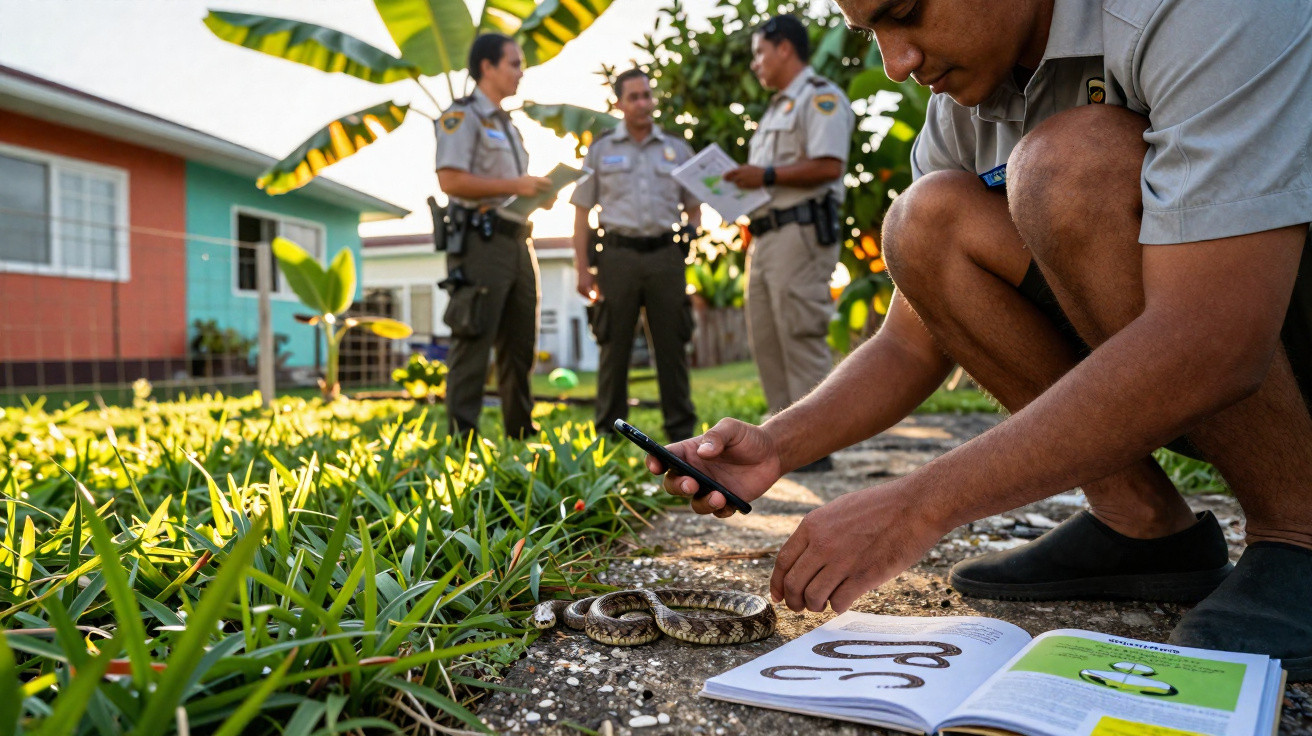
Guadeloupe looks like the perfect tropical paradise on postcards: palm trees, beaches and turquoise water. Yet behind this scenery, a quiet drama is unfolding. A once widespread, entirely harmless snake is at risk of disappearing. Researchers and public authorities are now making an unusual appeal to everyone moving around the island, from farmers to holidaymakers.
Snakes in crisis: a global phenomenon
What is happening in Guadeloupe is not an isolated case. Reptiles are under pressure worldwide. Snake populations are declining in many areas, sometimes unnoticed because these animals are secretive and are rarely seen directly.
The causes are varied, but are usually human-made. Forests are cleared, wetlands drained and farmland used ever more intensively. Places that once contained hedgerows, meadows and wilderness are now occupied by roads, resorts and monocultures. For snakes, this means fewer places to hide, less prey and more hazards.
- In Europe, adders are losing habitat to intensive farming.
- In Asia, tropical forests inhabited by pythons are disappearing.
- In North America, timber rattlesnake populations are declining.
- In Australia, invasive species are placing vulnerable native snakes under pressure.
Climate change adds another threat. As cold-blooded animals, reptiles depend on particular temperature ranges. When average temperatures shift, entire life cycles can fall out of rhythm, including reproduction, hibernation and prey availability.
In Guadeloupe, this global trend affects a particularly special species: a native colubrid found only in the Antilles, which is now at immediate risk of disappearing.
The “Couresse” snake: an almost invisible island resident
The threatened snake, most commonly called the “couleuvre couresse” in French, is among the endemic species of the Lesser Antilles. Endemic means it occurs only in this region and nowhere else in the world. If it is lost there, it will be globally extinct.
This colubrid was apparently seen far more often in the past. Today, biologists report only extremely few sightings. It is already regarded as absent from some parts of the archipelago. Elsewhere, just individual animals are recorded, too few to safely assume that a stable population remains.
What the rare snake looks like
Anyone travelling around Guadeloupe could theoretically encounter this colubrid, but would need to look closely. It has a slender build and smooth scales that gleam from dark brown to deep black depending on the light. The snakes appear elegant, almost glossy, and are generally relatively small and light.
- slender, elongated body
- smooth, dark scales with a slight sheen
- colouring ranging from brown to black
- quick, fleeting movements
- extremely shy behaviour and avoids people
The colubrid has no venom apparatus, no venom and no threatening attack posture. When it encounters a person, it instinctively chooses to flee. A brief shadow in the undergrowth, a rustle among fallen leaves, and it has usually already vanished.
The snake is completely harmless to people – but indispensable to the island’s ecosystems.
A useful garden helper despite its poor image
Snakes face a difficult reputation in the public imagination. Many people are startled by them, while some respond with panic or even violence. Especially on islands where venomous species are a concern, fear often outweighs any factual information.
In Guadeloupe, this fear leads to a tragic misunderstanding about the colubrid. The animal performs an important role in gardens, fields and scrubland. It mainly hunts small lizards and insects, keeping their populations in balance. Where it remains active, certain pests are much less able to multiply.
Scientists describe this as a “key function” in the local food web. If such a link is removed, there may be consequences: some prey species can multiply rapidly, other species come under pressure, plants are eaten more heavily and crops could suffer indirectly.
Dangerous enemies: from mongooses to domestic cats
The greatest threat does not come from people deliberately hunting the snake. Instead, the issue lies in the combination of habitat loss and introduced predators. Guadeloupe is now home to animals that did not originally belong on the island but have spread rapidly.
- Mongoose: Originally introduced to control rats, it now also hunts reptiles.
- Stray cats: Cats prey not only on birds but also on small snakes.
- Birds of prey: Species such as the kestrel, known locally as the “Gligli”, take the colubrid as prey.
Because the snakes have already become so rare, every loss carries particular weight. Young animals are easy prey, while adults have few places to retreat when scrubland is cleared and gardens are paved over.
Why authorities are now relying on the public
As specialists record the colubrid ever less frequently, there is a lack of reliable data. How many animals are still present? Where do they live? Which habitats are still functioning, and which are already empty?
These questions can scarcely be answered through scientific field studies alone. The island is large, parts of its terrain are difficult to access, and the period during which the snakes are active is limited. The Prefecture of Guadeloupe is therefore taking a new approach and specifically asking the public for help.
Every individual sighting, every mobile-phone photograph and every brief report can provide crucial clues about where the last surviving populations remain.
How the public appeal is intended to work
The principle resembles citizen science, used in Europe for projects such as bird counts and insect surveys. In Guadeloupe, the focus is now on one highly endangered species. Anyone who sees a suspicious snake in a garden, while walking or during fieldwork should report the location, ideally with a photograph, date and time.
The information is collected by the authorities and participating research teams. Experts then assess the reports, verify the species identification and map the sighting locations. Step by step, this creates an up-to-date picture of the species’ distribution.
- Reports from residents or tourists
- Verification by specialists
- Entry into digital maps
- Planning conservation measures in priority areas
The priority areas could later lead to targeted conservation programmes, such as restrictions on development plans, refuge zones in gardens, focused predator management or new information campaigns in schools.
What visitors and residents can do in practice
Anyone living in Guadeloupe or visiting on holiday can help without much effort. In most cases, being observant and briefly reaching for a smartphone is enough.
- Never kill or capture snakes.
- If one is spotted, keep your distance, take a photograph and note the location.
- Pass the report on to local authorities or conservation bodies.
- Retain features such as hedgerows, stone piles and dense scrub in your own garden.
- Keep cats indoors at night wherever possible.
Owners of rural properties can do even more: avoid clearing large areas of scrub, do not seal entire plots with hard surfaces, and use pesticides sparingly. This benefits not only the colubrid, but also birds, insects and lizards.
Why the disappearance of this snake matters to us all
At first glance, the fate of a small island snake may seem like a marginal issue. In the wider context, however, a different picture emerges: reptiles are regarded as indicators of ecosystem health. When they are struggling, something is often fundamentally wrong.
The decline of the colubrid in Guadeloupe reflects problems occurring around the world: overexploited landscapes, invasive species, rising temperatures and the loss of small-scale habitat features. Anyone who ignores these developments on an island will encounter them later on a larger scale, in forests, cities and farming regions across the globe.
For children in Guadeloupe, this snake is more than a biological footnote. It represents part of their home and the characteristic wildlife their grandparents once took for granted. If the animal is lost, it leaves a gap, including in the island’s cultural memory.
The authorities’ current initiative shows how conservation is increasingly working in the 21st century: no longer only in laboratories or protected areas, but in everyday life. Every sighting and every considered action in one’s immediate surroundings can be a building block in ensuring that this shy, black colubrid does not survive only in old stories.




Comments
No comments yet. Be the first to comment!
Leave a Comment