
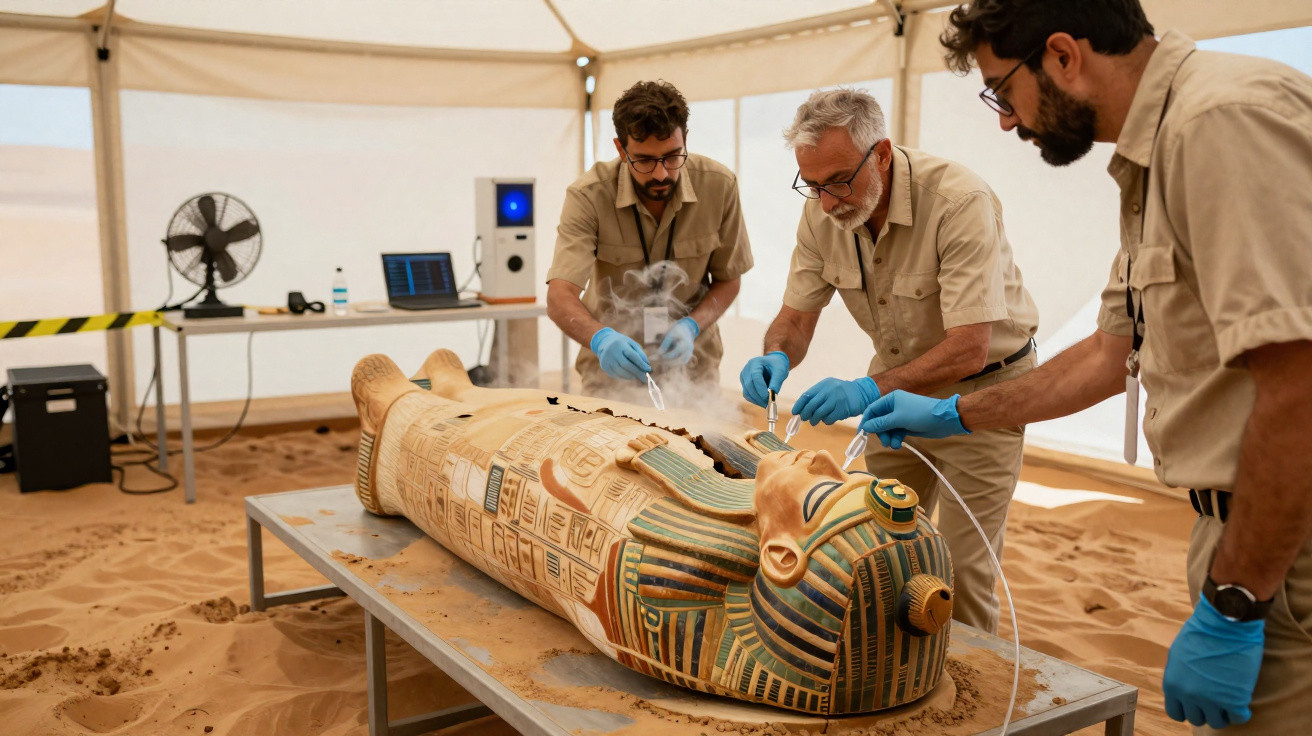
The stone lid remained sealed with ancient resin, its joins as precise as a surgeon’s stitches. When the team drilled a minute test hole to check the atmosphere, there was first a soft hiss, followed by a sweet-and-sour smell that sent experienced archaeologists stepping back. Monitors flickered and radios crackled. This was more than trapped air escaping: it was a message from an inaccessible chamber of the past, one nobody yet knew how to interpret.
The day had started with a stillness that felt less like silence than a collective held breath. Sand tapped against kneepads while a conservator placed a hand on the granite, almost as though greeting an old acquaintance. A micro-valve turned, a cold trap hummed, and the first molecules travelled into stainless-steel equipment. One person compared the odour to resin and damp soil; another suggested bitumen and garlic. The wind was indifferent to every theory. Then the sarcophagus exhaled.
What amazed the researchers was not solely the preservation of an unopened coffin, but the ongoing activity within. Although three millennia had elapsed, its enclosed chemical environment had continued changing in darkness: resins had aged, oils had broken down, and linen and bone had formed their own tiny weather system. Technicians arranged detectors in a protective ring for hydrogen sulphide, volatile organic compounds, oxygen and carbon dioxide. There were no shouts or theatrical reactions, only a deliberate widening of the working area as everyone gave the unknown more space. The lid remained closed, while the story escaped through an opening scarcely wider than a barley grain.
The sealed sarcophagus atmosphere
The “black sarcophagus” discovered in Alexandria in 2018 attracted headlines because of its unpleasant odour and morbid viral fascination. This discovery is not the same: the coffin has not been opened. The team is choosing to listen before acting. Readings from the first hour indicated a chamber with little oxygen and a mixture of volatile substances, including traces described in field notes as terpene-like and acidic, potentially produced by ancient embalming resins. A chemist recorded a faint signal compatible with acetic acid, along with a slight presence of sulphur compounds that prompted a careful withdrawal and the use of fresh masks. No one inhaled the air deliberately. Instruments did the smelling, and the chamber-if a sarcophagus can be called a chamber-revealed its history through chemistry rather than inscriptions.
Why should a coffin breathe at all? Even stone does not stop time. Plant-derived resins used in embalming, including pistacia, conifer and cedar, gradually alter as oxidation releases minute molecules. Linen treated with oils and unguents incorporates that chemistry into a layered microclimate. Where bacteria and fungi persist, they may sustain a faint metabolic activity for centuries. Bitumen seals produce almost hermetic pockets, retaining and concentrating whatever develops inside through long, slow cycles of summer warmth and winter cold. Once a micro-vent is opened, differences in pressure and temperature take over. The coffin is not living, but it acts like a small historical lung.
Careful sampling before opening
The most secure way to examine a sealed environment is to allow it to speak softly. This requires staged venting: initially a pinhole, followed by controlled collection through inert tubing and into sorbent traps, with every fraction recorded before the opening is enlarged. Chemistry must come before spectacle. A cold finger captures heavier vapours, while portable GC-MS provides an on-site outline ahead of laboratory confirmation. In-line filters are used-silver for sulphur and activated carbon for wider sampling-and an infrared sensor monitors CO₂ closely. If readings approach dangerous levels, the valve is shut, the team regroups, and the coffin returns to silence. Moving slowly is the only pace that respects both the science and the person inside.
Errors tend to arise when curiosity meets adrenaline. They include lifting the lid in a rush because the timetable is tight, handling a sample bag without gloves because it is “just one quick test”, or overlooking the fact that odours carry stories that cannot be taken back once released. In truth, this is not routine work. That is why carefully practised procedures are essential: PPE buddy checks, a designated person recording every valve movement, and a lead researcher repeating the readings aloud as though directing a dance. Everyone knows the instinct to move nearer; training means keeping your feet where they are while your mind investigates.
One field chemist stated it simply before returning to enter figures on a tablet.
“If this atmosphere truly hasn’t mixed with our air since the New Kingdom, it’s a library card we’ll only get to scan once. I’d rather read slowly than tear the page.”
- Known so far: low oxygen, a resinous signature, trace sulphur compounds.
- Unknown: pathogen risk, precise resin recipe, whether gases came from decay, ritual additives, or both.
- Next moves: staged venting, duplicate sampling, independent lab verification, non-invasive imaging.
- For readers: curiosity is welcome; certainty will take time.
What the ancient gases may reveal
What remains is an emotion that runs ahead of the evidence. The thought that 3,000 years can exist in a handful of molecules, before entering our lungs and memories, is at once intimate and unsettling. We all recognise the smell of age before we name it. If the results hold, the sarcophagus suggests that the embalmer’s world has not entirely disappeared; on a winter morning, it is slowly diffusing out and asking us not to confuse scent with myth. There is no curse in a gas chromatogram. There is wonder in a signal that takes its time. Share that, and the story continues breathing for a little longer.
| Key point | Detail | Why it matters to readers |
|---|---|---|
| Sealed atmosphere | A near-hermetic sarcophagus released ancient volatiles through a micro-vent | Explains why scientists paused before opening it and what “breathing” actually means |
| Preliminary chemistry | Resin-like terpenes, faint acids, trace sulphur compounds, low oxygen | Provides a concrete picture of what was detected without exaggeration |
| Method first | Staged venting, PPE, in-line filters, portable GC-MS, independent labs | Shows the careful process and why patience safeguards people and heritage |
Frequently asked questions
- What gases are likely inside an ancient sarcophagus? Field teams often find a mixture of carbon dioxide, low oxygen, traces of volatile organic compounds from resins and oils, and sometimes sulphur compounds resulting from microbial activity or bitumen-related chemistry.
- Is it dangerous to inhale these “mysterious gases”? Potentially, yes. Even low concentrations of hydrogen sulphide or mould-related aerosols may irritate or cause harm. This is why controlled sampling, respirators and real-time detectors are used first.
- Does the smell mean the mummy is decaying? Smell by itself does not prove active decay. It may result from the slow chemical ageing of resins and textiles. Only laboratory analysis and imaging can distinguish breakdown from stable ancient aromas.
- Could this be evidence of a “curse” or supernatural activity? No. Gases reflect chemistry, not magic. Cultural stories matter, but measurements indicate natural processes within a sealed microclimate.
- When will the sarcophagus be opened fully? Only after staged venting, duplicate samples and non-invasive scans. The process may take weeks to months, because the initial opening is also the final opportunity to conduct the science properly.




Comments
No comments yet. Be the first to comment!
Leave a Comment