
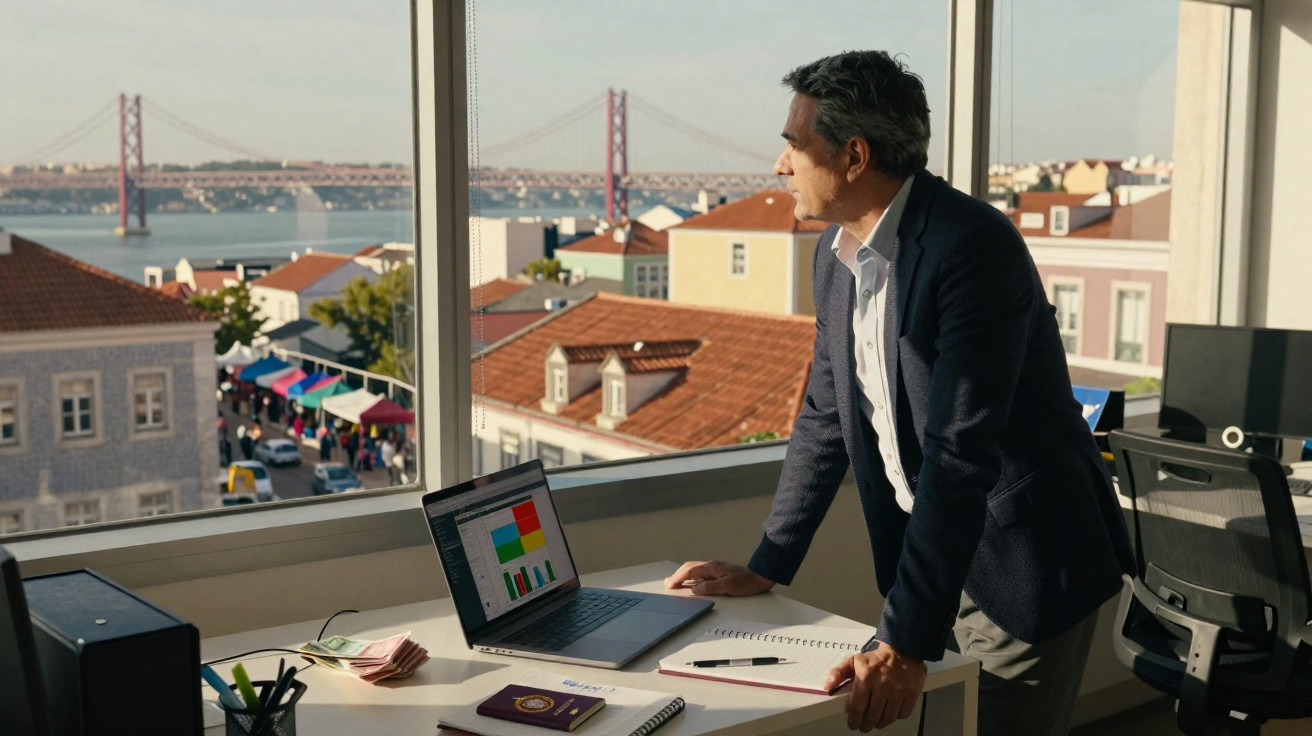
Portugal ranks fifth in the European Union for the longest average weekly working hours - 39.7 hours - behind only Greece, Poland, Romania and Bulgaria. Yet its adjusted average wage barely exceeds €2,000 gross per month, far below the EU average of €3,317.
The hasty conclusion, endlessly repeated in debates and official reports, is that Portuguese people are unproductive. The proponents of “risk-free neo-capitalism” - a system in which profits are private but the costs of poor leadership are paid by everyone - invariably place the blame on workers.
But what if that is not the reality? What if productivity figures - calculated by dividing GDP by hours worked - are distorted by a deliberate omission and by leadership failures across the state, public administration and the business sector? The available evidence, considered alongside what is known about the shadow economy and how Portuguese people perform when given decent conditions, points to an uncomfortable conclusion: the problem is not those who work, but those who lead.
Portugal’s productivity figures and the shadow economy
Statistics Portugal, the National Statistics Institute, includes an estimate of the non-observed economy in its GDP calculations. However, one detail is seldom mentioned: the Government does not publish either the value of this informal economy or the amount incorporated by Statistics Portugal into GDP. Cross-sector studies nevertheless indicate that Portugal’s shadow economy accounts for roughly 15% to 30% of economic activity, making it one of the largest in Europe.
If a substantial share of the wealth created is not recorded, the denominator used to calculate productivity is overstated in relation to the numerator. People work long hours, but part of that work never appears in the statistics. Who gains from this lack of transparency? Not ordinary workers, whose efforts remain unrecognised, but the sectors in which fraud and tax evasion are systematic.
When a business pays half a wage under the table, or fails to issue an invoice for a service, official GDP does not capture the full value created. The hours worked, however, are still counted. This produces an artificially depressed productivity figure. Workers, who often accept such arrangements because they have no alternatives, are then labelled less efficient when they are actually victims of a system that profits from making them invisible.
Portuguese workers, management and leadership
There is, however, a natural experiment that entirely dismantles the myth of “Portuguese laziness”. Portuguese emigrants in Switzerland, Luxembourg, Germany, the United States and the Netherlands consistently achieve individual productivity levels equal to or higher than the averages in those countries. This is not because they become genetically different when crossing a border, but because they encounter capable leaders, organised processes and a management culture based on results rather than time spent at a desk.
SIADAP, the Integrated System for Performance Management and Assessment in public administration, demonstrates how a poorly designed appraisal system contributes to low productivity while itself wasting working hours on pointless tasks. The difference lies with the manager, the management culture and organisational structure - not with the worker.
What is failing, then, is not Portuguese human capital, which is well educated and resilient, but management capability. Portuguese leadership remains captive to a nepotistic model, fixated on hierarchical control and remarkably tolerant of administrative inefficiency. How many working hours are lost each day queuing for a signature, attending unproductive meetings or navigating bureaucratic and absurd procedures within organisations themselves? Those hours are attributed to workers, but leaders bear the responsibility. At the Tax Authority, I could write an entire book about useless internal processes.
Labour reform, precarious work and political accountability
It is in this setting that “labour reform” emerges, promising to “combat precariousness” while persisting with measures that give employers greater flexibility. The narrative is always identical: work must become more productive, and because workers supposedly refuse to cooperate, they must be disciplined through more insecure contracts and more flexible hours.
Portuguese people work many hours, but those hours are poorly managed. In practice, the “labour package” worsens precariousness - especially for young people, nearly 40% of whom are on temporary contracts, the fourth-highest figure in the EU, and for immigrants, 34% of whom are in temporary work compared with 14% of nationals. Rather than demanding better management, workers are asked to accept their situation.
If the issue is low measured productivity, why is there no commitment to an in-depth investigation into the shadow economy and tax fraud? Why is tackling fraud and economic crime absent from the top priorities of every government? The uncomfortable answer is that the shadow economy is not merely tolerated: in many sectors, it is structural. It is also because political and administrative leaders themselves have dismal productivity.
Appointments based on party loyalty and personal friendships, alongside the lack of meaningful performance assessment for senior officials, undermine leadership quality.
And what of political leaders who have promised for decades to “simplify” and “cut red tape” but never deliver? Who keep state services under chronic pressure? Tax evasion costs the country billions of euros every year - money that would increase GDP and, with it, productivity. But tackling evasion requires will, independence and technical expertise: precisely the things our leaders have prevented the Tax Authority from obtaining.
This is not to deny that Portugal has some productivity problems. It is to ask where the true source of those problems lies. The available data suggests a clear answer: the problem is not the person who clocks in at 9 am and leaves at 7 pm. It is the person who decides, manages and legislates.
Workers’ Day should have been an opportunity to remember this: Portugal does not need longer hours or more flexibility. It needs to end mediocre leadership and tackle tax evasion, corruption and the shadow economy. Do that, and the country will quickly become more productive.





Comments
No comments yet. Be the first to comment!
Leave a Comment