
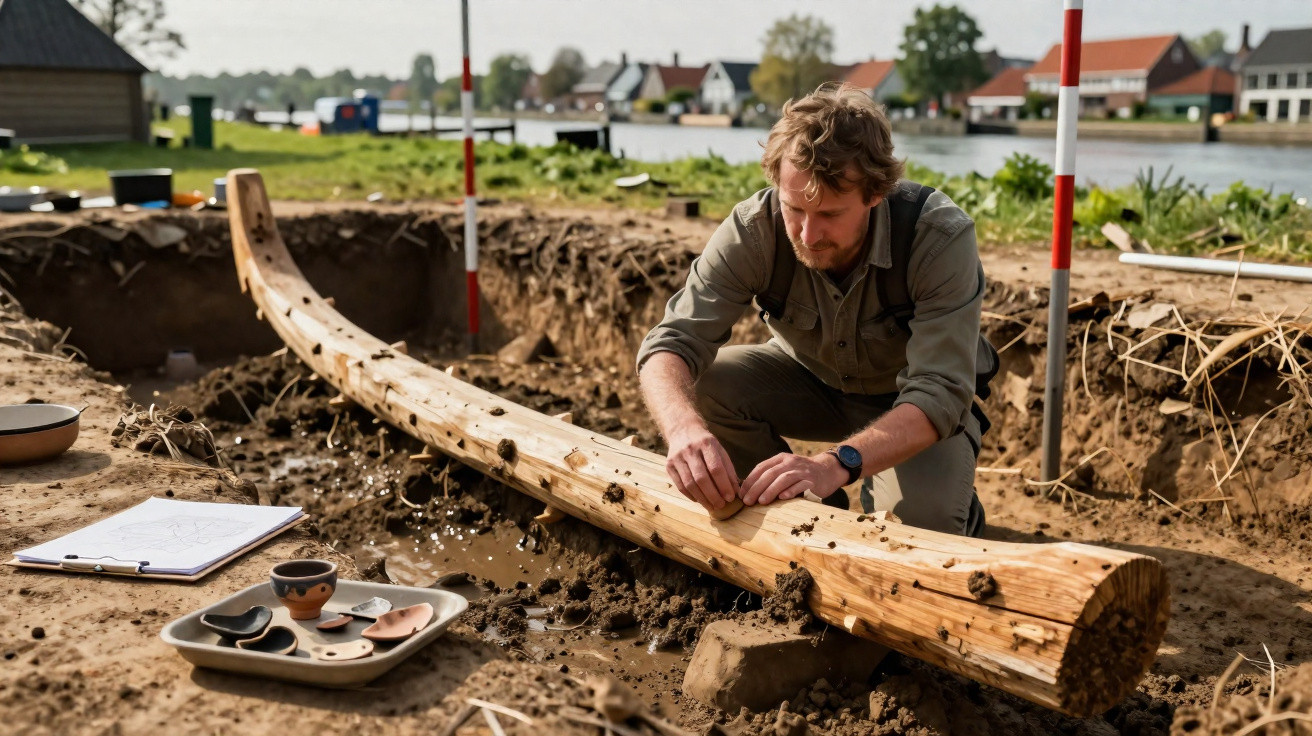
Beneath an unremarkable street in the Dutch town of Wijk bij Duurstede, a huge timber has emerged that rapidly proved to be far more than discarded building wood. Specialists believe it may be a structural rib from a medieval vessel – perhaps dating from the Viking Age or from a later peak in North Sea commerce. Crucially, the discovery was made on the site of former Dorestad, a major hub of early European long-distance trade.
How a drainage scheme became an unexpected sensation
The story began at a construction site on de Promenade in Wijk bij Duurstede. The municipality is replacing ageing sewer pipes and creating a modern rainwater retention basin. At first, there was nothing to suggest an archaeological discovery: excavators, pipework and construction noise were simply routine features of an urban works project.
That changed when an unusually large piece of timber protruded from the excavation. It measures around 3.20 metres in length, is roughly 30 centimetres thick and shows clear signs of shaping. Danny van Basten, an amateur archaeologist with the local ArcheoTeam, took a closer look and immediately recognised that it was not ordinary construction timber: its form appeared characteristic of a ship. He alerted the local authority, which then called in experts from Museum Dorestad and the foundation responsible for a historic Viking ship.
Initial examination revealed notches, tool marks and a curved profile strongly resembling a frame – one of the ribs that gives a ship’s hull its shape. In a television interview, a Dutch shipbuilding specialist confirmed that both the proportions and workmanship were consistent with a ship’s structure.
“Within a few hours, what seemed to be a beam becomes a possible section of a medieval ship’s hull – with enormous implications for research.”
At the same time, a strict preservation procedure came into force. Municipal archaeologist Anne de Hoop arranged for the wooden structure to be carefully lifted, immediately wrapped and transferred to secure storage. There, the timber is being cleaned gradually and kept damp to prevent cracking or distortion. With oak that has survived for centuries, every sudden shift in temperature or moisture matters.
Why this particular location is so significant
In many other places, the find would simply be an intriguing curiosity. In Wijk bij Duurstede, it carries far greater importance. The modern small town stands on the site of Dorestad, an early medieval port city that was among northern Europe’s leading trading centres from the 7th to the 9th century.
Dorestad linked the Rhine to the North Sea and the Frankish realm. Goods from many routes converged here, including:
- pottery and glass from different parts of Europe
- textiles, furs and leather goods
- metals, weapons and jewellery
- luxury imports such as wine and fine pottery
Whoever controlled the river junction at Dorestad also controlled taxes, tolls and political alliances. The settlement was therefore highly sought after. Written sources record attacks by Scandinavian groups in the early 9th century, and Dorestad was repeatedly targeted in raids.
This combination of commerce, power and violence is precisely what makes the discovery so compelling. A ship component at such a strategic point could have belonged to many kinds of vessel: a cargo carrier, escort ship, military craft or local transport boat. Every centimetre of wood may reveal part of that story, from the hull’s width to whether the vessel was designed for rivers, coastal waters or the open sea.
“The location on the site of the old trading town turns a fragment of timber into a possible key to the economic and political history of the early Middle Ages.”
Viking ship, Carolingian era or a later trading cog?
The obvious question is whether this is a ship connected with the Vikings. For now, experts are refusing to endorse that headline too quickly. Instead, several possible interpretations remain under consideration.
Possible dates at a glance
| Period | Interpretation | Historical implication |
|---|---|---|
| c. 700–900 | Carolingian period, early contacts with Scandinavia | The ship may have operated within the first North Sea trading networks and during early Viking activity |
| 9th century | Period of documented attacks on Dorestad | A possible warship or hybrid type combining trade and violence |
| around 1200–1300 | Late medieval merchant shipping, typical cog | The vessel would provide evidence of later North Sea and Baltic trade, perhaps linked to the Hanseatic League |
Some of the evidence, including the timber’s position in the ground and nearby pottery fragments, cautiously points towards the Carolingian era. If so, the ship could belong directly to the period when Dorestad lay between the Frankish empire and Scandinavian groups.
However, archaeologist de Hoop urges restraint. The timber’s shape and workmanship could also fit a later trading cog. These box-like cargo ships dominated the movement of goods across the North Sea and Baltic during the High and Late Middle Ages. Such a date would make the discovery younger, but no less important: it would point towards the era of major merchant towns and the Hanseatic League.
How research will solve the Wijk bij Duurstede ship mystery
To answer the unresolved dating question, researchers will use a well-established technique: dendrochronology. The tree rings in the timber record the tree’s growth. By comparing that pattern with regional reference sequences, it is often possible to identify the felling date to within a few years.
In the best case, the analysis can provide several clues at once:
- an approximate felling date and therefore the ship’s construction period
- the possible source of the oak, whether a local woodland or imported timber
- insights into shipbuilding traditions in a particular region
Conventional archaeological examinations will complement this work. Which tools left the visible marks? How was the wood bent and worked? Do its dimensions correspond with known vessel types? Each finding narrows the range of possible answers.
“The combination of tree-ring analysis, tool marks and archaeological context will determine whether the timber belongs more to the early phase of Viking contacts or to the era of the great Hanseatic merchants.”
What the discovery reveals about medieval trade and everyday life
Even before a final date has been established, the find demonstrates how closely technology, economics and politics were connected on the river. A ship is never merely an object made from wood. It reflects practical decisions, including:
- how much cargo it needed to carry
- the water depth for which it was intended
- how manoeuvrable it needed to be – for swift raids or lengthy freight routes
The thickness of the frames, the curvature of the hull and the type of joints all indicate the vessel’s purpose, the risks faced along its route and the knowledge of its builders. At a crossroads such as Dorestad, local traditions would have mixed with influences from the Rhine, the North Sea and Scandinavian coasts.
The discovery also encourages a more nuanced view of the Vikings. Archaeologists have stressed for years that trade and exchange were often more important than dramatic plundering raids. Should a Scandinavian connection be confirmed, the vessel may have served not only as an instrument of war but also as transport for goods, people and ideas.
How the public will share in the story
The municipality of Wijk bij Duurstede announced the find early on through social media, attracting considerable interest. Museum Dorestad is already planning to display the timber once the analyses have been completed. Visitors will then be able to encounter a highly tangible piece of the Middle Ages, far removed from maps and abstract timelines.
Standing in front of a conserved frame makes it easy to grasp how large these vessels were, how substantial their construction was and how closely the modern town is woven into its past. A building site on a contemporary street has suddenly become a window onto a river-port district from more than a thousand years ago.
Explainer: what are a ship’s frame and a cog?
For anyone unfamiliar with shipbuilding, the technical terms can be confusing. A frame is essentially a ship’s “rib”. A succession of frames forms the skeleton onto which the planking is fixed. Their shape determines the curve of the hull, and therefore its stability and cargo capacity.
The frequently mentioned cog was a type of vessel particularly common from the 12th to the 14th century. Its typical features include:
- a broad, rounded hull with a large cargo hold
- usually a single mast carrying a large square sail
- a pronounced high stern and often a raised bow
- use mainly in the North Sea and Baltic regions
If the timber from Wijk bij Duurstede corresponds more closely to these features, the interpretation will lean towards the Late Middle Ages. If, instead, it reveals a slimmer shape suited to rivers, it may belong to an older, perhaps early North Sea vessel.
For researchers, the appeal lies precisely in this uncertainty: one well-preserved component can call entire trade routes into question and turn an ordinary excavation into a source for Europe’s economic history.






Comments
No comments yet. Be the first to comment!
Leave a Comment