
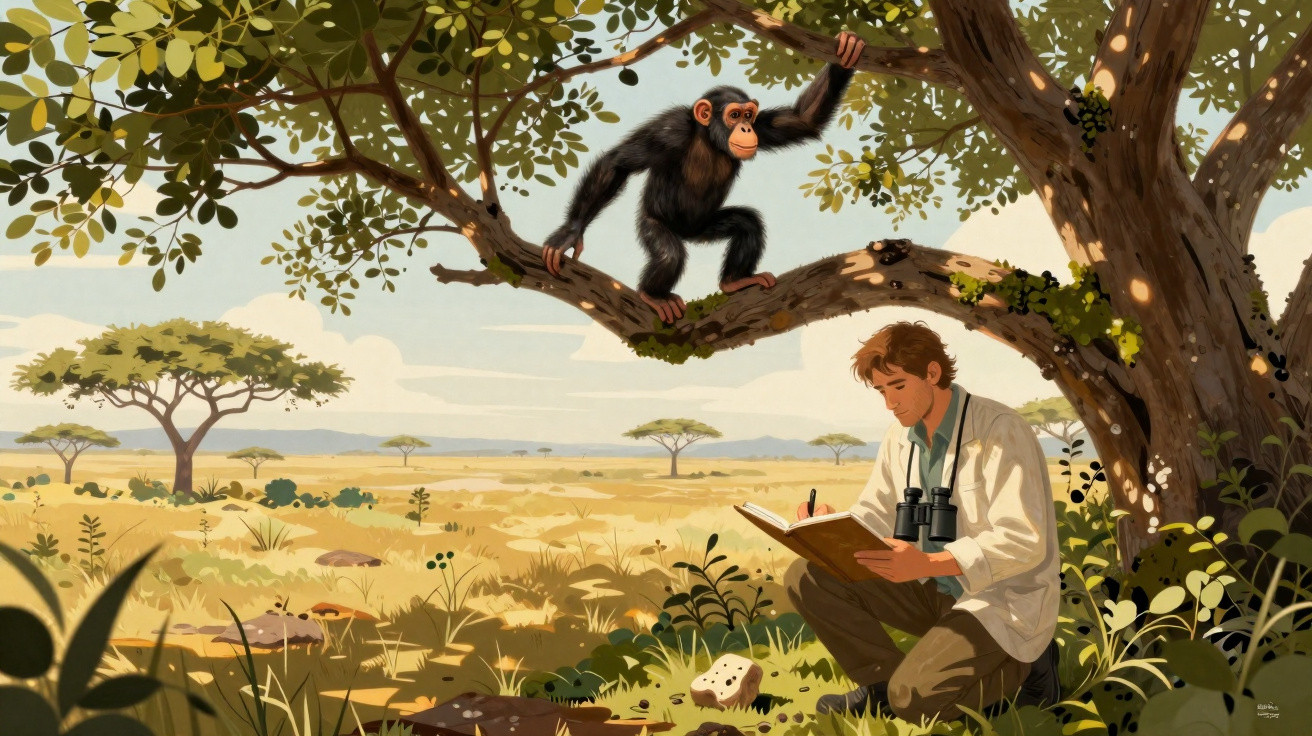
Early human ancestors may have developed upright, two-legged walking in the trees, rather than on the solid ground of Africa’s ancient savannah.
A landmark study, led by scientists from Germany’s Max Planck Institute of Evolutionary Anthropology, has found a connection between the woodland foraging methods of chimpanzees in Tanzania’s Issa Valley and how they move. The findings raise the prospect that bipedalism in our own lineage may have evolved to help ancestors reach upwards, rather than travel across open terrain.
Rethinking the origins of bipedalism
This explanation disputes the deeply familiar picture of early human ancestors taking their uncertain first steps as climate change opened up the landscape. In that account, they had to leave the trees and cross the savannah on foot, facing large cats and an unfamiliar environment while seeking food and shelter.
"For decades it was assumed that bipedalism arose because we came down from the trees and needed to walk across an open savannah," says Max Planck Institute anthropologist Rhianna Drummond-Clarke.
When, then, did early human ancestors begin walking upright, and what prompted them to do so?
These remain two of palaeoanthropology’s most compelling questions. In their latest research, the team examined how chimpanzees (Pan troglodytes schweinfurthii) forage in trees in relation to different tree types, uncovering several possible clues.
Issa Valley chimpanzees and tree foraging
Chimpanzees in the Issa Valley inhabit savannah mosaics: dry, open woodland environments resembling the palaeohabitats travelled through by early hominins, the group that includes modern humans and extinct ancestors. They occupy some of the world’s driest regions inhabited by chimpanzees, where grass fires affect more than 75 percent of the landscape during the May-October dry season.
Despite living in these savannah mosaics, the Issa Valley chimpanzees spent far more time in trees than expected-an amount comparable with chimpanzees living in densely vegetated forests. This is partly because their foods demand more processing: seeds need to be extracted from pods, while unripe fruit is more fibrous and requires greater effort to consume.
The particularly notable finding is that, because chimpanzees are comparatively large, they travel through trees either by hanging beneath branches or by standing and walking upright while using nearby branches to maintain their balance.
How arboreal movement may have shaped upright walking
The unexpectedly high degree of arboreality and branch-walking seen in these chimpanzees-behaviours also documented in other populations-supports hypotheses proposing that ancient apes and human ancestors slowly moved towards habitual bipedalism, or upright walking, while still in an arboreal setting.
That possibility runs counter to the common explanation for why humans became so adept at moving on two legs.
Near the end of the Miocene Epoch, 23 to 5.3 million years ago, forests gave way to savannahs. This environmental shift was thought to have driven hominins towards orthograde locomotion, or upright walking, so that they could travel more effectively through open landscapes where food sources were more widely dispersed.
However, fossils of hominids dating from roughly 4 to 7 million years ago-around the transition from the late Miocene to the early Pliocene-are scarce. This was a crucial period that may have involved a broader emergence of habitual bipedalism in response to ecological change.
What fossil evidence does exist from the late Miocene indicates that several extinct hominins retained traits suited to life in trees, including comparatively long upper limbs and curved fingers.
In addition, analyses of tooth wear and carbon isotopes indicate that certain hominins continued to depend substantially on tree-derived foods despite living in open habitats. Their diets may, in some cases, have resembled those of living chimpanzees, making the apes a valuable comparison.
"We suggest our bipedal gait continued to evolve in the trees even after the shift to an open habitat," explains Drummond-Clarke.
Much as bicycle training wheels provide support while a rider learns, human ancestors may have practised their gait in trees, where branches could be gripped for stability. Over time, this may have helped them develop the upright movement abilities required to survive in increasingly open habitats with less abundant food, before eventually spreading to almost every part of the world.
The research was published in Frontiers in Ecology and Evolution.






Comments
No comments yet. Be the first to comment!
Leave a Comment