
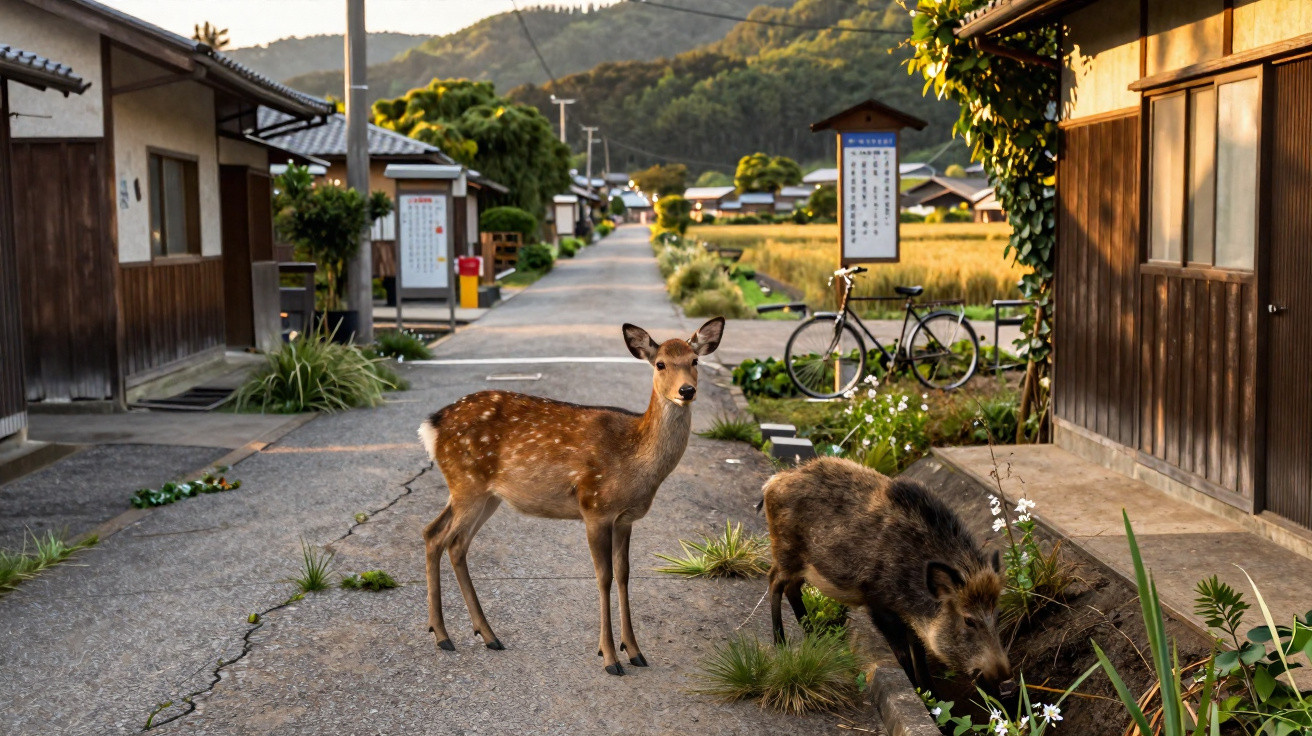
Across rural Japan, empty homes are becoming a familiar sight, while the rice paddies alongside them are left uncultivated. Villages that formerly supported hundreds of people may now have only a few dozen residents, with a large proportion of them in later life.
This vacated landscape is not remaining unoccupied. Wildlife is expanding into the areas people have left, and new projections suggest it will extend into nearly every part of Japan within a single human generation.
Tracking the spread
The species in question are sika deer and wild boar. The projection was produced by a team headed by Takahiro Morosawa of the Japan Wildlife Research Center (JWRC), who investigated the factors driving the movement of both animals across the country.
Climate and topography appeared to be the likely explanations. However, the clearest pattern in the data was more straightforward: the areas deer and boar colonised next were determined chiefly by how near they were to their existing range.
Milder winters and altered land use did contribute, although less strongly. Deer and boar are highly capable of moving into unfamiliar territory, and when the model is projected forwards, it places them across most of Japan by 2050.
Sika deer and wild boar follow different patterns
Despite these similarities, the species do not act alike. Sika deer tend to avoid people, becoming scarcer in densely settled areas and preferring woodland and hilly landscapes.
Wild boar are less constrained. They establish themselves in areas already occupied by people, advancing along suburban fringes and into developed districts that deer generally shun. Boldness, rather than habitat alone, appears to shape their movements.
The projections reflect this difference. Deer are expected to occupy the wooded interior while avoiding the densely populated Kanto region surrounding Tokyo. Wild boar, meanwhile, are forecast to spread into those developed areas as well.
As the population recedes
Underlying the wildlife story is Japan’s demographic decline. The national population has been shrinking for years, with the steepest falls occurring in rural areas as younger people relocate to cities and older residents remain.
As people depart, the forces that once restrained these animals weaken. Unworked fields turn into abandoned farmland, becoming overgrown and offering food to wildlife moving through. A smaller rural population also means fewer hunters in the uplands.
In the model, densely populated locations deterred the animals, particularly deer, an influence associated with hunting pressure. Another study of Japan’s large mammals likewise connected their movement into human areas with this reduction in control.
The snow question
Historically, snow has defined the boundaries for both species. Thick winter snow cover restricts movement and leaves them short of food, keeping the cold and snowy north beyond their reach for decades after the war.
With warmer winters bringing less snow, this obstacle is receding, allowing the animals to move into territory where the conditions once excluded them. In heavy-snow regions where deer had not previously been recorded, snow-tolerant conifers now provide winter shelter.
Snow has a less certain effect on wild boar. Their short legs struggle in deep snow, meaning the extent of their northward expansion will depend on how far winters become milder, an issue the researchers leave unresolved. A 2016 paper had already associated declining snow cover with the spread of deer.
A prolonged recovery
Their resurgence has roots well beyond the past few decades. During the prehistoric Jomon period, deer and boar occupied areas throughout Honshu, Japan’s principal island, before centuries of hunting forced them into isolated refuges.
Their populations reached their lowest point around 1950, reduced more by hunting than by climate or predators. Japan then replanted extensive forest areas following World War II, creating space in which both species could recover.
That recovery has been dramatic. From 1978 to 2018, the deer range expanded by almost threefold, while the boar range nearly doubled. Both species have also returned to the snowy north from which they had once retreated.
An enduring presence
To create the projections, the researchers split Japan into thousands of grid squares, each measuring about 5 kilometres across, and recorded whether deer or boar occupied them in 1978, 2003 and 2014. After establishing themselves in an area, the animals very rarely leave it again.
During the first period examined, deer disappeared from fewer than 2% of their grid squares, while boar disappeared from about 6%. This persistence is notable. A previous projection estimated that deer would occupy 70% of the country by 2103, whereas this model brings that near-nationwide expansion forward by more than half a century.
The wild boar projection is significant in its own right. Before this work, no study had mapped where the species was likely to expand across Japan. It is a first for Japan, offering managers a future view they had not previously had.
Preparing for new arrivals
More animals are likely to occupy much more land. Deer and boar damage young trees and agricultural crops, cause collisions on rural roads, and carry ticks and disease. One study linked the increasing number of deer in Japan’s forests to this health risk.
The research gives managers an opportunity to act earlier. By identifying where deer and boar are likely to arrive, authorities can target hunting and install fencing before animals become established, rather than responding only once damage has occurred.
For decades, it was unclear whether snow or urban areas would ultimately stop the expansion. This research provides an answer: if left unmanaged, neither is likely to do so. As rural Japan loses population, deer and boar appear set to take over much of the land people leave behind.





Comments
No comments yet. Be the first to comment!
Leave a Comment