
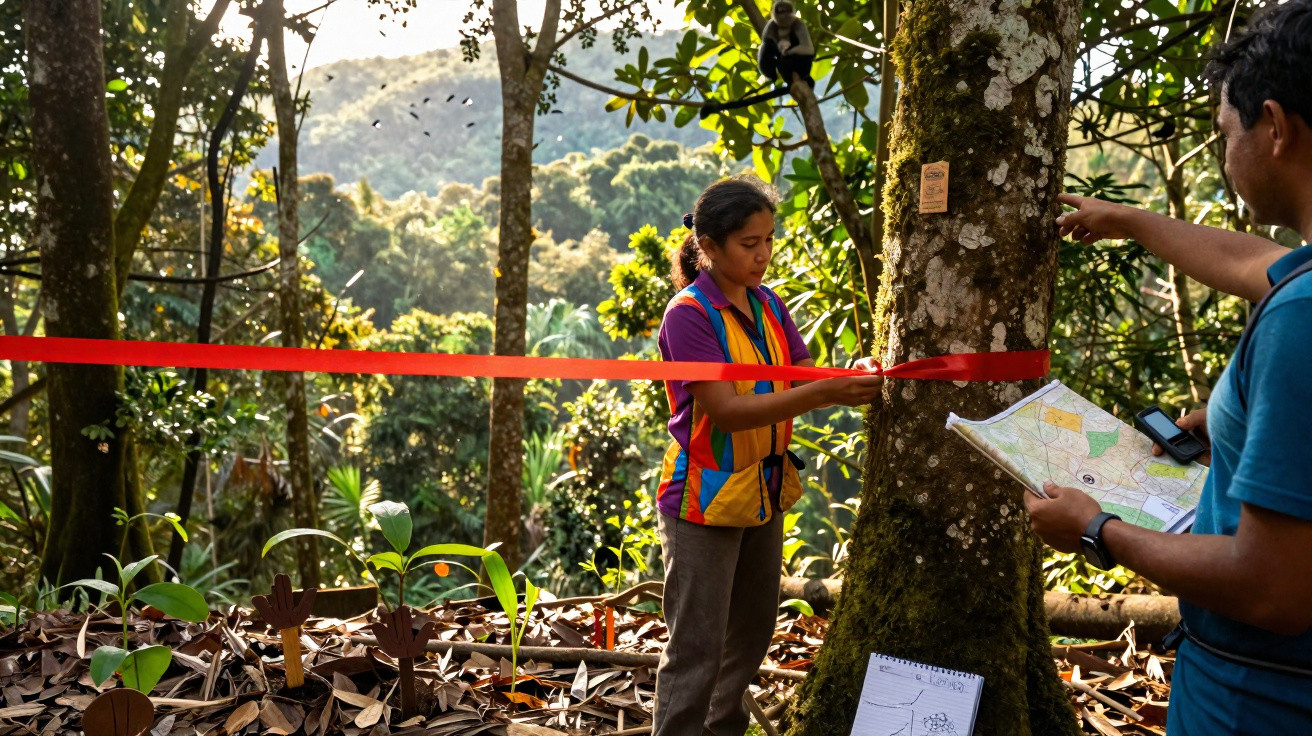
In a Nepalese village on a hillside, children race through young sal trees as a woman in a vivid red shawl carefully records the number of trunks felled this month in a battered notebook. At the forest boundary, a weathered sign bears the peeling words “Community Forest – Our Future”. There are no fences or guards, yet the woodland remains.
Only a few years earlier, this hillside was nearly stripped bare. Timber was quickly sold, while heavy rain carried the exposed soil away. Now, the same ridge appears deep green on satellite imagery and has brought smiles to local faces. The difference was not an elaborate climate scheme, but control over decision-making. Across the world, more than 40,000 community forests are managed by local people, quietly retaining tonnes of carbon and providing refuge for species with few other places to survive.
Spend enough time listening and the change becomes clear: the forest is no longer simply a commodity; it is a relationship.
From “empty land” to a living shield for climate and wildlife
A closer look at a global deforestation map reveals something striking. In many places, cleared areas end abruptly at borders that cannot be seen. One side has clear-felling, fires and cattle; the other retains an unbroken canopy and birdsong. Those unseen lines frequently define community forests: land whose rights are legally held by local villages, Indigenous peoples or user groups.
Researchers have identified more than 40,000 community forests across Latin America, Africa and Asia. Behind that figure lies extraordinary diversity. Some consist of a few dozen hectares of agroforestry in Guatemala, while others cover extensive mosaic landscapes in Mexico or the Congo Basin, where farmland, rivers and sacred groves meet. Their shared principle is straightforward: those living nearest to the forest determine how it is used.
Changing who makes the decisions changes how trees remain standing - and for how long.
For instance, nine community forest concessions operate within Guatemala’s Maya Biosphere Reserve, an area that could easily have turned into a logging frontier. Two decades ago, many observers expected widespread destruction after local people received logging rights. The reverse occurred. Satellite records show these community concessions have among the region’s lowest deforestation rates, even below those of neighbouring strictly protected national parks.
A walk with forest rangers from Uaxactún explains why. Each tree selected for felling is checked. Families know which area will be harvested a decade from now and which streams need shade to protect fish. Children are taught to measure trunk diameter before they can read a climate report. Income is reinvested in schools, clinics and patrols. These are not idealised “untouched” forests; they are managed much like a cherished garden that also sustains a family.
The same trend can be seen in Nepal’s middle hills, Tanzania’s village land forest reserves and Mexico’s well-known ejidos. When rights are secure and communities are organised, forests remain greener on the map - and village life remains more viable.
Why does community control support climate protection and biodiversity hotspots? Time is the first part of the answer. External companies commonly work to short contracts and quarterly returns. Local people plan around harvests, weddings, difficult seasons and children who will require firewood in 15 years. Such a longer outlook promotes selective felling, regeneration requirements and the protection of seed trees.
Knowledge matters next. Local residents understand which valley floods earliest, which ridge receives the strongest winds and where a rare medicinal orchid continues to flower. Official management plans seldom capture these details, although they guide countless everyday decisions: where goats graze, when fires are prohibited and which species should be replanted. Collectively, those decisions retain carbon in tree trunks and soil, while preserving room for monkeys, insects, fungi and large predators that rely on continuous habitat.
There is also a less measurable factor: dignity. People are more likely to defend land they feel they own. Remote forests labelled “state-owned” can be viewed as nobody’s responsibility and everyone’s opportunity. Once a village assembly has formally established a community forest, felling a living tree without approval is no longer a harmless act. It becomes theft from neighbours - and from grandchildren.
How communities protect forests, tree by tree
Every satellite image of intact green cover is underpinned by an ordinary routine: meetings, rules, patrols and disagreements. The operational core of community forestry is a management plan, not a polished document left on a shelf but an active set of rules defining who may do what, where and when. Many communities separate their forests into zones for strict protection, sustainable timber extraction, fuelwood collection, grazing or sacred places that remain untouched.
A common approach works as follows: villagers map the forest by combining GPS with local memory. They establish harvesting rotations, such as removing only mature trees of specified species once every 20 or 30 years in a particular block. Limits are set on the wood each household may take without charge and on what must be paid for. Although unpopular, fines are enforced. Patrol teams walk at dawn or after dinner, alert for illegal chainsaws and gunshots. It may appear orderly on paper, but in practice it is an ongoing negotiation with both nature and fellow residents.
During a misty morning in Tanzania’s Kilosa District, a village forest committee meets beneath a mango tree. Charcoal is the central issue. Young men want the income generated by selling it in town, while elders fear the miombo woodland is rapidly thinning. Their compromise is to designate one small area for tightly regulated charcoal production, with firm quotas and compulsory tree planting around farms. A separate zone is closed to axes so wildlife and watersheds can recover.
The decision is entered in a worn ledger before a committee member photographs the page on his phone and sends it to the district office. Bureaucracy meets WhatsApp. The system is imperfect, and some residents will still breach the rules. Nevertheless, compared with the earlier free-for-all, the forest now has boundaries, seasons and common expectations. Over five or ten years, these are the conditions that rebuild canopy cover and retain carbon in the soil.
Many policies endorse community rights in theory, but conditions on the ground are tougher. Land titles can remain trapped in administrative offices. Rangers may harass villagers even when they comply with regulations. Timber businesses lobby governments for access. In some cases, corrupt local leaders take the benefits for themselves. The appealing image of “forest guardians” conceals genuine struggles for power and the burden of exhaustion.
Let’s be honest: nobody in a poor rural village wakes up chiefly concerned with global climate graphs. They are thinking about school fees, the next harvest and whether the stream will still flow in May. This is precisely why community forests can persist when top-down conservation fails. If the forest storing carbon also provides fodder, mushrooms, clean water and modest income from certified timber, people have immediate, everyday reasons to keep it alive.
That balance can break down in a difficult year. Drought, crop failure or political crisis can make selling logs seem desperately appealing. Some community forests have, in fact, reverted to open access. The success stories celebrated today depend on a complicated combination of rights, incentives, pride and external assistance. They are not miracles. They are hard-won arrangements that need constant care.
What this means for you, even if you live far from the forest
All this may seem to take place on a different planet: mist-covered Nepalese ridges, humid Amazon clearings and cicada-filled savannas. Yet threads lead from those 40,000 community forests into everyday life. Consider the certified timber in a bookcase, coffee marked “shade-grown” from a smallholder co-operative or the carbon offset quietly purchased by an employer each year. Many such products rely on communities that keep trees standing through choice rather than coercion.
To make everyday decisions more supportive of those choices, begin with small, practical steps. Seek labels linked to community or Indigenous management instead of vague “green” promises. Back NGOs focused on land rights as well as tree planting. When travelling, choose guides or lodges owned by local co-operatives, ask who controls the surrounding land and genuinely listen to the response. Such actions will not change the world overnight, but they shift money and attention towards people undertaking the slow work of protection.
On a screen, the climate crisis can appear abstract: graphs, degrees and scenarios. Along a forest track, the experience is the reverse. You notice lines of stumps creeping uphill and springs that once flowed throughout the year drying up in August. We have all experienced a moment when the world seems to be changing faster than our habits can. That is why advice based on guilt often fails: people freeze, scroll and move on.
A more truthful response recognises limitations. You cannot personally patrol a forest in Cameroon, and you are unlikely to read every page of your pension fund’s ESG report. But you can choose a few points of influence - spending, voting and professional expertise - and link them to particular people and places. Discuss those connections over dinner and in meetings, not as moral lectures but as stories: “This coffee comes from a cooperative that saved a corridor for jaguars,” or “This village in Indonesia doubled its income when its forest rights were recognized.” Small stories spread.
“When the government said this forest was ours, I slept here the first night,” one Mexican community leader told me, laughing softly. “Not because I was guarding it. Because for the first time, I felt at home under these trees.”
There is a subtle strength in that sort of attachment, and it travels outward in ways policy PDFs never can. If you are unsure where to start, consider these simple entry points:
- Choose at least one regular purchase - coffee, chocolate or timber products - that demonstrably supports community or Indigenous rights.
- Follow and share the work of one organisation defending land rights or community forestry.
- Ask your employer or university how its climate strategy supports locally led forest protection, rather than only faraway offsets.
Forests that belong to people who belong to forests
Somewhere tonight, in a forest you will never see, someone is walking with a torch and a worn notebook rather than a rifle. They are checking boundaries, listening for lorries and perhaps pausing to touch the bark of a tree planted by their grandmother. In climate science language, this person is “avoiding emissions” and “protecting biodiversity hotspots”. In their own words, they are simply caring for what belongs to them.
More than 40,000 community forests create such a patchwork around the globe. Many are too small to appear in glossy reports, while a handful are conservation-world stars. Together, they hold billions of tonnes of carbon and shelter more birds, insects, mammals and tree species than have even been named. Their true strength is continuity. Year after year and meeting after meeting, they reject quick money in favour of a living landscape to pass on to the next generation.
These landscapes are not static museums. Children move to cities, mobile phones arrive and market prices change. Some communities will decide to harvest more, while others will choose greater protection. Forests will grow, burn and regenerate. Still, every time a village secures rights to its land and uses them to retain a forest, the balance shifts slightly: less carbon in the atmosphere, more oxygen in the breeze, and another haven where a tapir can drink, an orchid can cling to a branch and a child can grow up knowing the scent of rain-soaked earth.
Viewed from far enough away, these 40,000 green areas resemble a scattered archipelago: islands of resilience in a warming world. They raise a lingering question - not only how forests can be saved, but how to live so that this kind of guardianship becomes ordinary rather than heroic.
| Key point | Detail | Why it matters to the reader |
|---|---|---|
| Community forests slow deforestation | More than 40,000 community-managed forests show lower forest loss than nearby areas | Demonstrates that local control can outperform distant regulations in climate impact |
| They retain vast carbon stocks | Long-term, selective management keeps carbon in trunks, soil and roots | Links everyday decisions, including products and advocacy, to tangible climate benefits |
| They protect biodiversity hotspots | Traditional rules and sacred areas safeguard distinctive species and habitats | Shows how culture and conservation strengthen one another in practice |
FAQ:
- What exactly is a community forest? A community forest is land where local people or Indigenous groups have recognised rights to manage the forest and benefit from it, normally through shared rules and a formal management plan.
- How do community forests help fight climate change? They limit deforestation and promote careful harvesting, retaining carbon in trees and soil instead of allowing it to enter the atmosphere.
- Are community forests always successful? No. Some fail because of insecure land rights, corruption or poverty-related pressures, but many work as well as, or better than, state-managed protected areas where rights and support are strong.
- Can urban consumers really support community forests? Yes, by purchasing goods from community co-operatives, supporting land-rights campaigns and pressing companies or institutions to finance locally led forest protection.
- Do community forests mean no logging at all? Not necessarily. Many permit selective, planned logging and use the proceeds for schools, clinics and patrols, while keeping the forest ecosystem largely intact.






Comments
No comments yet. Be the first to comment!
Leave a Comment