
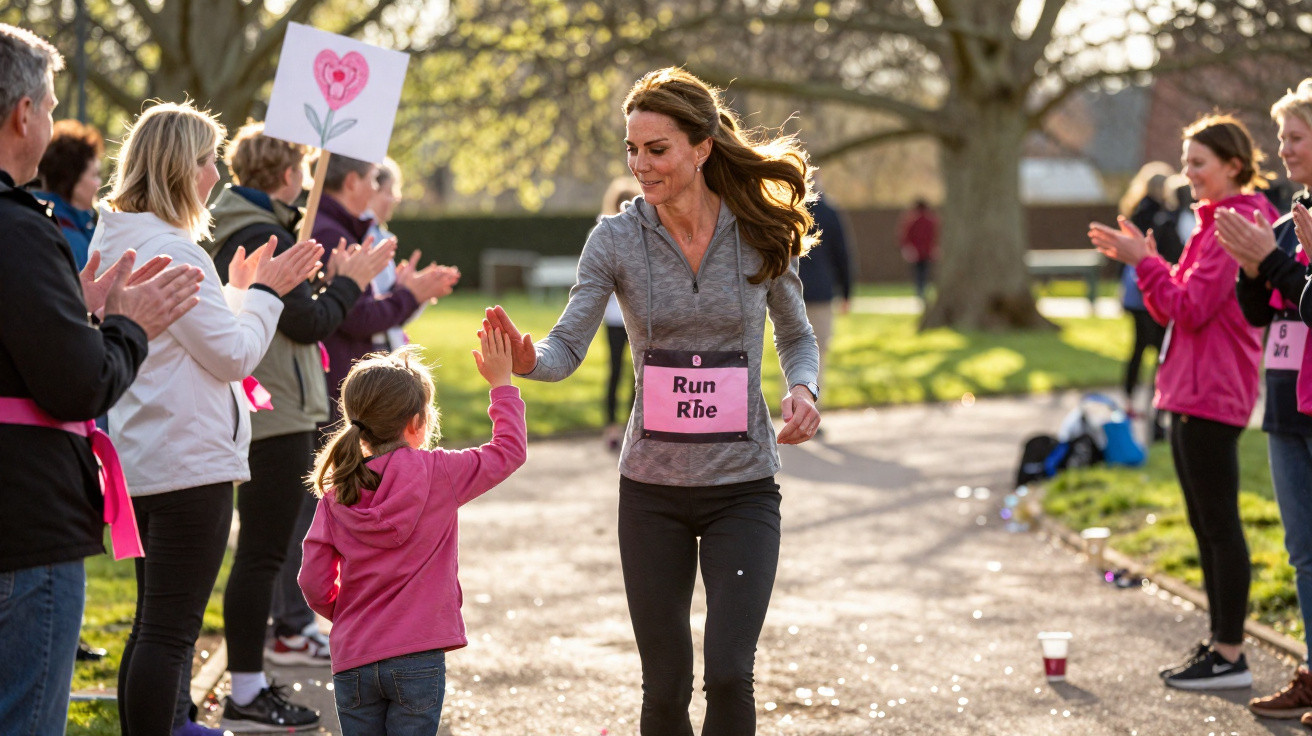
The first detail people noticed was not the finishing time. It was Catherine’s smile - the broad, faintly startled grin of someone whose personal endeavour has suddenly become very, very public.
At the edge of the “Run for Rose” charity event, phones rose like a small forest of aerials. Parents pushing buggies, teenagers in hoodies and pensioners on folding chairs all tried to glimpse the Princess of Wales tying her trainers and stepping up to the start line.
For a moment, the typically polished royal world resembled an ordinary local fun run, complete with drizzle and poorly printed race numbers fluttering in the wind. Then the starting horn went, and the internet had no hope of keeping up.
When a royal fun run becomes a global moment
Catherine did not charge away like a professional athlete. She began at an easy, almost reserved pace, her arms held close and her ponytail bouncing in a familiar, likeable rhythm.
Spectators applauded, while some called “Go on, Kate!” in the instinctive manner they might cheer on a cousin or neighbour. A woman in a vivid pink raincoat laughed as she wiped away tears: “I can’t believe I’m crying over a 5K.”
That is the unusual power of the scene. A royal wearing running shoes and becoming a little breathless felt more immediate than a thousand formal portraits.
When Catherine reached the finish, #RunForRose had worked its way onto trending lists from London to Sydney. Videos of her waving, sweaty yet glowing, appeared throughout TikTok feeds amid dance challenges and recipe hacks.
A 14-second clip showing her stopping to speak with a young girl holding a paper rose passed three million views in under a day. A slowed GIF of her fixing her ponytail before the race developed a life of its own on X, with captions ranging from “Monday mood” to “When you remember you left the oven on.”
Everyone knows the feeling: an ordinary action can suddenly seem far more significant when somebody is watching. Catherine’s charity jog captured that sensation and projected it on a royal scale.
The reason is not simply that “people like the royals”. Users were drawn in by the meeting point between public privilege and private effort.
Here was a future queen doing something anyone with trainers and 30 minutes could replicate. There was no ballgown or balcony - only a charity race number, a track drenched by drizzle and a cause, Rose, that struck deeply with families affected by cancer.
Social media thrives on moments that are at once aspirational and achievable. Watching Catherine breathe a little harder on an uphill section made her seem human, without dispelling the mystique that encourages people to keep watching.
Behind the scenes of a “perfectly imperfect” royal moment
At the event itself, the plan was straightforward: arrive quietly, warm up alongside the other runners, speak softly with families connected to the Rose foundation and complete the route. There was no red carpet, only a wet path lined with plastic cones.
Staff had politely asked participants to keep their phones down during the private remembrance section for Rose. But once the runners set off, that unspoken barrier gave way, and the glow from screens illuminated the trackside.
It was not grandeur that stood out, but the smaller acts. Catherine stopped to fix an elderly volunteer’s wristband. She cast a quick look towards a teenager who was visibly finding the halfway point difficult. Such brief moments made a royal visit feel like a morning shared by everyone present.
Online responses divided into the usual groups, though the supportive voices were louder this time. Thousands posted side-by-side screenshots of Catherine’s health journey, contrasting a more fragile public appearance months earlier with this resolute runner, cheeks flushed.
One viral post stated: “She turned surviving into showing up.” Another said: “I wasn’t planning to move today. I’m going for a walk now.”
In truth, nobody does that every day. Most people scroll, experience a brief burst of motivation and remain right where they are. Still, seeing a princess who has faced her own medical headlines running for Rose made a modest first step seem less abstract and more pressing.
Digital analysts quickly began breaking down the surge of attention. They said the engagement was not solely about royalty, but about three potent forces coming together: vulnerability, purpose and movement.
Catherine’s run for Rose contained all three. There was the vulnerability of a princess still subject to scrutiny over her health. There was the distinct purpose of raising funds and awareness in one young girl’s name. And there was the simple, universal act of moving your body onwards.
From an algorithmic perspective, it was ideal. Brief, easily shared videos. Several camera viewpoints supplied by attendees. A clear and emotional storyline running from the warm-up to the finish line. What seemed to be a local charity run contained every ingredient needed for a worldwide social media event.
What this run changed quietly for Catherine - and for us
For Catherine, the occasion was not just about the people gathered around the track. It also offered a subtle way to reshape her public narrative.
Since her health challenges became international news, much discussion about her has been clinical, speculative and sometimes intrusive. Running “for Rose” provided a gentle but decisive shift in focus: away from her diagnosis and towards what she remains able to do, as well as the people she chooses to support.
Observers noted that she turned towards the families rather than the cameras. She listened more than she spoke, nodding slowly while parents described treatment updates, bereavements and small victories. That stance - not merely upright in a physical sense, but quietly grounded - said more than any official declaration could.
Many viewers at home recognised something of their own experience in it. They had waited on cold pavements during charity walks, holding laminated photographs of people they loved. They had attached race numbers to worn T-shirts, feeling proud but also strangely guilty at being well enough to run.
A frequent social-media error is to regard these occasions as lifestyle content. Curated playlists, “flawless” race pictures and polished captions. Catherine’s run for Rose instead reminded people that these events begin with grief and love; pace and performance come afterwards.
If your own charitable effort is untidy - a red face, unmatched socks or an awkward photo at the finish - it is not a failure. It shows that you turned up for somebody important.
“I saw her jog past, and for a second I forgot she was a princess,” said Chloe, 23, who ran in memory of her younger cousin. “She was just another woman trying to keep going for a girl called Rose. That made me feel less alone.”
Notice what connects
Consider which clips from the run appeared throughout your feed: the quiet exchange with a child, laughter shared at the start line or the relieved smile at the end.
These are the human moments that remain with people.Keep the unseen stories in mind
Each hashtag such as #RunForRose represents hospital appointments, late-night online searches and families having to learn difficult new language.
A viral moment is often built upon years of private hardship.Allow inspiration to be modest
Being touched by the story does not require running a marathon.
Sending a message, lighting a candle or donating the price of a takeaway are all ways to “run” alongside another person.
After the finish line, another kind of race starts
By evening, the barriers around the course had been removed and the route once more resembled any other public track. What remained was harder to see: new regular donors, newly arranged GP appointments and private promises made from sofas while people watched clips of Catherine’s flushed face and the now-famous paper rose.
For the Princess of Wales, this day will probably become one engagement among many. For families who ran in Rose’s name, it will join a much shorter and more intense list of unforgettable days. Some went to sleep replaying the instant she pressed their shoulder, crouched down to speak at their level or simply ran past, carrying their child’s story for a few brief strides.
The internet moves on fast, but the people at the heart of these stories don’t. Perhaps that is the understated lesson of this viral rush. Posts and reposts, trending tags and repeating clips are only the outer layer. Beneath them lies the sense that pain can be carried together, and that even Catherine, watched and examined so closely, can decide to tie her shoes, walk into the drizzle and run beside a family whose world once stopped for a girl named Rose.
| Key point | Detail | Value for the reader |
|---|---|---|
| Royal relatability | Catherine came across as an everyday runner rather than a remote figure | Helps readers understand that their own modest efforts have meaning and are not insignificant |
| Viral ingredients | Short videos, an emotional cause, evident vulnerability and a clear purpose | Explains why certain moments spread online while others fade without notice |
| Quiet impact | Beyond views and likes, families received visibility, support and solidarity | Encourages readers to see beyond the trend and recognise the human stories underneath |
FAQ:
- Why did Princess Catherine’s Run for Rose go so viral? The combination of a highly personal cause, Catherine’s recent health journey and the relatable act of running created a moment that people wanted to share and form an emotional connection with.
- Was the run mainly symbolic or did it raise real funds? As well as its symbolic significance, the event generated donations for the Rose foundation and other cancer-related charities, supported by worldwide visibility and refreshed media attention.
- Did Catherine run the full distance? Yes, witnesses and organisers confirmed that she finished the planned route at a consistent, sustainable speed, joining the group rather than treating the event as a staged photo opportunity.
- How did people at the event react to her presence? Most reported a combination of surprise and reassurance: the unusual experience of seeing a princess close up, alongside the warmth of realising that she was principally there for the families and Rose’s story.
- What can ordinary people take from this event? Visible titles and platforms have importance, but ordinary acts matter too: entering a local race, making a small donation or messaging a friend who is struggling are all ways of “running for Rose” in daily life.






Comments
No comments yet. Be the first to comment!
Leave a Comment