
This article was written by Laura Kehoe of Humboldt University of Berlin and was first published by The Conversation.
On my first field expedition in the savannahs of the Republic of Guinea, I stumbled awkwardly through thick undergrowth, unsuccessfully trying to last five minutes without becoming caught in the thorns that seemed to snare me at every turn. Our goal was to document and understand a community of wild chimpanzees that had never previously been studied. Rather than living with the relative security of a protected area, these chimpanzees survive in fragments of forest scattered between farms and villages.
We stopped in a bush clearing. Relieved to be beyond the reach of any thorns, I nevertheless wondered why we had halted. I went to the front of our party to ask Mamadou Alioh Bah, the village chief and our renowned guide. He said he had spotted something unusual: apparently harmless marks on a tree trunk.
In the crowded, untidy landscape of the savannah, he had noticed something that most of us would have missed entirely. Among our group of six, some thought the scratches had been left by wild pigs rubbing against the trunk; others suggested they were the work of teenagers playing about.
Alioh, however, had a suspicion. When someone capable of finding a single shed chimpanzee hair on the forest floor, and of seeing chimpanzees kilometres away with the naked eye more effectively than you can using costly binoculars, has a hunch, you pay attention. We installed a camera trap, hoping that whatever had created the marks would return and repeat the behaviour - this time on camera.
A world first
Camera traps begin filming automatically whenever something moves in front of them. This makes them an excellent way to capture wildlife behaving naturally without being disturbed. I noted that we should return to this location in two weeks, approximately the life of the batteries, and we headed back into the wilderness.
Returning to a camera trap always brings a feeling of anticipation about the secrets it may contain. Most of our footage showed branches moving in high winds or farmers' cattle eagerly licking the camera lens, yet there is always an irresistible hope that it has recorded something extraordinary.
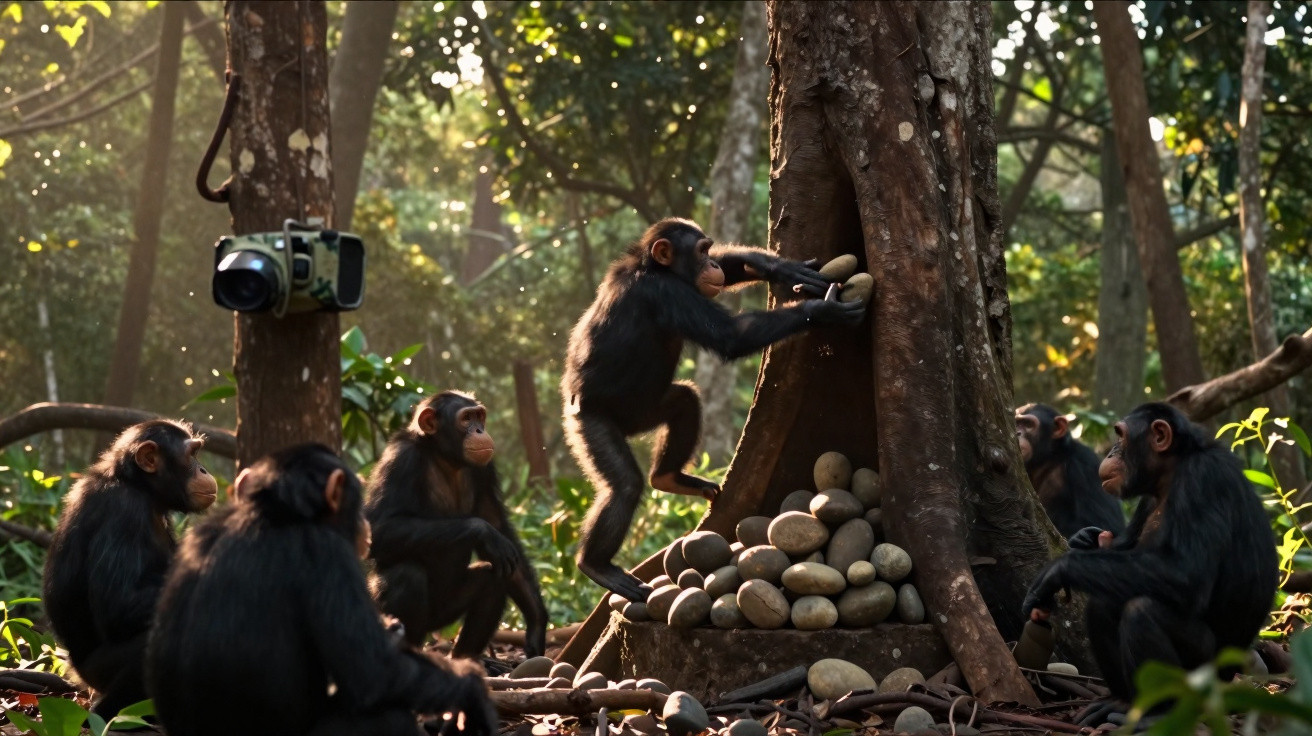
The footage from this camera was thrilling. A large male chimpanzee walks up to our mysterious tree and stops briefly. He then looks around quickly, picks up a huge stone and hurls it with all his strength at the trunk.
I had never seen anything comparable, and it gave me goosebumps. Jane Goodall first identified wild chimpanzees using tools during the 1960s. Chimpanzees use twigs, leaves and sticks, while some groups even use spears, to obtain food. They also use stones to open nuts and split large fruits. At times, chimpanzees throw rocks in displays of power intended to establish their standing within a community.
Yet the behaviour revealed by our study, now published, was not an isolated or chance occurrence. It was repeated behaviour with no obvious connection to food or social status, and it may be a ritual. We investigated the surrounding area and located numerous further sites with similarly marked trees. In many cases, stones had collected in piles inside hollow trunks, recalling the stone piles uncovered by archaeologists from human history.
Footage soon began to arrive. Other teams involved in our project started looking for trees bearing the distinctive marks. We identified the same puzzling behaviour in small areas of Guinea-Bissau, Liberia and Côte d'Ivoire, but nowhere farther east, despite searches across the chimpanzees' full range from Guinea's western coast to Tanzania.
Sacred trees
Alongside many other researchers, I spent months in the field seeking to understand what these chimpanzees were doing. At present, we have two principal explanations. The behaviour may form part of a male display, with the loud crack produced when a rock strikes a hollow tree increasing the impact of that display.
This may be particularly probable in places with few trees that have large roots, which chimpanzees usually beat with their strong hands and feet. Where certain trees generate a striking bang, the sound could accompany, or take the place of, foot drumming during a display. Trees with especially effective acoustics might then become favoured sites to revisit.
Alternatively, the act may carry a more symbolic meaning, more closely echoing our own history. Using markers such as stone piles to identify routes and territories was an important development in human history. Establishing how chimpanzees' territories relate to sites where rocks are thrown may help us determine whether the same explanation applies here.
More intriguingly still, perhaps we have uncovered the first evidence that chimpanzees create a form of shrine, potentially pointing to sacred trees. Indigenous people in West Africa keep collections of stones at 'sacred' trees. Such human-made stone collections are widely seen around the world, and they look uncannily like the features we found.
A vanishing world
To solve the mysteries of our nearest living relatives, we must leave room for them in the wild. In Côte d'Ivoire alone, chimpanzee numbers have fallen by more than 90 percent over the past 17 years.
Chimpanzees are gravely threatened by the devastating combination of growing human populations, habitat loss, poaching and infectious disease. Leading scientists caution that, unless circumstances change, chimpanzees and other great apes may have only 30 years remaining in the wild.
In Guinea's unprotected forests, where we initially found this enigmatic behaviour, fast deforestation is making the landscape nearly impossible for the chimpanzees that once lived and flourished there to inhabit. Letting wild chimpanzees continue their downward path towards extinction would be not only a severe blow to biodiversity, but also a tragic loss to our own heritage.
You can help chimpanzees by giving your time: become a citizen scientist immediately and watch them at chimpandsee.org. You can also contribute financially by donating to the Wild Chimpanzee Foundation. Who knows what we may discover next that could permanently transform our understanding of our closest relatives.
Laura Kehoe, PhD researcher in wildlife conservation and land use, Humboldt University of Berlin
This article was originally published by The Conversation. Read the original article.






Comments
No comments yet. Be the first to comment!
Leave a Comment