
The previous time I decided to “sort my life out”, I began with the wardrobe.
I dragged every item out, created theatrical little heaps across the bed, and promised myself I would finally become the sort of person with coordinated hangers and a Pinterest-worthy capsule wardrobe. By lunchtime, the bedroom resembled an exploded charity shop. At 4pm, I was sprawled on the floor in a jumper nest, doom-scrolling and quietly disappointed in myself. The wardrobe was no longer merely untidy; it felt like visible evidence that I was incapable of being a properly functioning adult.
Here is what nobody mentions when you binge-watch those organising time-lapses: beginning with your wardrobe is a near-certain route to burnout. Professional organisers understand this. When they enter a home overwhelmed by possessions, they very rarely start with hangers and hemlines. They choose somewhere else entirely – a place so small it may seem insignificant, yet one that can alter everything.
The Wardrobe Trap We All Fall Into
Wardrobes have an oddly magnetic appeal. They appear to be the sensible place to begin: they are visible, symbolic and perhaps taunting you each morning, when you pull open the door and a stray shoe lands on your foot. Clothing seems as if it ought to be simple to organise. Too small? Donate it. Worn through? Put it in the bin. Does not “spark joy”? Away it goes. So we give ourselves a pep talk, put on a decluttering playlist and dive headlong into textile warfare.
But wardrobes are not emotionally neutral spaces. They are minefields. There are the jeans you are certain you will fit into again, the costly dress that never got worn, and the blazer tied to the career you expected to have by this point. Every hanger brings a small decision about identity, spending, regret and guilt. It is unsurprising that you run out of energy halfway through, push it all back inside, and leave it slightly worse than it was.
Professional organisers witness this cycle so regularly that they call it the “closet crash”. It follows a familiar pattern: a grand, dramatic beginning, emotional overload, decision fatigue, and then a quiet return to previous habits. You are not left only with an untidy wardrobe; you also gain a new narrative about how you “can’t stick to anything”. That narrative can do far more harm than any clothing pile.
Where Professional Organisers Really Start Instead
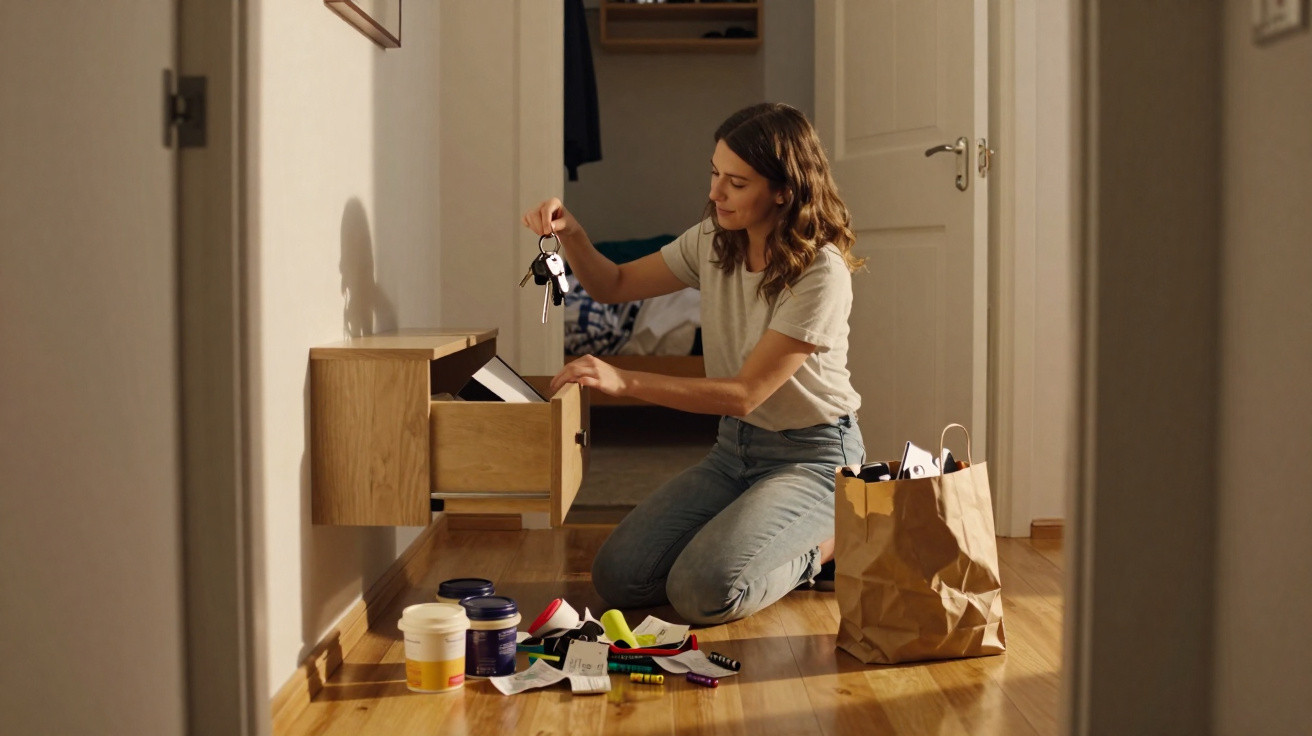
Ask several professional organisers where they tend to begin and the same short list will recur: the junk drawer, the bathroom cabinet or the kitchen worktop where you drop the post. They are tiny, dull, unglamorous spots. There are no fairy lights, velvet hangers or Instagram-ready before-and-after shots. There is simply a shallow drawer or lone shelf that has gradually turned into a graveyard for batteries, elastic bands and half-used bottles of something.
At first glance, this seems illogical. Why start with the least photogenic corner of the home? Because it is where you can genuinely succeed. Small, low-pressure areas serve as practice grounds. They allow you to exercise the three skills essential to proper decluttering: making choices, completing a task and living with those choices for a while. Those are the skills that stop you failing once you eventually tackle the wardrobe.
One organiser told me that she always begins with the bedside table. “It’s intimate but not loaded,” she said. “You get to feel what it’s like to clear space around you, without getting stuck sobbing over prom dresses.” You can still experience emotional changes – the relief of shutting a drawer that is not crammed full, or the unexpected calm of seeing one hand cream rather than seven – without attempting to rewrite your whole life in a single afternoon.
The Strength of a Small Win
People are driven more by momentum than motivation. We wait to “feel ready” for the major jobs, then question why that feeling never arrives. Professional organisers do not wait around. They create readiness by deliberately producing small wins. Empty the junk drawer, feel quietly pleased with yourself, and carry that modest momentum into the next manageable area.
Consider the last task you completed after delaying it for ages. The lift you felt afterwards was not only about the task; it was about what it suggested about you. “Maybe I’m not as hopeless as I thought.” Clearing an entire wardrobe seldom produces that feeling because the job is so huge that you exhaust yourself before reaching the finish line. A bathroom shelf, however, can be done in 20 minutes. Afterwards, toothbrush in hand, you can think: I did this. It is finished. That restrained, almost private sense of achievement provides the energy required for more difficult rooms.
The Emotional Weight of Your Possessions
Everything you own carries weight in your home. This is not physical weight, but emotional drag. A muddle of cables on a hall table is a minor irritation. A stack of unopened letters, avoided because you fear bad news, is much heavier. The wardrobe generally contains the greatest weight of all: objects that stand for who you used to be, or who you believe you ought to be.
We have all had the experience of finding an old outfit and feeling our stomach sink. There is the dress from a relationship that ended painfully, the work trousers from the job you were made redundant from, and the “someday” skirt that amounts to self-criticism in fabric form. This is why professionals tread carefully around wardrobes initially. They know you need emotional resilience in reserve before confronting those ghosts.
Instead, they select areas containing more neutral possessions. Out-of-date sun cream? Straightforward. Dried-up nail varnish from 2013? Into the bin. A pile of takeaway menus from restaurants that shut years ago? Gone. You can practise letting go without feeling as though you are bleeding through the entire process. Slowly, your home’s physics begin to shift: less drag, more lightness and increasing proof that you can make decisions and survive them.
The “Truth Moment” We Avoid Admitting
Let us be honest: almost nobody empties, edits and refolds their wardrobe each season, as minimalist YouTubers insist they do. Life intervenes. You are tired, work is noisy, children are sticky, and at 8pm on a Wednesday the last thing you want is to debate the future of your third-favourite cardigan. Assuming you will become a wholly different person overnight is the quickest way to end up feeling like a failure.
Professional organisers discreetly plan around who you really are, rather than the person you imagine becoming. This is why they choose places you use every day – the bathroom, fridge door and kitchen counter – as their starting point. You see the difference whenever you brush your teeth or pick up your keys. That regular reminder gradually changes your self-image from “I’m messy” to “I can keep some things under control”. It is neither dramatic nor glamorous. Nevertheless, it is remarkably effective.
The First Place to Tackle That Is Not Your Wardrobe
Ask ten organisers for the ideal first area and their answers may differ slightly. Yet most will return to one of three options: the junk drawer, bathroom cabinet or the surface where everything ends up when you get home. Choose the one that makes your shoulders relax slightly rather than tighten. That is your starting point.
The junk drawer is popular because it contains chaos on a small scale. Pens, keys, receipts, twist ties, dead batteries and a solitary Allen key that likely belongs to furniture you no longer have. You can clear it all out at once, spread the contents over a table and sort them without getting under your own feet. There is something curiously satisfying about the gentle rattle of unwanted metal and plastic dropping directly into a bin bag.
The bathroom cabinet may be even better if clothes and weight already feel sensitive subjects. You are not facing jeans in a “someday size”; you are deciding about moisturiser you never enjoyed or perfume that smells faintly of regret and talcum powder. The stakes are low, and choices are quick. Then the following morning, you open the cabinet and feel an almost bodily exhale. Your day begins with less visual noise.
A Straightforward Method That Does Not Feel Punishing
In these starter spaces, most professional organisers follow a variation of the same routine: empty, sort, decide, then return items intentionally. You do not need elaborate labels or a 20-piece bamboo storage kit. Make four simple piles: keep, bin, relocate and donate. There is nothing revolutionary about it. The difference lies in the scale. You are doing this with one drawer, rather than confronting your entire existence suspended from a rail.
The magic is not in the method; it is in being able to finish. You can take one small area from chaos to order in less than an hour, perhaps even in under 30 minutes. Completing it teaches your brain that household projects need not be sprawling, shame-filled marathons. They can be sprints. Shut the drawer, notice the satisfyingly sharp sound of wood meeting wood, and make yourself a cup of tea. That is the pace professionals want to establish.
Why Starting Small Makes the Wardrobe Easier Later
After spending a few weeks on smaller areas, a subtle change happens. You begin spotting clutter hot spots without panicking. You may find yourself binning items automatically rather than keeping them “just in case”. Decisions become quicker and less fraught. Without forcing yourself through an intense boot camp, you have developed a form of decluttering stamina.
When you finally return to the wardrobe, it no longer seems like a mythical beast. It is simply… the next space. You have already shown yourself that you can choose, edit and live with less in the bathroom, kitchen and hallway. You have seen that you cope perfectly well without a fifth spatula or a drawer packed with mystery chargers. That evidence is quietly present in your body when you eventually bring out the clothes.
Clothing will likely always feel more emotional than expired paracetamol. You may still feel a lump in your throat as you part with a dress from an earlier life. The difference is that you have practised not allowing that feeling to derail the entire job. You have learned that discomfort is temporary, not a signal to stop. That is what prevents decluttering failure: not being magically “good at tidying”, but having evidence that you can weather the wobble and complete the task.
The Real Aim Is Not a Perfect Home
Much organising content rests on a quiet falsehood: once your home is organised, you will finally become the person you were meant to be. Calm, productive, always punctual, and perhaps drinking lemon water from a glass that never shows fingerprints. That is not how life works. Homes become untidy again. Children grow, jobs change, and winter brings bulky coats and muddy shoes. Perfection is a moving target, keeping you striving without ever letting you arrive.
Professional organisers with years of experience rarely promise perfection. What they offer is something more realistic: a home that does not oppose you every time you enter it. A morning when you can get dressed without a minor breakdown. A kitchen where you can prepare one simple meal without first clearing the entire worktop. Those outcomes come from small, repeatable successes, not one heroic wardrobe purge.
So, the next time you feel the urge to “fix everything”, resist the wardrobe’s drama. Leave the hangers alone for a while. Go instead to the drawer that makes you sigh every time you open it. Clear it out. Complete it. Close it softly. That quiet, almost dull action is where easier decluttering in the future truly begins.
The professionals already understand this: you do not start with the wardrobe because a wardrobe is not merely storage – it is a story. And the wisest way to alter a story is never to begin with its most painful chapter.






Comments
No comments yet. Be the first to comment!
Leave a Comment