
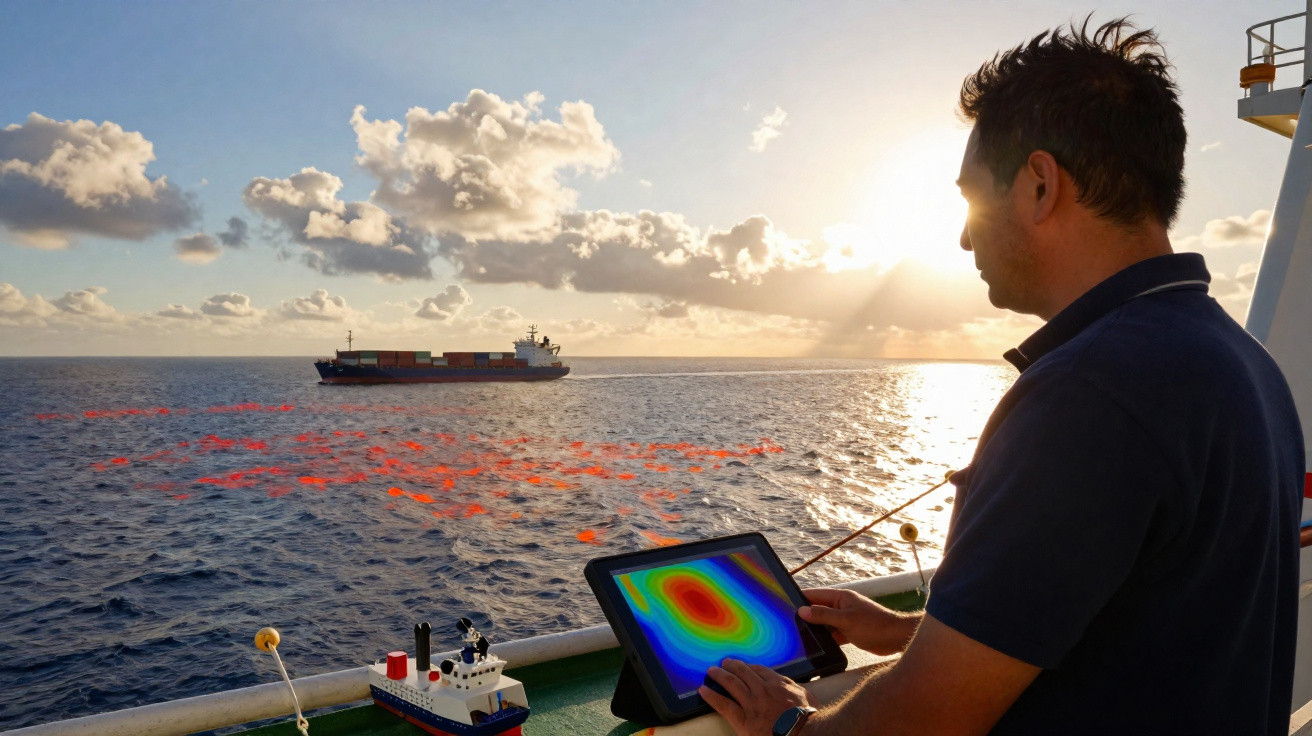
A French researcher believes he has identified the decisive trigger.
The seas had already been unusually warm for a long time. Since 2020, however, temperatures in the Atlantic have surged into record territory that has surprised even seasoned climate researchers. A French scientist has now examined in detail what lies behind this extreme marine heatwave – reaching a conclusion that many had previously regarded as merely a side issue in climate policy.
Atlantic fever: what has happened since 2020
Sea temperatures have risen continuously since the middle of the 20th century. This is consistent with what climate models project for an Earth climate with increasing greenhouse-gas concentrations. From around 2020, though, something changed: the curves began to bend sharply upwards, particularly in the North Atlantic. Temperatures in 2023 and 2024 were far above all previous records.
The French researcher – a specialist in ocean physics and climate data – assessed the Atlantic surface measurement series in depth. His work included satellite data, buoy readings, ship observations and reanalyses that combine several datasets. His finding is that rising greenhouse gases alone cannot account for this abrupt jump.
Global warming provides the long-term trend – but an additional boost has catapulted the Atlantic into a genuine fever phase.
He therefore looked for factors that had changed substantially in recent years. He found one in what initially appears to be good news: cleaner ships.
Stricter shipping rules – and suddenly less protection from the sun
Since the beginning of 2020, stricter worldwide limits have applied to sulphur in the fuel used by ocean-going vessels. The International Maritime Organization (IMO) drastically lowered the maximum permitted sulphur content. Shipping companies had to adapt by using more refined fuels, fitting filtration systems or adopting alternative propulsion.
As a result, the exhaust from cargo vessels and tankers releases considerably less sulphur dioxide into the atmosphere. Concentrations of these substances above major shipping routes, including those in the North Atlantic, have fallen sharply.
How ship emissions affect clouds and sunlight
At first glance, this is an unambiguous benefit: fewer air pollutants and cleaner air for coastal cities and port workers. Yet the French researcher points to an uncomfortable physical side effect. Sulphur compounds in exhaust contribute to the formation of fine particles, which act as condensation nuclei for clouds.
- More particles in the atmosphere create brighter, denser clouds.
- Bright clouds reflect a larger share of solar radiation back into space.
- Less sunlight then reaches the sea surface, causing it to warm more slowly.
When these particles disappear, clouds above the oceans become thinner or change their structure. Consequently, more sunlight penetrates to the water. The researcher regards this effect as one of the principal drivers of the recent Atlantic heat.
Less sulphur above the oceans means less “sun protection” – at a time when the climate system is already heating up.
Up to 80 per cent less sulphur – a climate buffer disappears
Measurements show that pollution from sulphur-containing particles has declined by up to 80 per cent since 2020 in some heavily used ocean regions. The researcher compares this to suddenly taking off sunglasses that the climate system had worn unnoticed for years.
His model calculations suggest that the fall in air pollution from shipping has made a measurable contribution to the additional warming of the Atlantic sea surface. This effect does not by itself explain the entire heatwave, but it substantially intensifies it.
Other factors included in his analysis are:
- persistent high-pressure systems above the North Atlantic, with little wind and mixing;
- natural fluctuations such as El Niño, which alter global weather and ocean-current patterns;
- changes in Saharan dust blown over the Atlantic, which also influences radiation.
Despite these secondary influences, his conclusion remains clear: the abrupt reduction in sulphur emissions acts as an additional climate switch that has heated the Atlantic far more strongly within a short period.
Why climate action and clean-air measures can conflict
The researcher’s study illustrates a dilemma. From an environmental-policy perspective, cutting air pollutants is rightly considered a success. Less sulphur means less acid rain, less particulate pollution and fewer respiratory illnesses. For people in port cities, this represents a major health benefit.
At the same time, some of these pollutants had a cooling side effect on the climate system. They concealed part of the true warming impact of greenhouse gases. As that veil disappears, the full strength of climate change becomes more exposed.
| Factor | Effect on air quality | Effect on the climate |
|---|---|---|
| Low-sulphur marine fuels | significantly cleaner air, less particulate pollution | fewer cooling particles, more surface warming |
| Greenhouse gases such as CO₂ | hardly any direct effect on the air people breathe | long-term warming of the atmosphere and oceans |
| Cloud formation above the sea | indirectly affected by particles | determines how much sunlight reaches the oceans |
Effects of Atlantic heat: storms, fish and ice melt
Record temperatures in the Atlantic are not simply an abstract climate signal. They directly affect weather, ecosystems and sea level. A warmer ocean supplies more energy to tropical storms. Hurricanes can form more rapidly and grow more intense when moving across exceptionally warm water.
At northern latitudes, marine ecosystems are thrown out of rhythm. Cold-water species retreat while fish that prefer warmer conditions spread. Fisheries must adapt to changing stocks. Coastal areas face greater heat stress affecting seabirds, corals and seagrass meadows.
A hot Atlantic also contributes to the melting of the Greenland ice sheet. Warmer water reaches beneath glacier tongues, speeds up their retreat and adds to sea-level rise. The French researcher warns that several such processes can overlap.
Explanation: what is a marine heatwave?
The term “marine heatwave” does not mean only a few warm days. Specialists use it when seawater temperatures in a location remain significantly above the normal seasonal level for days or weeks.
- The threshold generally concerns the upper few metres of the water surface.
- Many scientific studies use the warmest five or ten per cent of historical measurements as a reference point.
- The longer such a period lasts, the greater the damage to organisms that can tolerate only narrow temperature ranges.
The French researcher’s analyses reveal several such heatwaves in succession in the Atlantic. This compounds the stress because ecosystems have barely any opportunity to recover between episodes.
What the findings mean for future climate policy
The researcher’s work sends a clear message: when countries reduce air pollutants, they must cut greenhouse gases even faster at the same time in order to limit the additional warming boost. Otherwise, periods may occur in which the climate system responds more strongly than many models have so far anticipated.
Climate specialists identify several possible approaches:
- a major expansion of renewable energy to replace fossil fuels;
- efficiency programmes in industry and transport;
- increased electrification of shipping close to the coast;
- research into climate-friendly fuels such as green ammonia or methanol.
The researcher also stresses the importance of dense monitoring networks across the oceans. Only buoys, ship data and satellites can detect such abrupt shifts at an early stage. The more precise the data, the better models can estimate future developments in the Atlantic.
Practical example: what cooler seas would achieve
To make the scale of the issue more tangible, specialists often cite a comparison: in 2020 alone, all oceans together absorbed an estimated 20 sextillion joules of heat. Part of this was stored in the Atlantic. If this quantity of energy had been held in the atmosphere rather than in the water, air temperatures would already have risen far more dramatically.
The oceans therefore function as an enormous heat buffer. The warmer they already become, the closer this buffering system comes to its limits. With the additional boost caused by declining ship emissions, the Atlantic is approaching precisely such limits in some regions. The French researcher sees this as a warning signal extending far beyond shipping.






Comments
No comments yet. Be the first to comment!
Leave a Comment