
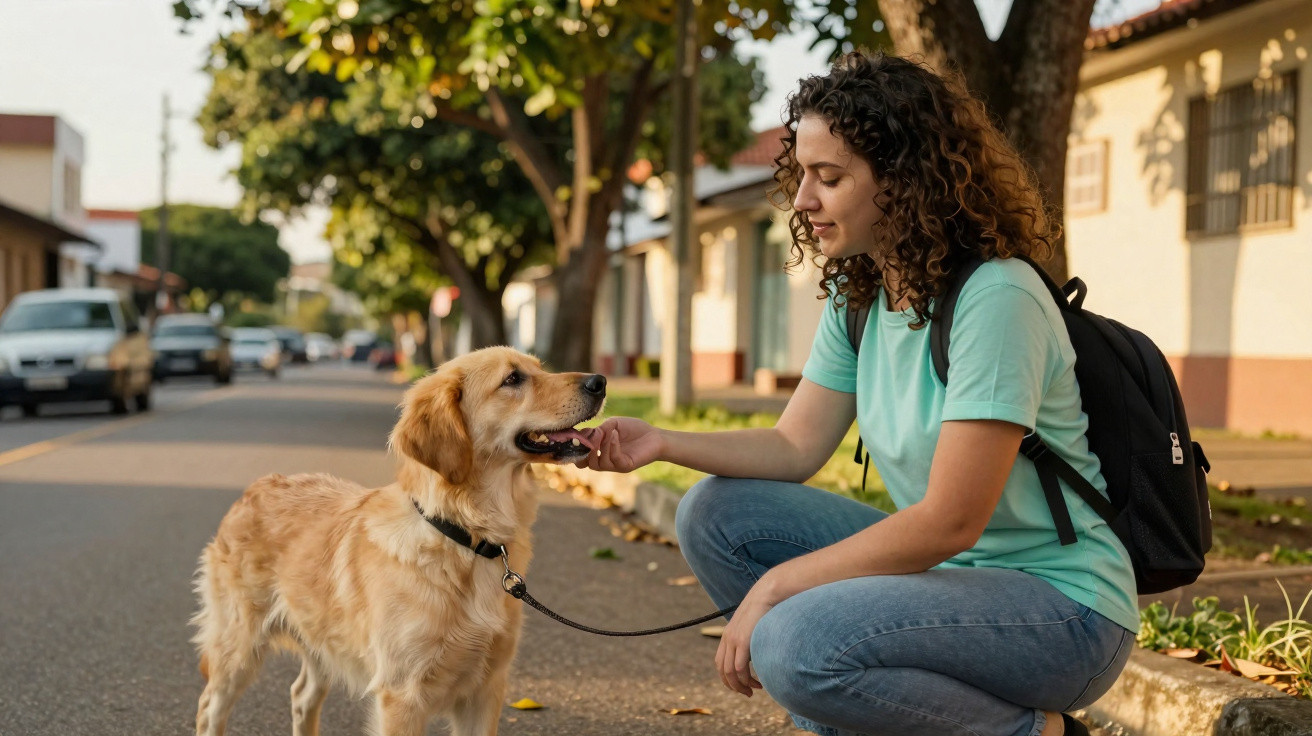
She pauses. Her knees dip slightly, her voice rises by a note, and moments later she is on the pavement asking a dog she has never encountered, “Hi sweetheart, what’s your name?”
The owner gives an amused, faintly embarrassed laugh as the lights change and pedestrians stream around them. One person rolls their eyes; another smiles to themselves, as though they are witnessing a half-familiar private ceremony.
On streets in cities like this, there tend to be two sorts of people: those who pass dogs as though they are street furniture, and those who simply can’t. They change course, squat down, chat and hold out a hand to be sniffed.
Psychologists suggest that this small choice - stopping or continuing on - is seldom arbitrary. Even without conscious thought, it can hint at something specific about your character.
What your urge to greet strange dogs reveals about you
The attraction you feel towards a dog you do not know is not merely an endearing impulse. Many psychologists associate it with a combination of traits: strong openness, warm agreeableness and ease with showing vulnerability in public.
People who instinctively greet dogs often call themselves “soft” or “too emotional”, yet personality research offers a more defined interpretation. They tend to score more highly on empathy measures, react strongly to non-verbal signals and favour social connection over social caution.
Put simply, you are doing more than stroking a dog. You are opting for contact rather than distance, and your nervous system is registering the choice.
One grey Tuesday in Manchester, Dr. Helen Fisher, a clinical psychologist researching everyday behaviour, sat outside a café with her notebook. For an hour, she watched how people responded when they met dogs along the way.
A few looked down for a moment before carrying on. Others smiled at the owner but ignored the dog. A smaller number slowed almost without thinking. They crouched, used a higher-pitched voice and relaxed their bodies into something resembling a social bow.
Fisher subsequently spoke with several of these dog-greeters. Most said that crowds made them anxious, while animals left them feeling “oddly comfortable”. Many worked in care, education or customer service. Several mentioned that greeting a dog felt like a tiny reset button in their day. The same qualities appeared repeatedly in her notes.
From a psychological perspective, this everyday practice corresponds with three major indicators. The first is an inclination towards what researchers call “social approach”, rather than social avoidance. You take a small chance to connect, even when the other party has four legs.
The second is greater responsiveness to emotional cues. A wagging tail, soft ears or eye contact can draw you in much as a baby’s face attracts certain people. Your instincts are set up to respond.
The third involves a subtle aspect of identity. Those who pause for dogs often regard themselves as people who spot life’s small pleasures. That personal narrative then strengthens the behaviour: greeting the dog helps you remain true to the person you think you are.
How to read and use this habit without overthinking it
If you are the person crouching on the pavement, pay attention to the instant before you say hello. That brief inner “spark” is your emotional radar coming online. Rather than writing it off as foolishness, consider it a real-time sign of what you want: gentleness, connection or relief from having to perform.
Psychologists sometimes suggest a straightforward technique called the “micro-choice pause”. When you next spot a dog you do not know, stop for half a second and ask yourself quietly, “What am I actually hoping for here?” Is it a smile, touch or a moment of being noticed without judgement?
There is no need to dissect every walk. Even so, this brief internal question can make an automatic habit reflective. You are no longer only touching fur; you are discovering how your nervous system seeks comfort during your commute.
Dog trainers and therapists who include animals in their sessions make a similar observation: how someone says hello to a dog often reflects how they approach other people, only with fewer filters. Some people hurry in too quickly. Others hold back and want the dog to initiate contact. Some talk, some remain silent and some barely acknowledge the owner.
Every approach tells its own small story. If you tend to burst into a dog’s personal space, that same intensity may show up in friendships without your noticing it. If you stay one metre away and merely offer your hand, you may prefer trust that develops slowly alongside clear boundaries.
Let us be honest: nobody genuinely does this every day. But noticing yourself occasionally in the middle of a greeting can expose your usual relationship setting - do you lead with play, care, caution or control?
“How someone approaches an unfamiliar dog is often how they wish people would approach them: gently, with curiosity, and without hidden demands.” - Dr. Anna Morales, behavioural psychologist
This is when an apparently silly habit becomes something close to a pocket-sized personality test. Its purpose is not to label you, but to help you recognise patterns and alter them if they cause you harm.
- Leaning in too fast? Try waiting for the dog’s - and people’s - signals.
- Avoiding eye contact? Experiment with a brief look and a gentle “hello” - directed at the owner as well.
- Feeling guilty about stopping? View it as a 10-second mental health break rather than wasted time.
Most of us have experienced kneeling on a busy pavement, forgetting our task list just long enough to scratch a stranger’s dog behind the ears. These snippets of time are not neutral. They may train your mind towards gentleness, or show you how severe you are with your own needs.
The quiet psychology behind why it feels so good
There is also a bodily dimension. Research into human-animal interaction indicates that even short contact with a friendly dog may reduce cortisol, the stress hormone, and increase oxytocin, often called the bonding hormone. Your body genuinely changes pace.
This helps explain why a two-second pat on the head can feel unexpectedly calming after an awful meeting. For a moment, you are borrowing a small space of non-verbal safety: no performance review, no small talk, only fur, warmth and a tail with no interest in your inbox.
For people who chronically overthink, this can be invaluable. Greeting dogs in the street works like a micro-meditation: for a fleeting period, you leave your thoughts and become present in your senses. The reset is not imagined; your nervous system can detect it.
Psychologists also pay attention to those who do not greet dogs. Highly conscientious, risk-averse or preoccupied people may simply fail to notice the animal altogether. Their focus is fixed on objectives rather than textures.
That does not make them uncaring; it means their mental filters are calibrated differently. One brain may light up at a wagging tail, while another tracks the pedestrian crossing, the time and a meeting agenda. To that person, the dog is background noise.
Conversely, some people would like to greet dogs but feel awkward socially. They fear that the owner will think them strange or that they are “too much”. This self-censorship also reveals something: fear of judgement and the burden of feeling watched in public.
So the seemingly simple question - do you stop for dogs? - discreetly maps a triangle: how you manage your needs, how you respect strangers’ boundaries and how much space you permit for spontaneous joy.
Perhaps that is why the encounter stays with you long after the dog has wandered off.
| Key point | Detail | Why it matters to the reader |
|---|---|---|
| Greeting dogs signals empathy | Connected with greater agreeableness and emotional sensitivity | Helps explain why you may feel attracted to animals |
| Your greeting style mirrors relationships | The way you approach dogs often reflects how you approach people | Provides a low-pressure way to identify personal patterns |
| Micro-moments change your mood | Brief contact with dogs can lower stress hormones | Offers a straightforward everyday tool for regulating stress |
FAQ:
- Does greeting unfamiliar dogs mean I’m an extrovert? Not necessarily. Many introverts greet dogs because it feels safer than approaching people, while still feeding their need for connection.
- What if I love dogs but feel too shy to stop? That mix is common. You can start with a smile or a quick “He’s lovely” to the owner, without going in for a full pet.
- Is it weird to analyse myself based on how I greet dogs? A bit - and that’s fine. Think of it as a playful lens, not a diagnosis. It’s useful if it sparks reflection, not if it boxes you in.
- Can this habit really lower my stress? Short, positive contact with animals has been shown to reduce stress markers in many studies, especially when it feels voluntary and pleasant.
- What if I’m scared of dogs - does that say something bad about me? Fear says more about your past experiences than your capacity for warmth. You might express care in other ways, with people or different animals.





Comments
No comments yet. Be the first to comment!
Leave a Comment