
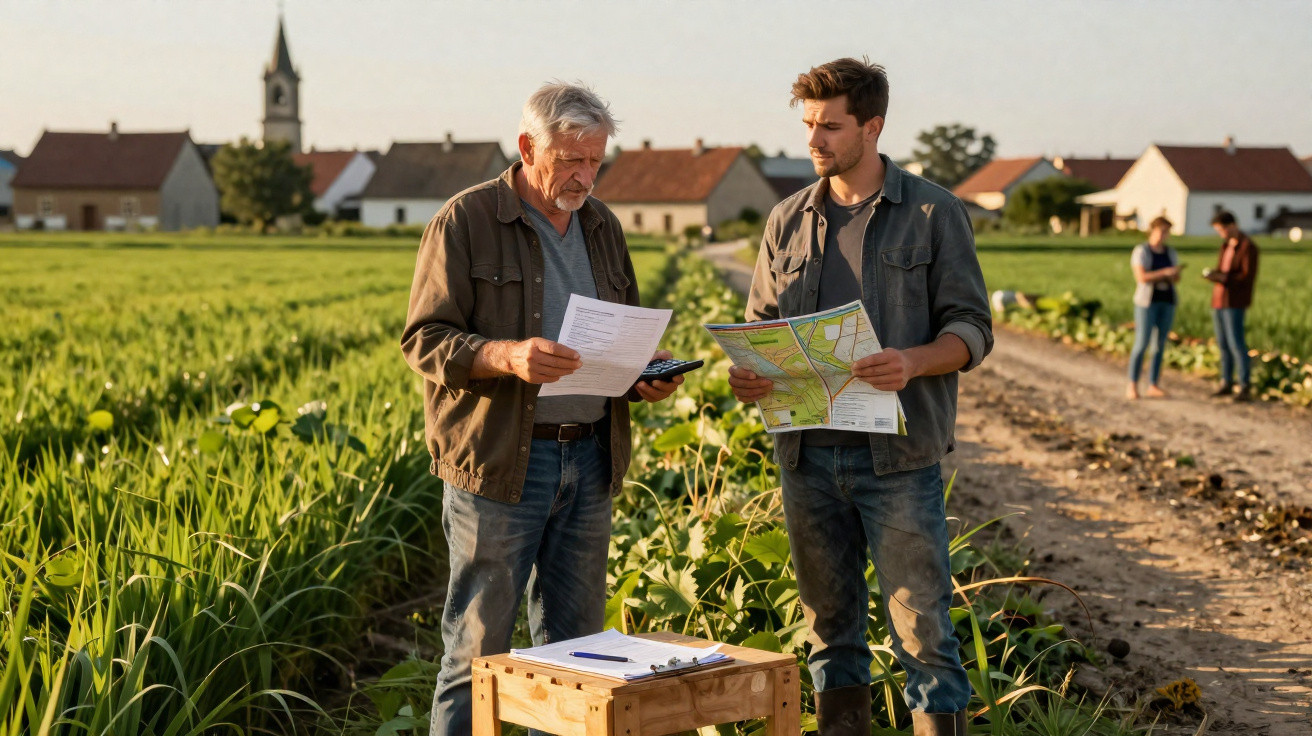
The letter came on a Tuesday, pushed beneath the gate of a modest stone cottage at the end of a rural lane. Pierre*, 71, a retired mechanic and the proud owner of six hectares he had never properly used, opened it absent-mindedly over his morning coffee. Then he saw the figures. An agricultural tax adjustment, applied retrospectively over several years, for an amount that consumed almost his entire annual pension. His hands began to tremble.
On the surface, nothing extraordinary had occurred. A few seasons earlier, he had allowed Lucas, 27, a young farmer trying to establish himself without bank backing, to use his unused fields. There was no rent and no formal agreement, only a handshake beneath an old walnut tree.
Now that handshake is proving extremely costly. And it has divided the village.
When a generous gesture becomes an agricultural tax nightmare
For Pierre, it began with one simple belief: “Land that sleeps is land that dies.” The fields behind his home had stood unused for years, with grass reaching waist height while tractors drove past without entering them. One evening in the café, he overheard Lucas speaking about neglected plots, the unaffordable cost of buying or renting land, and his hope of keeping free-range chickens. Pierre offered him the land as readily as someone might offer a spare room to a person in need. There was no deed, solicitor or paperwork. Only trust.
The months went by and the fields were transformed. Fences, small shelters and vegetable rows began to appear. Pierre looked on with a sense of pride in later life. Then the tax authorities also noticed that the land was no longer lying unused.
The tax demand was far from a minor adjustment. It was overwhelming. The authorities not only reclassified the plots as actively farmed land, but also recalculated several years of agricultural property tax and added penalties. For a pensioner surviving on a limited income, the amount was not merely surprising; it was devastating.
Neighbours began to speculate. Some argued that Pierre had been foolish not to declare the arrangement, formalise the free loan or ask for advice. Others suggested that Lucas had “used” him by having him sign declarations he did not understand. Conversations at the bakery became bitter. “It’s his own fault, he should’ve known.” “Yes, but who reads all those forms?”
Lucas, caught between both sides, maintains that he has done nothing improper. He declared his farming activity and provided evidence of how the land was used when asked, believing that the fact it was provided free of charge would protect Pierre. It did not.
The case reveals a much more troubling reality. Tax authorities do not assess good intentions; they examine declarations, cadastral records and actual use. Once land becomes productive, it may fall under different tax rules, potentially with retrospective effect, regardless of the generosity behind the arrangement. The law often presumes a financial motive where there is simply human support.
Tax specialists explain that lending land free of charge is lawful, but it can rapidly become a grey area when nothing is documented, no one makes clear declarations and the activity changes the plot’s status. The more the young farmer invests, constructs and develops on the land, the more apparent that activity becomes to the authorities.
This is where the trap shuts. What appears beyond reproach in a village may be viewed by a remote tax office, reviewing satellite imagery and declarations on a screen, as an undeclared tenancy.
Helping without going under: the delicate art of being generous but protected
It is possible to help a young farmer, neighbour or relative without exposing yourself to a tax shock. The first step is one that unnerves many pensioners: setting the arrangement down in writing. A straightforward loan-for-use agreement can state clearly that the land is being lent without charge or rent, for a specified purpose and fixed period.
Even a one-page document of this kind can alter the discussion with the tax office. It demonstrates that there is no concealed rent or disguised commercial arrangement, but a solidarity agreement. Some local farming unions and chambers of agriculture even provide free template agreements that can be adapted to individual circumstances.
Simply sitting down together, reading every line aloud and agreeing to it can prevent years of confusion.
Many people avoid paperwork because they link it with mistrust or conflict. “If we write it down, it means we don’t trust each other.” That idea has undermined more than one well-meant arrangement. In reality, the reverse is often true: written terms safeguard both parties, particularly when they value one another.
In truth, few people examine tax regulations every time they help somebody. Lending a field can feel as ordinary as lending a ladder. Yet a ladder does not appear in official records, while a field does. The error is not being generous. It is assuming that goodwill alone will satisfy an administration based on procedures and classifications.
Most of us know that moment when a small act of kindness unexpectedly creates a problem we never anticipated.
Within the village, Pierre’s experience has become a cautionary tale, although everyone tells it differently. Some believe he should challenge the decision and appeal; others think he should agree a payment plan and move on; a few have quietly resolved never to lend anything again. That final response worries social workers and rural mayors most of all. Once people have been hurt, they often retreat completely.
“I’m being punished for helping,” Pierre repeats to anyone who will listen. “Next time, I’ll just let the land rot. At least the taxman will leave me alone.”
On the other side of the fence, Lucas whispers another version. “Without him, I had no start. Without me, his fields were sinking into brambles. We both lose if solidarity dies.”
- Before lending land: speak with a local agricultural organisation or tax adviser, even if only for 30 minutes.
- Put the arrangement in writing, using simple and unambiguous language.
- Establish who declares what: the land, the activity and any potential subsidies.
- Keep copies of every exchange, letter and declaration.
- Reassess the arrangement together each year, particularly if the farming activity expands.
A village divided in two… and a wider question for everyone
Behind this retired man’s agricultural tax nightmare lies a deeper concern about how solidarity is valued in a system fixated on classifications. On one side is the human perspective: “He helped a young guy, nobody got rich, where is the crime?” On the other is the state’s approach: land use must be declared, categorised and taxed under consistent rules, rather than according to personal circumstances.
Pierre’s neighbours debate the matter at the market. Some say he should have taken greater care, while others regard him as a symbol of a world in which helping someone has become risky. The argument has spread to family dinner tables: should people still lend, accommodate or share when any gesture might later arrive in a rigid little envelope bearing the logo of a tax authority?
Generosity, poorly protected, can become a burden that poisons relationships instead of enriching them. This story offers no tidy lesson. Instead, it places a difficult question before anyone who owns something another person needs: how can you remain open-hearted without becoming the next example whispered about at the bakery?
| Key point | Detail | Value for the reader |
|---|---|---|
| Formalise generosity | Use a straightforward written loan or use agreement, including with relatives and friends | Lowers the risk of tax reclassification and later disputes |
| Clarify declarations | Decide who reports land use, subsidies and activity to the authorities | Prevents shocks such as retrospective tax demands or penalties |
| Seek local help | Speak to farming unions, chambers of agriculture or legal advisers before lending land | Turns a risky instinctive act into a secure, lasting gesture of solidarity |
FAQ:
Can I lend my land for free without paying more tax?
Yes, it is possible to lend land free of charge, but this may affect the way it is classified. Where activity is regular and visible, certain taxes or reclassifications can still apply. Written evidence that no rent is being paid is essential.Do I need a solicitor for a simple land loan?
Not necessarily. A private written agreement, dated and signed by both parties, will often be sufficient. However, a solicitor or legal adviser can make complex or long-term arrangements more secure.What documents should I retain if I lend my land?
Keep copies of the agreement, all letters or emails concerning the loan, and every tax or subsidy declaration connected with the land or activity undertaken on it.Can the tax office look back several years in this type of case?
Yes. Depending on the country and tax concerned, authorities may recalculate several earlier years if they consider that the situation was not properly declared.How can I support a young farmer without risking this kind of shock?
Speak to a local agricultural organisation early on, set out a clear framework covering duration, use and responsibilities, put it in writing, and review the arrangement as the farm develops. Remaining informal “to stay nice” is precisely what can lead to painful surprises.




Comments
No comments yet. Be the first to comment!
Leave a Comment