
Layered defence in the Indo-Pacific
The United States has been accelerating the development of integrated, multi-domain capabilities to maintain a layered defence against what is seen as an exceptionally demanding threat environment: drones, cruise missiles, ballistic threats and, increasingly, high-speed delivery systems. In the Indo-Pacific, this drive is directly connected to the pressure China is exerting across the first and second island chains, where Beijing envisages saturation-attack doctrines involving successive waves of different missile types intended to overwhelm the defences available to regional allies. At the same time, the deployment of intermediate-range, ground-based systems such as Typhon during exercises in Japan has prompted a strong Chinese response and raised the profile of the region’s strategic debate.
The US Navy has meanwhile repeatedly highlighted a structural challenge: the cost curve of air defence. Intercepting inexpensive drones with costly missiles could become unsustainable during a prolonged conflict. One response being advanced by the Pentagon is to broaden the range of lower-cost options, combining hypervelocity ammunition, interceptors, interceptor drones and guided munitions launched from systems already available aboard ship. This approach received public attention in a June 2025 House Armed Services Committee hearing, which outlined accelerated work to assess and field new capabilities specifically intended to counter UAS on deployed vessels.
HVP tests and lower-cost counter-UAS options
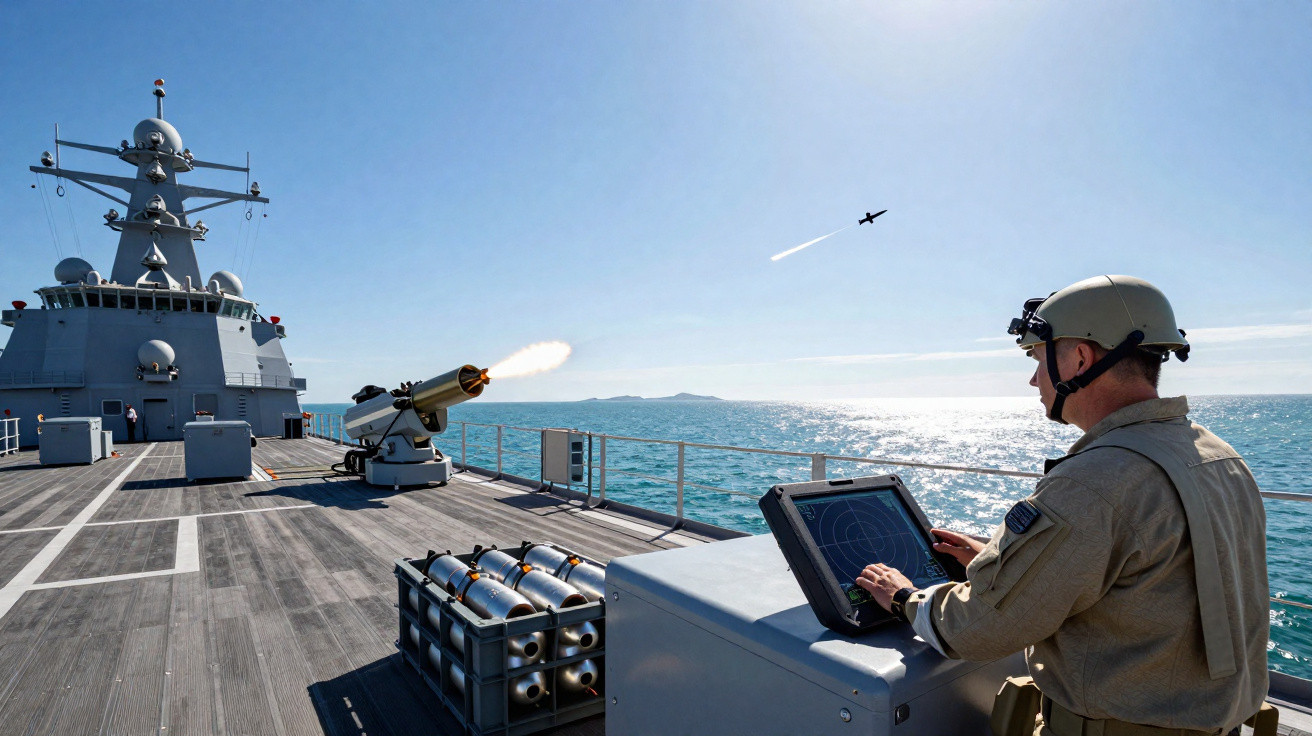
Among these trials, one of the most significant involved Hypervelocity Projectiles (HVPs) developed by BAE Systems. According to the information released, in August 2024, during the USS Harry S. Truman (CVN-75) Composite Training Unit Exercise, the destroyer USS Jason Dunham conducted an HVP test as part of an assessment campaign intended to determine future courses of action for “low-cost” air and missile defence. From an operational perspective, HVPs are attractive because of their speed and their potential use from naval gun systems already integrated across the fleet, expanding the available responses to airborne threats without using up higher-value interceptors.
As noted previously, a complete MDAC battery will be fitted with eight guns, four high-precision MFPR multifunction radars, two MDBM multi-domain radars and at least 144 HVPs. Its modular design and integration with advanced radars will enable targets to be neutralised efficiently, without relying on expensive interceptors such as the PAC-2, PAC-3 or SM-6. This makes it an ideal architecture for strengthening the air defence of bases, strategic facilities and troop concentrations.
It is important to clarify that the test campaigns conducted in mid-2024 also involved other assets, including the destroyer USS The Sullivans, which assessed alternatives such as Longbow Hellfire, Anduril’s Roadrunner and Raytheon’s Coyote. In more straightforward terms for modern warfare, the message is simple: counter-drone defence cannot be solved with a single “silver bullet”, but requires a layered set of solutions, some cheaper and quicker to replace, to sustain the rate of interception during mass attacks. In its assessment presented to Congress, the US Navy stated that these options had proved effective at downing drones and other airborne threats more cost-effectively than traditional approaches relying solely on missiles.
Typhon and China’s regional response
Against the backdrop of this Indo-Pacific-focused technological race, the introduction of ground-based systems such as Typhon, which can use munitions including the Tomahawk and SM-6, does more than add firepower. It also compels China to reassess its assumptions about freedom of manoeuvre within the first island chain. This explains the forceful Chinese diplomatic responses, which portray such deployments as threats to regional strategic security.
In this respect, the US effort is not confined to adding “more interceptors”. Rather, it continues to build a framework in which rapid detection, immediate deployment and the proliferation of cost-effective defences can sustain attrition, prevent saturation and preserve the operational continuity of assets that could be used in a highly complex environment such as the Pacific. It represents a shift in both pace and logic: integrating sensors, effects and platforms so that defence is not only more powerful, but also less costly to maintain over time.




Comments
No comments yet. Be the first to comment!
Leave a Comment