
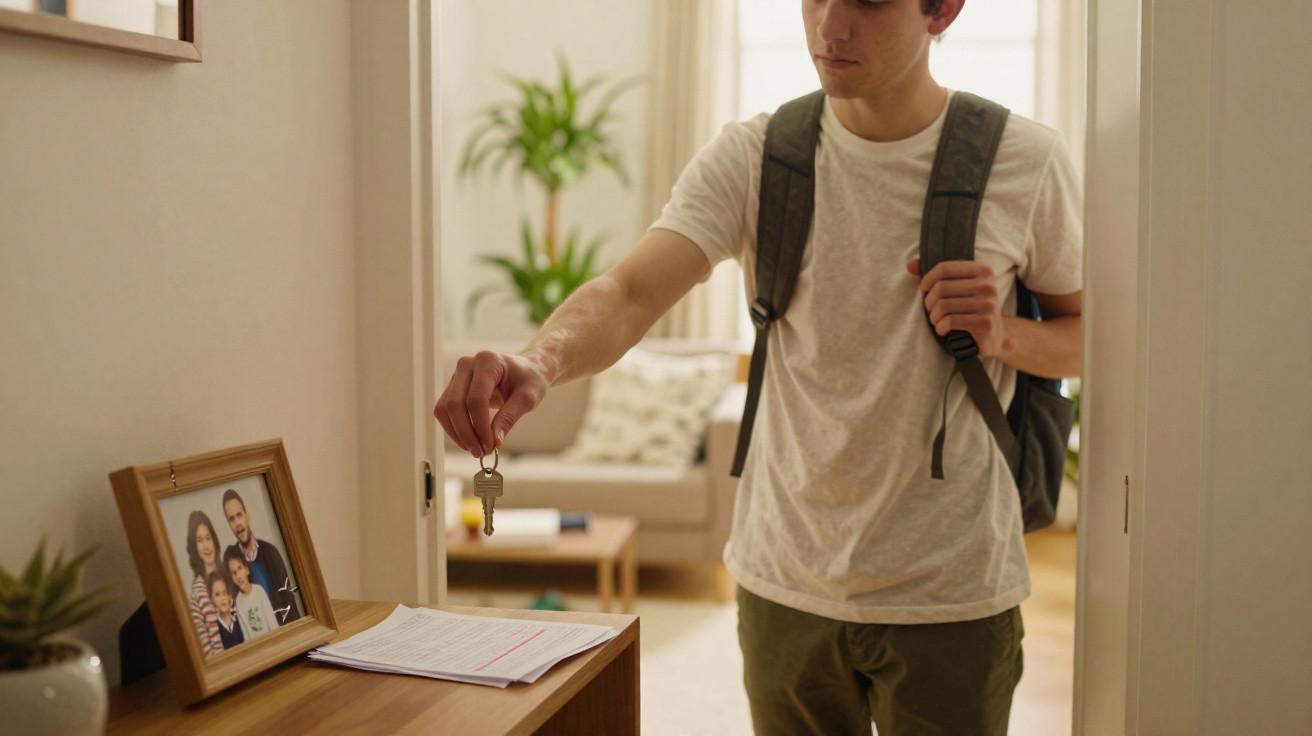
Breaking away from parents is not like changing your telephone number.
It usually happens through tiny fractures: messages left unanswered, increasingly infrequent visits, birthdays marked only by a text. From the outside, it can be mistaken for ingratitude or the whim of an “hypersensitive” adult. From within, the reality is very different.
Many adults who create distance do not announce it online or publicly settle old scores. They simply build a life further away, breathe a little more freely, and find another way to exist. Often, nobody truly knows what they had to endure as children before reaching that point.
People who quietly step back from their parents in adulthood have almost always moved through similar grey areas. There are seven in particular.
1. They became the family’s emotional sponge before they were ready
Speak to adults who have ended or reduced contact with their parents, and a familiar pattern emerges: they were the person expected to keep everyone together. As children, they acted as the peacekeeper, the therapist, the “little adult” in the room. While other children were learning to ride bicycles, they were learning to interpret moods as others might read a weather forecast.
They understood what footsteps in the hallway signalled. A slammed door meant “tonight will be loud”. A prolonged silence meant “walk on eggshells”. Emotionally, they were never allowed to be carefree, noisy or untidy. They were occupied with absorbing tears, calming tension and preventing the family from falling apart.
For someone raised this way, creating distance as an adult does not feel cruel. It can feel like putting on an oxygen mask for themselves for the very first time.
Imagine a nine-year-old girl at the kitchen table as her mother pours out worries about money and complaints about her father. The child listens, offers advice and makes another cup of tea. Nobody asks about her day at school. Nobody notices that she no longer invites friends round.
By the age of 15, she is phoning the electricity company, explaining late homework to teachers and soothing a parent who has had “a bad day”. On the surface, nothing appears especially dramatic: there are no police officers and no social services. There is simply a child quietly carrying the burden of two adults who never truly grew up.
At 28, she moves to another city and stops coming home for every small crisis. People whisper that she has “abandoned” her family. What they do not see is that she is only relinquishing a role she never chose.
Psychologists call this parentification: when a child assumes adult emotional or practical duties. At the time, it can make blurred roles seem normal, but the effect becomes damaging later. The child comes to believe that love means looking after others rather than feeling safe.
Years afterwards, friends may say, “You’re so strong, so independent,” without recognising that this strength came from having no alternative. In adulthood, distance becomes a boundary against being drawn back into endless, unpaid emotional work.
When these adults step away, it is seldom because they lack affection. It is because they have realised that remaining close means disappearing all over again.
2. Their emotions were dismissed, ridiculed or ignored
Many adults who now keep their parents at a distance remember a childhood full of “It’s not that bad” and “Stop being dramatic”. When they cried, they were told to toughen up. When they felt frightened, they were laughed at. Eventually, hiding their emotions became the safest option.
In a family photograph, everything may appear perfectly normal. Everyone is smiling. What the image cannot show is the child who has just heard, “You’re too sensitive, that’s why no one will take you seriously.” That kind of sentence lodges itself like a splinter.
When someone is raised believing their inner life is wrong or exaggerated, closeness can feel dangerous later on. The cost of belonging becomes betraying themselves.
One man in his thirties recalled coming home from school as a boy with a knot in his stomach after being bullied. Once, he attempted to tell his father about it. The reply was: “If you let them see you bothered, they’ve already won. Just ignore it.”
The issue was not that the advice had no value whatsoever. The problem was that nobody first sat with his pain. There was no “That must feel awful.” No “I’m here.” In time, he stopped speaking about anything vulnerable at home. He would talk about school grades and sport, but never his feelings.
As an adult, he sees his parents twice a year. They complain that he is distant. Once again, he hears that he is “cold” and “ungrateful”. Internally, the same thought returns: you never really wanted to know me, just the version of me that didn’t disturb you.
Invalidated feelings do not vanish; they simply retreat underground. The child adapts by making themselves smaller, censoring themselves and becoming the “easy” child who asks for very little. Eventually, that constant self-editing becomes unbearable.
Keeping distance can become a way to experience emotions without somebody rolling their eyes or changing the subject. It is not about clinging to old hurt indefinitely. It is about refusing to return to a setting where ordinary human feelings are treated as an inconvenience.
When parents ask, “You never talk to us,” they often overlook this quiet reality: you taught me my feelings were too much, and now you’re surprised I stopped bringing them to you.
3. Love was always conditional
Adults who gradually pull away from their parents often describe affection that felt contractual. They received warmth when they performed and distance when they disappointed. There were hugs after good grades and silence after poor ones. Helping brought praise, while saying no brought guilt.
The rules were rarely stated aloud: do not outshine a parent, do not disagree publicly, and do not choose friends or partners they dislike. Break those rules and warmth disappears like a switched-off light. As children, they quickly learn that connection comes with conditions.
When they finally have choices of their own, they begin to question the price they are expected to pay for that kind of love.
On paper, a parent may appear deeply devoted. They telephone every day and want to know every detail. Yet every favour carries a reminder: “After everything I’ve done for you…” Every visit becomes an inventory of sacrifices, and every boundary is treated as betrayal.
One woman explained that whenever she wanted to spend holidays with her partner’s family, her mother would say, “You know I only have you, you’re all I’ve got,”. The affection was real, but it came wrapped in a suffocating debt. Any move towards her own life was framed as abandonment.
After years of this, she reduced their calls to once a week. She did not stop loving her mother; she stopped accepting a form of love that cost her peace of mind.
Conditional affection teaches a dangerous message: you only deserve love when you are useful. That script can follow people into work, friendships and romantic relationships. They give too much, explain too much and stay too long.
Creating distance from parents, then, is not random rebellion. It is a quiet effort to redefine love. It is a chance to experience relationships where “no” does not cause emotional blackmail, and where being present is not a form of payment.
For many people, it is the first time they confront a frightening question: if I say no, will you still love me? When the answer repeatedly seems to be “not really”, taking a step back starts to look less like a choice and more like survival.
4. Guilt was their first language - and they are learning to let it go
Distance from a parent is rarely created through one explosive event. It is more like turning down a radio that has broadcast guilt since childhood. The first move is usually not ending contact. It is something quieter: replying to messages later, saying “I can’t this weekend”, or refusing to account for every detail.
Such small acts can feel enormous if guilt was the constant background noise of childhood. You decline Sunday lunch and then spend the day with a tight chest, waiting for a passive-aggressive message. Even so, you say no.
That is the new ability: tolerating guilt without immediately rushing back to make it disappear.
A practical approach used by many adults is to take things “one step at a time”. They alter just one element at first: shorter telephone calls, fewer visits or no engagement with particular subjects. They decide in advance when a visit will end, then leave at that time even if a parent objects.
Before a family event, some people write down three boundaries they intend to maintain: “I will leave if the shouting starts”, “I won’t discuss my love life”, “I won’t be pressured about money.” Having those points written down can help when emotions intensify.
These are not dramatic displays. They are modest, repeated actions that gradually reshape a relationship. Distance does not always require cutting contact; sometimes it simply means refusing to be emotionally bulldozed.
Common mistakes include moving from no boundaries at all to sending a nuclear message at 2 a.m., then regretting it. Another is sharing every internal doubt with the very parent who created those doubts. Let us be honest: nobody manages this perfectly every day with a neat, carefully prepared plan.
Many people move between extremes, going silent for months and then over-contacting out of guilt. The middle ground is more untidy, but gentler on the nervous system. Speak to one trusted friend or therapist rather than five people offering conflicting views. Practise saying, “I need some space, I’ll call you next week,” without defending every detail.
“You’re not a bad child for needing distance. You’re a grown human trying not to bleed from old wounds every Sunday afternoon.”
- Pay attention to your body: a clenched jaw, headache after calls or insomnia before visits are information, not drama.
- Keep one neutral sentence ready for conflict: “I’m not discussing this right now.”
- Arrange a small ritual after contact - a walk, shower or journalling - to reconnect with yourself.
- Reduce contact without rushing: a gradual reduction is often more sustainable than a sudden cut-off.
5. They were never truly seen - and distance helps them find themselves
Ask adults who have withdrawn from their parents what they remember most, and many will say some version of: “They never really knew who I was.” They were assigned roles: the clever one, the difficult one, the pretty one or the disappointment. Those labels endured even when their lives proved them wrong.
At a deeper level, there is a quiet grief in growing up in a household where your inner world felt unseen. Interests were mocked or brushed aside. Personality was forced into a family narrative you never wrote.
Later, choosing distance is not only about escaping pain. It is also about gaining enough room to discover who you are without the old script.
At 35, one man realised that his father still introduced him as “the lazy one who never liked studying”, despite his career, home and stable life. It was presented as a joke, accompanied by a nudge and a laugh, but the underlying message never shifted. In that version of events, he remained 16 years old.
Another woman, who was queer and out with her friends, was still described at family dinners as “the girl who will find the right man one day”. Her parents were not violently rejecting her. They simply refused to revise their image of her. Every visit felt like putting on a costume she had outgrown long ago.
Without knowing one another, and while living in different cities, both people did the same thing: they made a little more space. They visited less often and built more of their lives elsewhere, among people who used their real names rather than childhood roles.
There is a quiet power in being mis-seen and choosing not to stay in that frame forever. Distance becomes less about punishing parents and more about choosing places where the person you are now is permitted to exist.
People who grew up unseen sometimes create “chosen families”: friends, mentors and colleagues who listen, adapt and apologise. At first, the contrast can feel brutal. Then it becomes clarifying. Once you have experienced that kind of recognition, returning to the role of family scapegoat or mascot can feel intolerable.
They therefore create a life that fits them. The gap between them and their parents grows. From the outside, it may appear cold; from the inside, it can be the first time they have felt even remotely warm.
| Key point | Details | Why it matters to readers |
|---|---|---|
| Recognising signs of emotional parentification | Think back to childhood: were you mediating adult arguments, dealing with bills or comforting a parent more often than they comforted you? This pattern frequently repeats in adult relationships. | It can help you understand distance not as random rebellion, but as a correction to a role you should never have had to carry. |
| Setting “micro-boundaries” before big ones | Begin with smaller changes: shorten calls, refuse one subject or leave a visit on time. Notice how your body responds and how your parents react. | This makes the process safer and less explosive, so you do not burn out or feel compelled to end all contact overnight. |
| Building a support system outside the family | Nurture 1–3 people who know the real story - a friend, partner, therapist or colleague. Tell them what happens after family interactions and how it affects you. | It reduces the loneliness and self-doubt that commonly arise when you challenge long-established family dynamics. |
People who distance themselves from their parents may look composed on the surface. They have a job, pay rent, perhaps raise children and take holidays. The real story unfolds in quieter moments: the hesitation before answering the phone, the relief when a visit is cancelled, and the strange combination of love and dread attached to their childhood home.
We tend to prefer stories with obvious villains and heroic escapes, yet many family histories do not take that form. Affection and harm can be intertwined. Some parents did their best and still caused damage. Some adult children love deeply while still choosing less contact.
At some point, most of us have experienced the moment when loyalty to family collides directly with loyalty to ourselves. Some people repair things from within; others step back in order to breathe. Neither route is straightforward.
If you recognise yourself in these words, perhaps the question is not “Am I a bad child?” but “What did I live through that makes distance feel like the safest option right now?” That question alone can already change everything. Parents, children and siblings all carry chapters that remain untold.
Sharing those chapters - or deciding not to share them - is a form of courage in itself. Somewhere between silence and rupture, many people are quietly creating a new way of being family, one boundary, one awkward conversation and one necessary mile of distance at a time.
FAQ
Is it normal to feel guilty for taking distance from my parents? Yes, guilt is extremely common, particularly if you were brought up to put your parents’ needs before your own. The aim is not to remove guilt overnight, but to behave in line with your values when guilt arises and allow your emotions to catch up later.
How do I know if I should reduce contact or cut it completely? Look at patterns rather than isolated events. If every interaction leaves you anxious, ashamed or unsettled for days, greater distance may be worth considering with professional support instead of remaining in a cycle that never changes.
Can a distant relationship with parents ever improve? Yes, sometimes. Small and consistent boundaries can shift the dynamic, especially when parents are prepared to listen and adapt. It is generally slow and imperfect, and it usually works best when both sides accept that the relationship will never return to what it was.
How do I explain my choice to relatives who judge me? You do not owe anyone your full story. A simple sentence such as “Our relationship is complicated and I’m doing what’s healthiest for me right now” is enough. Those who genuinely care about you will respect this even when they do not fully understand it.
What if my parents were not “that bad”, but I still need space? You are allowed to need distance without a label of dramatic trauma. Emotional misattunement, continual criticism or years of feeling unseen are valid reasons to step back and protect your energy.





Comments
No comments yet. Be the first to comment!
Leave a Comment