
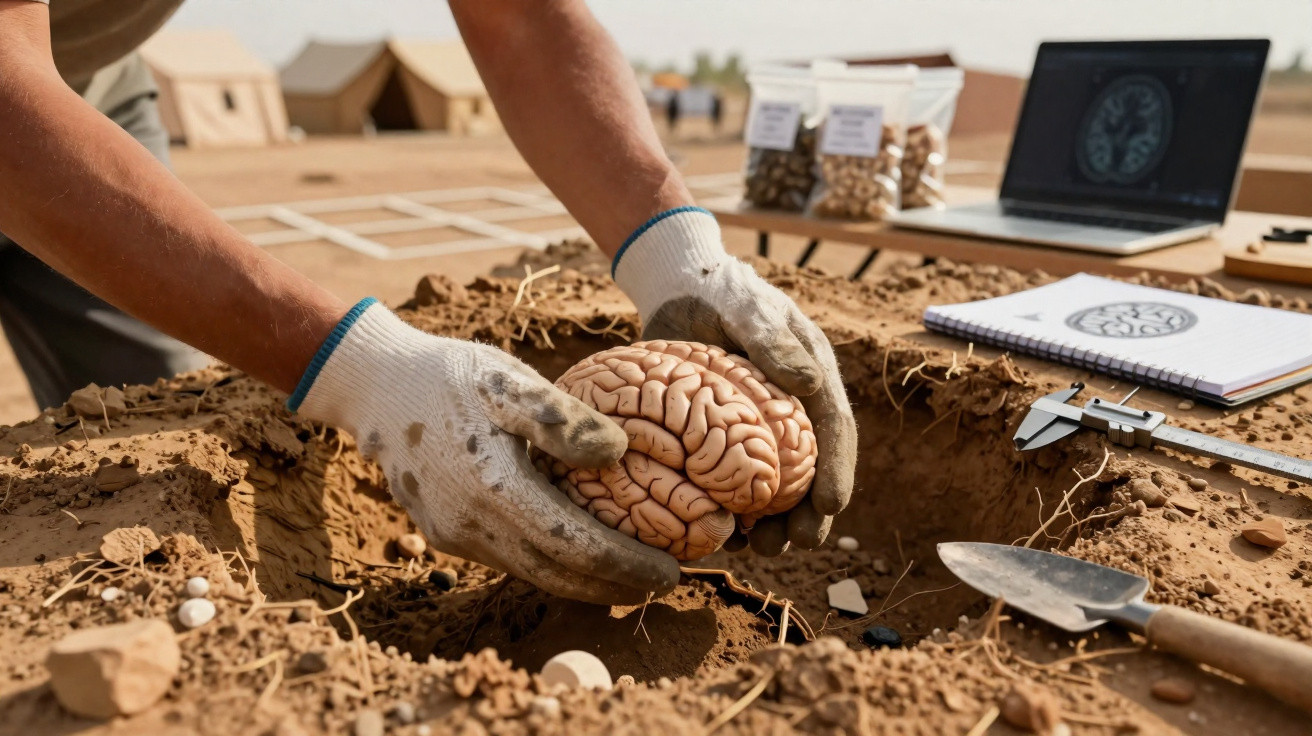
The human brain, it seems, may be far more resilient to the effects of time than expected.
Preserved human brains reveal an unexpected record
A new study has compiled instances of human brains recovered from archaeological sites worldwide. It found that this extraordinary organ can withstand decomposition much better than previously believed, even after all of a body's other soft tissues have entirely disappeared.
A research team led by molecular taphonomist Alexandra Morton-Hayward of the University of Oxford identified more than 4,400 preserved human brains, some dating to as long as 12,000 years ago. Their findings challenge earlier evidence suggesting that the brain is one of the first organs to deteriorate following death.
Experts say the discovery provides an archive that could help us learn more about human evolutionary history and the diseases that affect us.
"In the forensic field, it's well-known that the brain is one of the first organs to decompose after death – yet this huge archive clearly demonstrates that there are certain circumstances in which it survives," Morton-Hayward says.
"Whether those circumstances are environmental, or related to the brain's unique biochemistry, is the focus of our ongoing and future work. We're finding amazing numbers and types of ancient biomolecules preserved in these archaeological brains, and it's exciting to explore all that they can tell us about life and death in our ancestors."
Naturally preserved soft tissue in archaeological remains - where bodies have been left exposed to natural processes rather than deliberately preserved through embalming or freezing - is uncommon. Experimental studies of decay have indicated that the brain is among the organs most quickly affected by decomposition.
A global catalogue of archaeological brains
Previously, a preserved human brain within a body whose remaining tissues had decayed, leaving only bones, was considered an exceptionally rare occurrence: almost a one-off event. To establish just how unusual this was, Morton-Hayward and her colleagues began a worldwide search for preserved human brains.
Their investigation involved closely reviewing all available published scientific research and contacting historians around the world. They recorded 4,405 preserved human brains from 213 sources, with reports from every continent except Antarctica. The records extend back to the middle of the 17th century.
The brains came from a broad range of settings. These included a Spanish Civil War mass grave, in which brains survived despite severe gunshot injuries; the sandy deserts of Ancient Egypt; victims of Incan ritual sacrifice near the dormant Llullaillaco volcano around 1450 CE; Tollund Man, dated to 220 BCE and recovered from a peat bog; and the shore of a lake in Stone Age Sweden.
The environmental settings in which these brains were discovered corresponded with known routes of natural preservation. These processes include dehydration, freezing, tanning - as occurs in peat bogs - and saponification, during which fats become wax-like moulds.
Why some ancient brains survived alone
However, another pattern was particularly striking. Of the 4,405 brains, a remarkably large proportion - 1,308, nearly one-third of the total - represented the only surviving soft-tissue structure in remains that had otherwise been completely skeletonised. They were also all among the oldest examples, with some reaching ages of 12,000 years.
The preservation method for these brains could not be associated with recognised natural preservation conditions. They were recovered from places including shallow graves, mass graves, tombs, shipwrecks, burial mounds and even severed heads. According to the researchers, this points to a soft-tissue preservation process that may be specific to the central nervous system.
Exactly what that process is remains a major unknown, although the team believes it may involve interactions between molecules in the brain and elements of the surrounding environment. Proteins, lipids and sugars within the brain, for example, might combine to create stable polymerised macromolecules when certain metals are present, including copper, which is plentiful in the brain.
The researchers intend to examine this intriguing phenomenon in more detail to establish how it may occur. Yet the material uncovered by the scientists has much more to teach us.
"The archive compiled here represents the first step toward a comprehensive, systematic investigation of ancient brains beyond approximately 12,000 years before the present, and is essential to maximizing the molecular and morphological information they yield as the most metabolically active organ in the body, and among the most commonly preserved soft tissues," the authors write in their paper.
"Ancient brains may provide new and unique paleobiological insights, helping us to better understand the history of major neurological disorders, ancient cognition and behavior, and the evolution of nervous tissues and their functions."
The research was published in Proceedings of the Royal Society B: Biological Sciences.





Comments
No comments yet. Be the first to comment!
Leave a Comment