
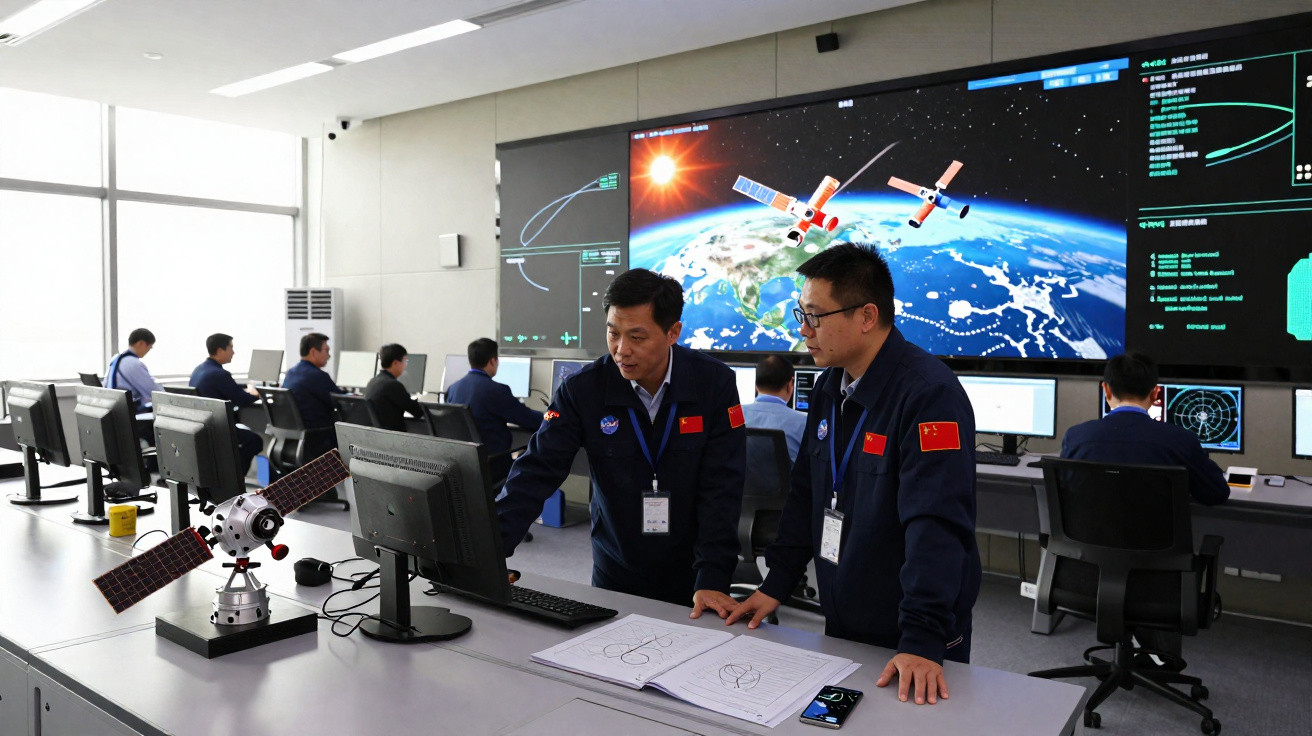
The call came without a dramatic countdown or a Hollywood-style warning siren. Instead, it was a discreet digital alert between two space agencies that seldom communicate: China’s space authorities contacted NASA over a possible collision involving their hardware far above Earth. There was no press briefing or flag-waving, only data and concern.
At an altitude of roughly 500 to 800 kilometres above the screen on which you are reading this, US and Chinese satellites use the same narrow orbital corridors. They race past at 28,000 km/h, with only a few moments and a few kilometres of vacuum between them.
On this occasion, that separation abruptly seemed far too slim.
In a darkened control room somewhere, somebody may well have had the thought many people would share: “We really can’t afford to mess this up.”
That was how an understated, unprecedented exchange quietly altered the usual narrative of space rivalry.
When rivals make an orbital call
At first glance, it appeared to be a routine technical notification: trajectories updated, timings revised and figures checked repeatedly. What happened behind it was much less ordinary - China asked NASA for assistance in avoiding a possible satellite collision, and NASA responded.
For years, the United States and China have presented one another as strategic dangers in orbit. They have competed to reach the Moon, constructed separate space stations and deployed mega-constellations.
Yet, confronted by the prospect of an in-space crash, they took an action that was both almost ordinary and quietly significant.
They spoke - and they paid attention.
Accounts assembled by space trackers and officials make the event sound remarkably restrained. Chinese engineers identified a concerning conjunction - the space-industry term for “two objects getting uncomfortably close” - involving one of their satellites and a NASA spacecraft, or debris listed in the US military catalogue.
Using an emergency deconfliction channel, they made contact, shared orbital information and requested updated projections. US teams supplied more precise tracking data and collision-probability assessments: in effect, this is what we observe, this is the apparent level of danger, and this is when a manoeuvre may be advisable.
There were no photographs of handshakes or astronauts smiling for cameras. Engineers on both sides simply watched their displays, seeking to prevent two metal objects colliding at ten times the speed of a bullet.
The reasoning is straightforward. Space, once viewed as an immense and empty frontier, has become congested: thousands of satellites, tens of thousands of trackable debris fragments and millions of pieces too small to track.
When two major space powers fail to communicate, the danger goes beyond geopolitics. It can become a literal cloud of debris that endangers every type of satellite, including systems supporting weather forecasts, GPS and broadband.
That makes a quiet, seemingly bureaucratic exchange far more than a technical detail. It is a direct recognition that physics doesn’t care about national flags. Orbital routes intersect and hazards accumulate. Eventually, there is a choice between cooperation and a crash.
How satellites steer clear of a space collision
The fundamental action sounds uncomplicated: make a small adjustment. Operators do not wrench a satellite from the sky; they alter its orbit by a few metres per second, hours or days before a possible impact.
When China made contact, the discussion focused on precisely these small figures. How close will the objects come? How much uncertainty is there? At what point is the threat greatest?
Mission teams then test different outcomes. If thrusters are fired now, how much propellant is consumed? Could that manoeuvre introduce a collision threat with another object? Is it better to wait for more reliable information?
In orbital dynamics, patience can be as powerful as fuel.
This is the stage at which people feel the pressure. Teams have seen graphs and charts documenting earlier orbital collisions, including the 2009 impact between an Iridium satellite and a defunct Russian spacecraft, which generated more than 2,000 fragments of debris.
No one wants to be accountable for another such event.
During those difficult hours, teams therefore tend to communicate excessively: further emails, urgent telephone calls and an endless stream of trajectory plots. Errors can still slip in - measurements may be confused, timestamps misinterpreted, or a manoeuvre may resolve today’s issue while making next week’s more difficult.
The reality is that nobody manages this at the boundary of perfection every day. The orbital ballet is partly science, partly art and partly exhausted engineers trying not to blink at the wrong moment.
During this particular near-miss, reports suggest that the exchanges between China and NASA remained technical and almost dry. Beneath that manner, however, something unusual was taking place.
They were exchanging more than figures; they were extending a measure of trust.
“We may disagree on almost everything else,” one former NASA official told a reporter off the record, “but nobody wins if low Earth orbit turns into a minefield. Talking about collision avoidance is the bare minimum of being a responsible space power.”
- Shared data: China sought and used NASA’s refined tracking information to gain a clearer view of the risk period.
- Prevention over pride: Both parties regarded the satellite as part of a common environment, not a piece in a public-relations contest.
- New precedent: The exchange created an unusual example of US–China space coordination outside formal high-level agreements.
- Future template: The approach that worked once can be repeated: direct channels, rapid data and no politics in the control room.
Why the China–NASA exchange could reshape space safety
There is an unusual closeness to cooperation in space. Two countries that have little trust in one another on Earth can suddenly rely on each other’s accuracy in a few digits after a decimal point.
One inaccurate number would not merely mean the loss of a satellite. It could scatter fragments through orbit, where they might strike weather missions, Earth-observation spacecraft or even crewed vehicles.
Everyone recognises the point at which rivalry appears insignificant beside the potential consequences. This was that point, playing out 600 kilometres above Earth.
The incident also reveals an uncomfortable reality: space infrastructure is considerably more vulnerable than glossy “New Space” messaging implies.
A single serious collision in the wrong orbit could impair satellite internet, interrupt navigation signals or leave climate-monitoring missions unable to operate properly for years.
This is why some specialists support arrangements more robust than improvised calls: genuine space traffic management, common standards and even semi-automated coordination systems that do not have to wait for political relations to improve.
It is not a matter of friendship. It is about avoiding foolish decisions in a vacuum where the consequences of mistakes can remain for decades.
For people on the ground, this may sound remote, but its effects reach directly into their pockets. Weather apps, maps and the timing signals that enable digital payments all rely on satellites surviving these near-miss situations.
This first-of-its-kind contact between China and NASA is therefore more than a diplomatic curiosity. It highlights that our digital lives hang on invisible decisions made at odd hours by people staring at orbital tracks.
Perhaps the larger question is not whether rivals spoke on one occasion, but whether people will expect them to continue speaking whenever calculations show that two paths are heading towards a dangerous collision.
| Key point | Detail | Value for the reader |
|---|---|---|
| Space is crowded | Thousands of operational satellites and vast clouds of debris occupy the same orbits | Explains why collision alerts are becoming more common and more newsworthy |
| US–China call was a first | China contacted NASA through a deconfliction channel to prevent a possible satellite collision | Demonstrates that even rivals can cooperate when connectivity, GPS and weather information are at risk |
| Future depends on norms | Experts support consistent space-traffic coordination and common rules | Indicates that public awareness and pressure can affect how safely space is used |
FAQ:
- Why did China contact NASA at all? NASA, through US tracking networks, holds some of the strongest data on objects in orbit; this information can improve collision-risk estimates and support safer manoeuvres.
- Does this mean the US and China officially cooperate in space now? Not in a broad sense. This was a limited, practical safety exchange rather than a full partnership or mission-level cooperation.
- How often do potential satellite collisions occur? Close passes take place every day, although only a small proportion present serious danger; nevertheless, alerts are increasing as additional satellites are launched.
- Could one collision really affect life on Earth? Yes. If essential infrastructure such as communications, GPS or weather satellites is affected, consequences could extend to navigation, finance, aviation and everyday apps.
- What happens after this first contact? Space-policy observers anticipate greater pressure for transparent “space traffic management” systems and more dependable hotlines between leading spacefaring nations.





Comments
No comments yet. Be the first to comment!
Leave a Comment