
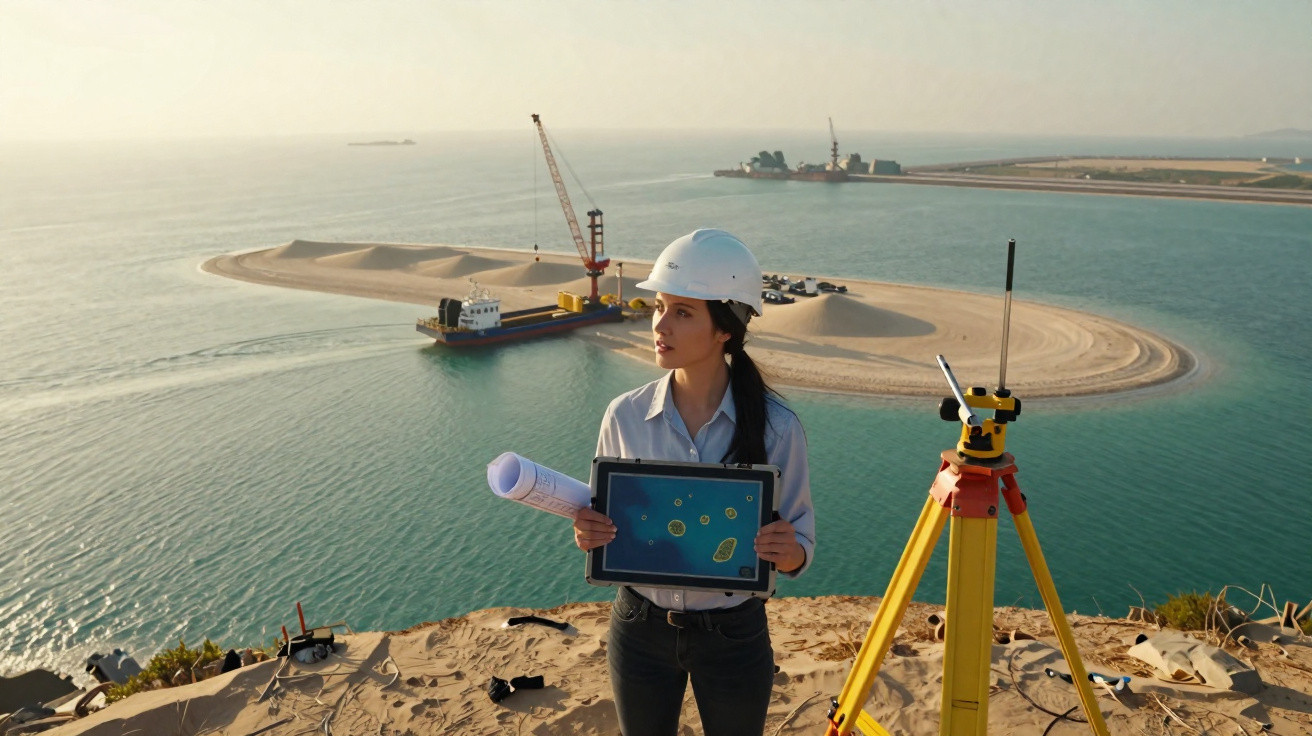
On a misty morning in the South China Sea, a Filipino fisherman steers his boat towards a place his grandfather insists was once open water. Beneath the washed-out sun ahead, something rises that seems almost unreal: a runway, radar domes, cranes and orderly lines of buildings perched on turquoise water that is no longer simply water. Twelve years ago, this was only reef. Today, it is a solid artificial island, with a Chinese flag fluttering in the breeze.
He switches off the engine and waits. In the distance, the dull pounding of dredgers carries across the water, like a building site suspended on the horizon. Sand continues to be drawn from the seabed and pumped ashore, grain by grain, changing blue into beige and shallow water into claimed ground.
Somewhere among those grains of sand is a question on which nobody agrees.
How China turned empty sea into hard land, one grain at a time
Seen from above, China’s new islands can appear implausible, as though Lego-style bases had been placed across the ocean. Jagged stretches of reclaimed ground slice through the organic shapes of coral reefs. Ships as large as small towns circle the sites, trailing lengthy black pipes that suck sand from the seafloor before spraying it into pale rings that steadily expand.
This long campaign of sand dumping began quietly in the early 2010s before accelerating with striking force. In only a few years, level, sandy platforms emerged in places where sailors had previously navigated cautiously around shallow reefs. Heavy equipment, rather than tides or time, was reshaping the sea itself.
Fiery Cross Reef illustrates the change. Its name once suited an isolated stretch of rock and coral battered by the waves. In 2012, it lay largely underwater at high tide and amounted to little more than a mark on maritime charts. By 2016, satellite imagery revealed a 3,000-meter runway, a deep-water harbor and rows of hangars built on some 2.7 million square meters of newly created land.
Working day and night, engineers dredged and deposited sand under GPS guidance and the protection of coast guard vessels. A reef once used by fishermen was turned into an airstrip capable of receiving bombers and surveillance aircraft. Local fishers say the conversion was so rapid that they would leave during one season and return to discover a new shoreline where waves had once broken.
Behind the spectacle lies a straightforward yet volatile rationale. Under the UN Convention on the Law of the Sea, natural islands may generate extensive exclusive economic zones. Artificial islands do not automatically receive equivalent rights. By raising a reef into an island, China is doing more than shifting sand. It is probing the limits of international rules, wagering that concrete and runways will ultimately carry more weight than legal footnotes.
The land exists, the law remains disputed, and power often favours what can be seen, constructed and protected. That is the uneasy reality beneath every fresh strip of beach.
The quiet method behind a very loud geopolitical statement
The underlying process is almost deceptively simple. First, select a submerged or barely visible reef. Surround it with rock and sheet piles to create a contained form. Next, bring in dredgers to vacuum sand, gravel and coral from the nearby seabed, then blast the slurry into the enclosed area until it stands above the waterline. Finally, level and compact the surface before pouring concrete much as would be done on land.
Engineers describe this as land reclamation. Pilots see a new airfield. Coastal states see a problem. Every artificial island creates a lasting presence where there was once only shifting water: a fixed pawn in a region long governed by moving currents.
For communities around the South China Sea, this is not an abstract game of chess. A Vietnamese captain in his fifties told journalists that his familiar fishing grounds near Subi Reef changed “like someone slammed a door” in his face. He once anchored near the shallow reef, swapping cigarettes and gossip with crews from across the region beneath the stars.
Then patrol vessels appeared with little warning. Chinese voices came through loudspeakers. Water that had been open for decades suddenly became a restricted area, patrolled by ships flying a flag he did not regard as local. In one season, his nets were full of fish; in the next, they brought up only silence and orders to leave.
Analysts following the reclamation surge say the changes were not random. The approach followed a recognisable sequence: locate disputed features, turn them into fortified outposts, then surround those outposts with a halo of claimed maritime “rights”. Dredgers deliver the sand, but strategy adds something more substantial.
By establishing facts on the water, China pushes neighbours and outside powers towards a new normal in which maps increasingly conform to steel and concrete. Legal objections can be lodged, press conferences staged and tribunals called. The islands remain where they are, runway lights glowing after dark while others debate the paperwork.
Why these islands trigger fear, fascination, and a quiet sense of déjà vu
Observing the construction can make the politics briefly fade into the background. There is an unusual order within the apparent chaos. Dredgers follow planned circuits, survey vessels draw precise tracks and barges queue like checkout lines as they wait to unload rock and steel. Industrial routine is being imposed on a place often imagined as wild and untouched.
Over twelve intense years, the technique has been sharpened: quicker pumps, improved modelling of sand behaviour and tougher sea walls designed to withstand typhoons. Gradually, China has converted technical expertise into a strategic habit: where it seeks a presence, it creates land.
Photographs of the work often bring Dubai’s palm-shaped islands or vast airport extensions on reclaimed shorelines to mind. The comparison is reasonable, but incomplete. Urban developments market sea views and shopping centres. The South China Sea islands offer security, reach and discreet leverage over shipping routes that support much of the global economy.
Still, the emotional reaction is much the same. Human control over coastlines can inspire both awe and unease. Many people recognise the feeling of seeing before-and-after satellite images and sensing a drop in their stomach, even if they cannot entirely say why.
Environmental scientists offer a stark warning that cuts through the rhetoric.
“Reefs that took thousands of years to build can be buried in a season,” says a marine biologist based in Manila. “You don’t just flip a switch and get that biodiversity back.”
Fishermen around the new islands describe murkier water and fewer coral species.
- Reefs blasted and dredged – The essential base of marine life is scraped away and crushed.
- Shipping lanes quietly reshaped – Ships change course to avoid sensitive areas, frequently without public discussion.
- New military footprints – Radars, runways and missile sites alter the region’s everyday assessment of risk.
Let’s be honest: maritime law is not something anyone reads for pleasure, yet these developments are already becoming part of the background to global trade, fuel costs and even the fish served on dinner plates far from Asia.
Who really owns the ocean when you can build your own coast?
The further you examine these sand-built islands, the more they seem to test the very meaning of “ownership” at sea. The law says one thing, while dredgers say another, leaving neighbouring countries caught between anger and practicality. They lodge protests, deploy patrols and seek partners as satellite feeds show new piers and bunkers appearing month after month.
For everyday people, the issue may be more personal than they care to acknowledge. Who has the right to draw a boundary across water and call it their own merely because they possess the machinery, funds and time to deposit enough sand?
| Key point | Detail | Value for the reader |
|---|---|---|
| How the islands are built | Dredging, sand dumping, sea walls, and rapid construction on former reefs | Helps you picture the physical process behind the headlines |
| Why it matters geopolitically | Artificial land changes power, patrol routes, and negotiating leverage in the South China Sea | Shows how remote disputes can influence trade, security, and daily life |
| Environmental and legal fallout | Reef destruction, fisheries disruption, and intense disputes over maritime rights | Encourages you to question how far technology should go in reshaping shared spaces |
FAQ:
- Question 1 Are China’s artificial islands legally considered “territory” with full maritime rights?
- Question 2 How long does it take to turn a reef into a fully functional island base?
- Question 3 Do other countries also build artificial islands in the South China Sea?
- Question 4 What kind of military infrastructure is usually installed on these islands?
- Question 5 Can the damaged reefs and ecosystems around these islands ever really recover?





Comments
No comments yet. Be the first to comment!
Leave a Comment