
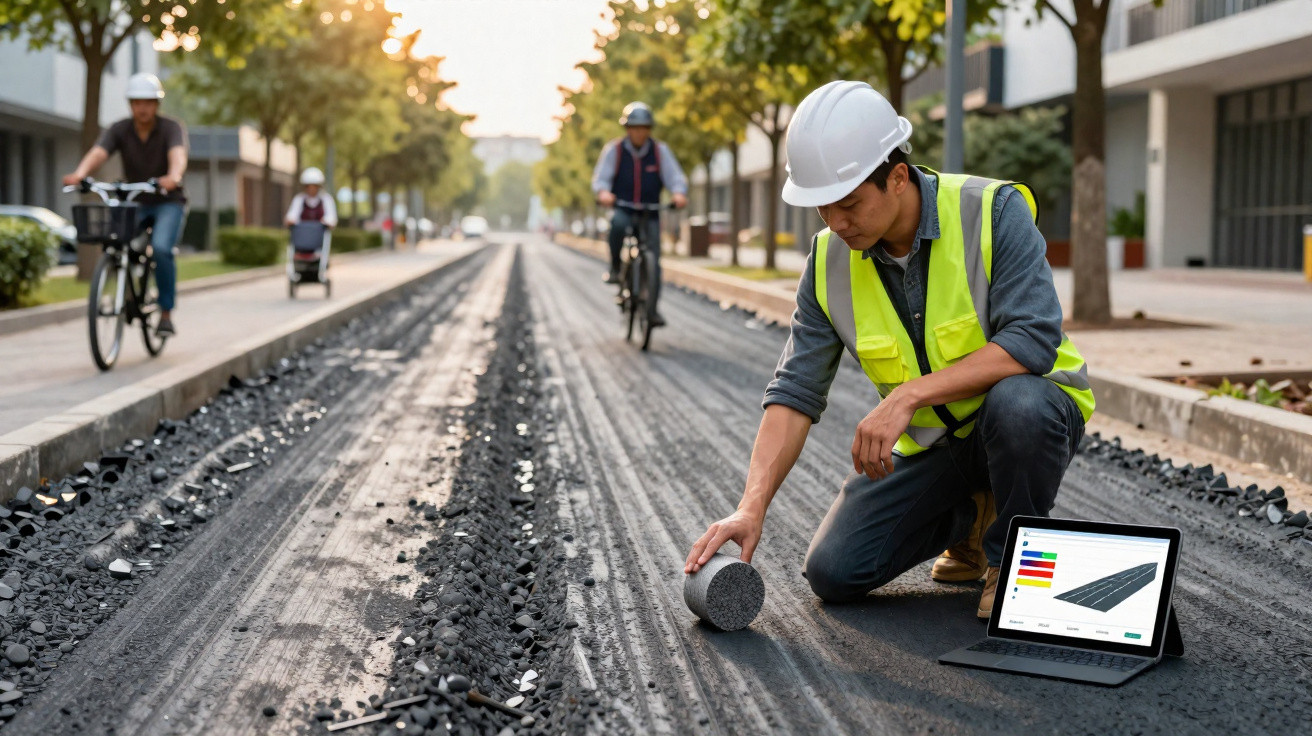
Everyone likes a win-win. This may be better still: a possible win-win-win.
Steel slag roads could cut emissions and disruption
Using an industrial by-product that would otherwise become waste in new road surfaces could help future highways and local roads lessen their climate-change impact and, potentially, save lives.
A fresh analysis indicates that swapping standard urban road surfacing for pavement partly made with recycled steel slag could markedly lower greenhouse-gas and air-pollution emissions. It could also reduce road maintenance, meaning fewer frustrating traffic queues caused by repair works.
If steel slag is unfamiliar to you, you are certainly not alone. It is a waste material produced when iron ore or scrap metal is melted to manufacture steel.
This residual material consists of silicon dioxide and metal oxides, and can be used to produce a steel slag epoxy asphalt mixture, or SEAM.
Steel slag is particularly well suited to paving because its strength and angular form help create a hard-wearing road surface. For the study, researchers paired SEAM with an epoxy-modified asphalt binder to create a material intended to resist wear and deformation more effectively than conventional pavement.
A road that lasts longer can limit both the public inconvenience and air pollution caused by congestion around roadworks.
There is another benefit, too: as road surfaces decline, vehicles consume more fuel, creating costs in both money and emissions. A road that deteriorates less frequently can therefore reduce the petrol, diesel and wear incurred by the vehicles travelling over it.
In the researchers’ model, these effects during the use phase made up roughly 95 percent of emissions and 60 percent of a road’s lifetime costs under the baseline scenarios.
Although the use phase accounts for most costs across any roadway’s life, the researchers found that SEAM is more expensive to construct, creates more emissions, and produces more fine particulate pollution in its initial years of operation. Crucially, however, when a conventional road surface requires replacement - and creates those emissions all over again - emissions from the SEAM-based road continue to be spread across its longer life.
That considerable durability shifts the calculation for SEAM-based roads.
SEAM durability and epoxy content
The researchers modelled three formulations containing 20, 35, or 50 percent epoxy. They assumed conventional pavement and SEAM with 20 percent epoxy would each endure for six years. The 35-percent epoxy version was estimated to last 15 years, while the 50-percent formulation was expected to last 20 years.
By distributing construction costs and emissions over a longer operational lifespan - while cutting the fuel-use and maintenance drawbacks associated with deteriorating roads - the more durable pavement could ultimately compensate for its larger initial footprint.
Among the scenarios modelled, the researchers judged the 35-percent epoxy mixture to offer the strongest balance. Increasing epoxy extended a pavement’s lifespan, but after approximately 35 percent, further environmental improvements flattened out as costs continued increasing.
They next expanded their model to cover China’s urban road network, examining cases where 25, 50, 75, or 100 percent of current urban asphalt pavement was replaced. Under the highest replacement scenario, the model forecast cuts of around 1.74 billion tonnes of CO2-equivalent emissions and 1.23 billion kilograms of PM2.5 during the assessment period.
PM2.5 refers to fine particulate pollution associated with deaths from heart disease, kidney disease, dementia, hypertension, lung cancer and other illnesses.
Potential health and economic effects of SEAM roadways
Taken together, these figures could represent a substantial effect. Across the replacement scenarios, researchers calculated that reduced exposure to PM2.5 alone might prevent 31,802 to 128,980 premature deaths.
The health results were generated through a model that connected projected reductions in fine particulate pollution with established links between PM2.5 exposure and mortality. The authors specifically characterise these findings as system-level estimates, rather than exact epidemiological forecasts.
SEAM could also deliver substantial financial savings. According to the study, it could generate 3.48–15.01 trillion Chinese Yuan ($519.14 billion to $2.24 trillion US Dollars).
Such changes in material performance at the system level could have broader consequences because they are "broadly transferable to other rapidly urbanizing economies with significant steel industries," the study’s researchers write.
"Countries such as India, along with several nations in Southeast Asia and Africa, generate large volumes of [steel slag] while facing accelerating transport demand and mounting environmental constraints." These countries could likewise gain from the climate, public-health and economic advantages offered by SEAM roadways.
Practical complications must still be considered. Steel slag is not generated evenly throughout China, so the team modelled its transport between provinces. This transport adds emissions, but their model still found a substantial overall reduction in CO2-equivalent emissions and PM2.5.
The research also does not assess whether existing industrial infrastructure could instantly manufacture and distribute sufficient material to satisfy demand across the country. One of the most significant disadvantages is that the new surface needs seven days to cure before it can fully reopen to traffic.
It is worth considering that the most sustainable road may not always be the one requiring the least energy to construct. Instead, it may be the road that remains reassuringly, wonderfully road-like for the longest time: smooth, durable and requiring fewer repairs.
The research was published in Communications Earth & Environment.
This article was fact-checked by Rachel Garner and edited by Fiona MacDonald. While we pride ourselves on our process, we are only human. If you spot a mistake, please let us know.





Comments
No comments yet. Be the first to comment!
Leave a Comment