
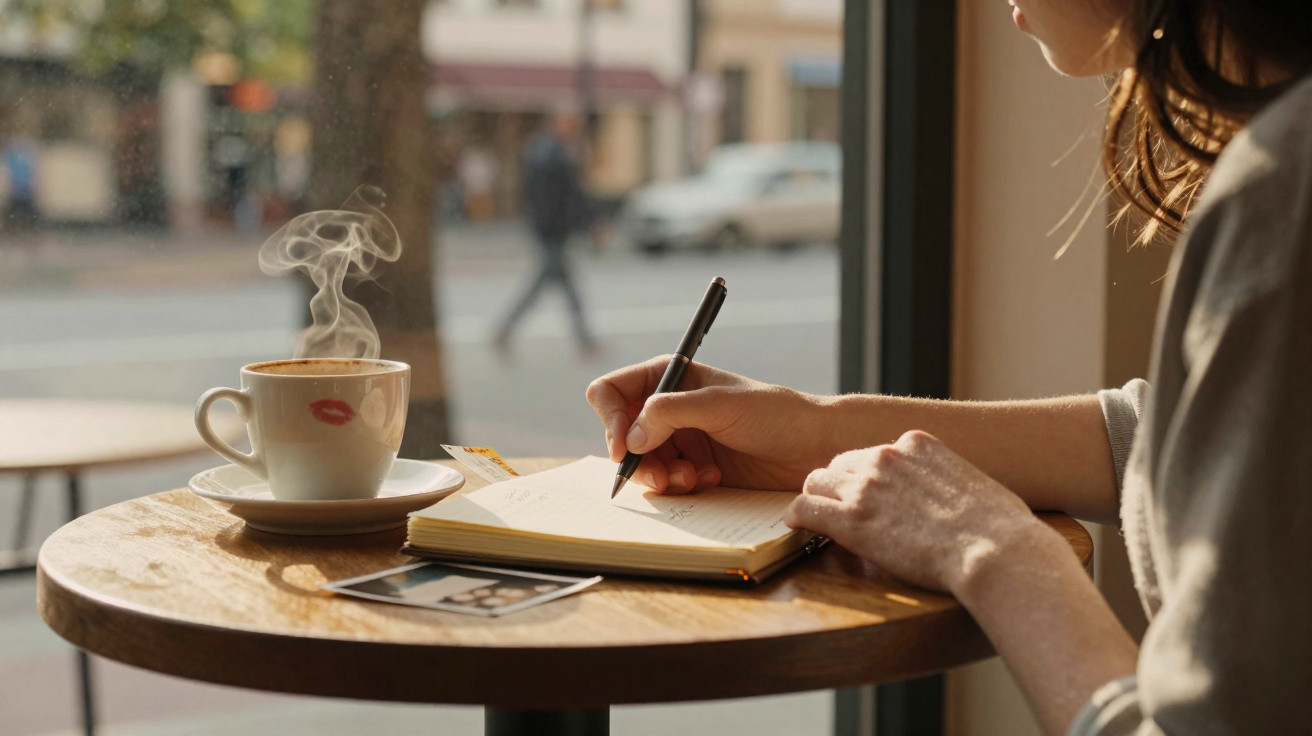
On the Tube, she takes out her small notebook before she even checks her messages. A sentence overheard the day before, the colour of a November sky, the first name of a waiter who reminded her of someone: it all goes in there, in handwriting that is sometimes rushed and sometimes almost illegible. We all know that instant when an ordinary detail suddenly brings back a whole emotion, as though it had been waiting behind a door. For people who always keep a paper notebook in their bag, this instinct is not simply about forgetting nothing. It can also reveal a very particular way of feeling, organising and reliving moments. This is not nostalgia on the cheap. It is often far more intimate.
The paper notebook, a quiet refuge for emotions
A notebook moves through the day unnoticed: it sits at the bottom of a bag, wedged between headphones, a receipt and a packet of tissues. When an emotion surfaces, people who write often instinctively place it there, without necessarily trying to create beautiful sentences. They jot down a date, something said by a loved one or an unusual feeling in their chest. This habit may foster an especially precise emotional memory, because the experience is not merely lived: it is revisited, selected and put into handwritten words.
A widely cited 2014 study by Princeton University and UCLA found that handwritten note-taking encouraged deeper understanding than typing on a computer in certain learning situations. The process is not quite the same with emotions, yet the idea resonates with many people. Camille, 34, has kept small black notebooks for ten years. She cannot remember every appointment she has had, but she can recall the smell of a café during her first break-up, or the sentence that reassured her on the day she changed jobs.
Writing on paper slows the movement down. That slower pace requires us to choose what matters, give shape to a blurred impression and sometimes look at an emotion rather than immediately running from it. Psychologists often refer to encoding: the more personally and sensorially information is processed, the more likely it is to remain available to us. A notebook does not hold on to life for us; it gives life points of reference. Someone who writes regularly can therefore retain exceptionally vivid memories, including those that others have already consigned to oblivion.
How to use this instinct without turning life into an archive file
To benefit from this sensitivity, there is no need to keep a flawless journal or write three pages every evening. One simple approach is to set aside a few lines for ‘traces of the day’: a moment, the prevailing emotion and one tangible detail. “I laughed in the kitchen with my brother; it was pouring with rain outside” is more than enough. A sensory detail has particular value: music heard in a taxi, the taste of a fruit or light falling on a face. Over time, these fragments become gateways to surprisingly complete memories.
A common mistake is assuming that every page must be brilliant, useful or fit to share. Many notebooks are given up after a week because their owner imposes an overly rigid routine, as if they had to produce a flawless account. Let us be honest: nobody really does that every day. The most alive notebook is often the one containing a shopping list, poorly expressed anger, a failed drawing and a sentence that means nothing to anyone else. That freedom keeps writing away from performance and gives emotion room to breathe.
It can also help to reread notes gently, without trying to interpret every detail. Some pages will bring tenderness to the surface, while others may cause mild discomfort: that is normal, because emotional memory does not sort pleasant recollections from those that have left a mark.
“The real voyage of discovery consists not in seeking new landscapes, but in having new eyes.” - Marcel Proust
- Write down one concrete detail rather than a long account.
- Name the emotion felt, even if it is only with a simple word.
- Reread only when you feel like it, with no obligation.
What these small paper notebooks truly say about us
Keeping a paper notebook does not mean that someone has a faultless memory, or that they experience life more intensely than everyone else. It may simply reflect a need to capture what passes too quickly, make sense of a confused moment or protect an inner voice that notifications sometimes drown out. For some people, this practice reveals a sensitivity attuned to subtleties: they remember not so much the bare facts as the atmosphere, the silences and the way they felt. These are often the memories that shape a personal story. An old notebook rediscovered at the back of a drawer can then bring forth a version of oneself thought to have vanished, opening an unexpected conversation with one’s own past.
| Key point | Detail | Added value for the reader |
|---|---|---|
| Handwriting | It slows down and personalises the memory. | It helps identify what truly matters. |
| Sensory detail | A smell, sound or light anchors the emotion. | It makes memories more vivid when reread. |
| Flexible regularity | A few lines are enough, with no strict rule. | It removes pressure and makes the habit sustainable. |






Comments
No comments yet. Be the first to comment!
Leave a Comment