
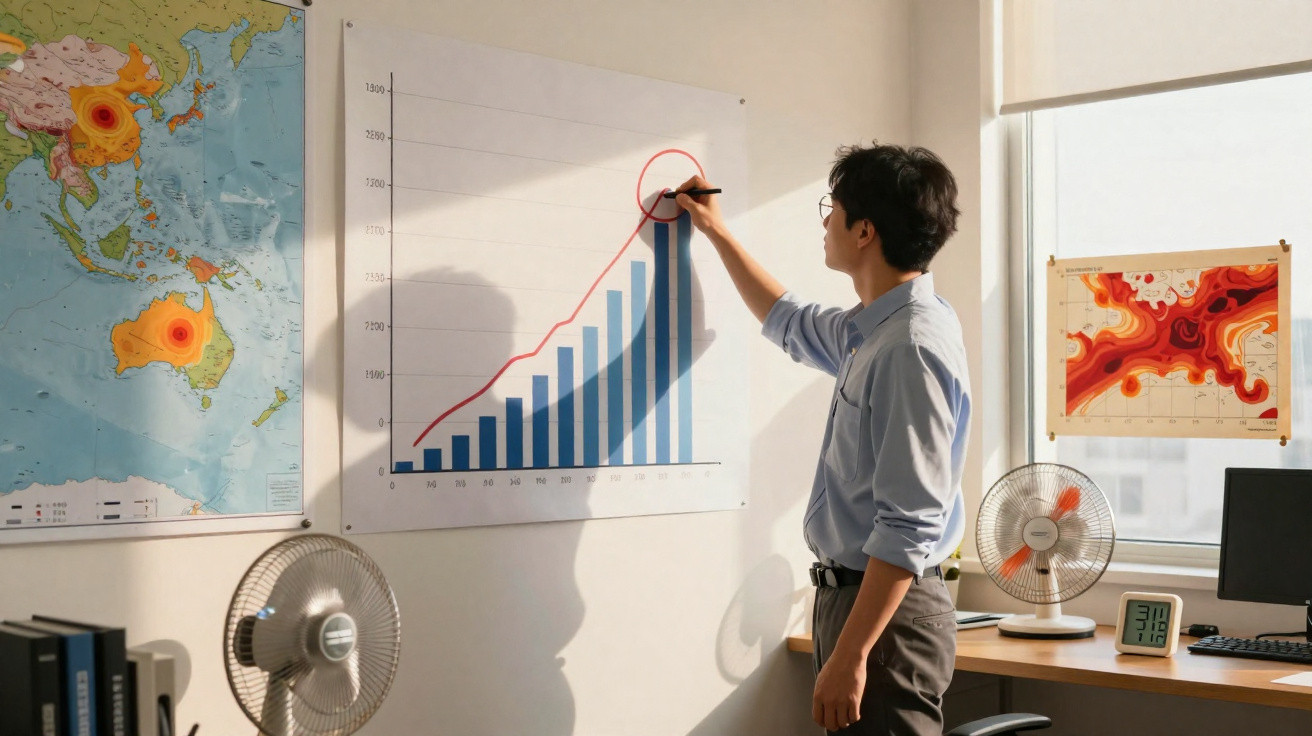
A 13-month run of record-breaking global heat has come to an end.
Between June 2023 and June 2024, average air and ocean surface temperatures were a quarter of a degree Celsius above records set just a few years earlier.
According to the EU's Copernicus Climate Change Service, July 2024 air temperatures were marginally lower than those of the preceding July, by 0.04°C – the slimmest possible difference.
Yet July 2023 had been 0.28°C hotter than the previous record-warm July, in 2019. The extraordinary temperature surge of the past year has therefore not fully subsided.
The highest global air temperature on record occurred in December 2023, when it was 1.78°C above the pre-industrial December average – and 0.31°C above the previous record.
In recent decades, global warming has repeatedly set new records for average global temperatures. However, surpassing them by as much as a quarter of a degree for several consecutive months is unusual. The end of this run does not reduce the growing danger posed by climate change.
What, then, drove these record temperatures? A number of influences converged, although climate change – caused largely by the burning of fossil fuels – is the biggest and most significant factor.
What caused the heat streak
Modern global warming is measured against temperatures typical of Earth 150 years ago. The comparison period of 1850–1900 predates the emission of most greenhouse gases linked to global industrialisation, which add heat to Earth's atmosphere and ocean.
July 2024 was 1.48°C warmer than a normal pre-industrial July. Around 1.3°C of that difference results from the broad global warming trend over the decades in between.
Temperatures will keep rising along this trend unless humanity stabilises the climate by leaving fossil fuels in the ground, where they belong.
Global warming does not, however, advance in a straight line. Much like UK house prices, the overall direction is upwards, with rises and falls on the way.
El Niño and record global temperatures
The El Niño phenomenon accounts for much of this variation. An El Niño event involves a reorganisation of water across the immense expanse of the Pacific Ocean.
El Niño has such a major effect on global weather because it raises average air temperatures across Earth's entire surface, rather than only above the Pacific.
In the intervals between El Niño events, conditions can be neutral or shift into the opposing La Niña state, which generally cools global temperatures. This movement between the extremes is irregular, while El Niño conditions usually return every three to seven years.
The warm El Niño stage of the cycle began taking effect a year ago, peaked around the close of 2023 and is now moving towards neutral conditions. This is why the record-breaking run has finished.
Although the 2023/2024 El Niño was strong, it was not exceptionally strong. It cannot entirely account for the striking extent to which temperature records were broken during the past year. Scientists have not yet completely disentangled the precise effects of other influences.
There is a small positive contribution from the Sun, which is currently at a point in its 11-year sunspot cycle when it sends fractionally more energy towards Earth.
Methane is another important greenhouse gas. It is produced by the fossil fuel industry, as well as cattle and wetlands, and its atmospheric concentration has risen faster over the past decade than it did in the decade before.
Scientists are also examining how far efforts to reduce air pollution could be contributing to warming. Some particulate air pollutants can reflect sunlight and affect cloud formation.
A temperature ratchet
During 2023, the global ocean brought a devastating summer for coral reefs and nearby ecosystems in the Caribbean and elsewhere. In the southern hemisphere summer that followed, extensive bleaching affected Australia's Great Barrier Reef.
While El Niño years are often when reefs worldwide experience mass mortality events, the underlying climate change trend is the longer-term danger. Corals are finding it difficult to adapt to increasingly extreme temperatures.
La Niña and the next global warming threshold
As the Pacific Ocean is now expected to move back towards La Niña conditions, global temperatures will continue to fall back somewhat. They are unlikely, though, to return to the levels recorded before 2023/24.
El Niño works rather like a ratchet for global warming. A major El Niño event sets fresh records and creates a higher baseline for global temperatures. That new baseline reflects the underlying global warming trend.
One credible scenario is that global temperatures will vary around the 1.4°C mark for several years. The next major El Niño event could then lift the world beyond 1.5°C of warming, potentially in the early 2030s.
Through the Paris agreement on climate change, the world committed to making every effort to hold global warming to 1.5°C, as climate change impacts are expected to accelerate above that threshold.
The encouraging news is that a move away from fossil fuels has begun in areas including electricity generation, where renewable energy is supplying an increasing proportion of growing demand.
However, the shift is nowhere near fast enough. Climate targets cannot be met while existing fossil-fuel infrastructure is fully exploited, yet investment in new oil rigs and gas fields is continuing.
Headlines reporting record-breaking global temperatures are likely to return. They do not have to continue indefinitely, however. Many ways exist to speed up the transition to a decarbonised economy, and pursuing them is becoming ever more urgent.
Christopher Merchant, Professor of Ocean and Earth Observation, University of Reading
This article is republished from The Conversation under a Creative Commons licence. Read the original article.





Comments
No comments yet. Be the first to comment!
Leave a Comment